But I wouldn’t know it, looking out my window. It’s sunny and green and quiet in this sleepy little neighborhood. Despite what my laptop screen reads, I can just look up a few inches and see a beautiful day. I can flip to a new tab and see that I have yet another email from The Odyssey even though I have unsubscribed and marked it as spam untold times. But if I turn on my phone, I find that this is not a normal morning – not at all – and the world is indeed burning, at least until I get a routine text from Festival Foods telling me about BOGO Palermo’s Screamin’ Sicilian or Loaded Pan Pizza valid thru 6/2 (!). I don’t buy frozen pizza but idk that sounds like a pretty good deal to me.
I’m reminded of the scene in Game of Thrones where Catelyn Stark looks out from a high window of Riverrun with her uncle Ser Brynden “Blackfish” Tully.
“A person could almost be forgiven,” says Cat, “for forgetting we’re at war.”
Brynden replies that he takes comfort in the knowledge that, “Even in war’s darkest days, in most places in the world absolutely nothing is happening.”
Catelyn is right (which doesn’t happen very often). It’s a beautiful day out. My neighbor just walked out into the yard with two friendly doggos. I’m listening to the dulcet tones of Frédéric Chopin. My world isn’t burning.
The Blackfish is, as usual, also right. Someone else’s world might be burning, but I don’t know, man; not much is going on here. I mean, the local bars are opening back up, so that’s something.
Ah, but, she says almost forgiven. And, ah, the comfort is indeed for the ones in the war, not the majority of people doing a bunch of nothing.
And so I turn my eyes back to the flames, and people are pissed.
Our very own Joffrey Baratheon, our very own “vicious idiot,” is out here advocating for the National Guard to shoot civilians (“When the looting starts, the shooting starts,” at 12:53 a.m….sounds like he might need some milk of the poppy).
Oh, the police also arrested a black reporter on live television, which seems like a bad idea.
Apparently there is “other evidence” suggesting nothing criminal happened in the killing of George Floyd.
And, of course, the usual suspects are out here with the usual talking points about looting and rioting.
My heart is racing. I’m sweating. And I have that pain in my chest that I get from time to time. I could look out the window – even better, I could get up and go outside. I could leave it behind and let it go. I’ve been feeling this pain for about five years now from my comfortable little pockets of the world. Does this really affect me? Is it worth getting worked up about? Plenty of other people are going about their day oblivious to the flames on someone else’s house.
My Facebook timeline looks very different than it did when they killed Freddie Gray and Baltimore boiled over. I’m in no way seeking an “Atta boy,” but there seemed to be so few others in my milieu expressing anger and sadness on social media. We were still trying to explain to people why it’s okay to say “Black Lives Matter.” But over the years my timeline – still overwhelmingly white – has become (to use an obsolete term) much more woke. Now, my Facebook is saturated with posts expressing anger and demanding justice and lasting reforms.
But, come on. We could all just log off and go back to our worlds where nothing is happening. We’re not going to go to Minneapolis and protest. There’s only so much money we can donate. What good is an email to a representative going to do? Nothing may be happening here, but that doesn’t mean I don’t have my own problems. We can just set aside the virtue signalling and check out what’s on Netflix or go make a sandwich or get out our AR-15 and militia cosplay and storm a state capital or whatever.
I see in my awakened timeline reflections of my own feelings of pain and helplessness engendered by my guilty whiteness. It sometimes feels like there’s really nothing I can do. The day after the news broke about the killing of Ahmaud Arbery, I went for my usual run without thinking once about my safety, but I did think about Maud. And I hated that it felt like all I could do was think about him. When I lived in Corvallis, a white supremacist put up a Participation Trophy Flag in their window across from the Black student cultural center, and when I ran past it in the early morning darkness I made sure to flip it off, which is some next-level white slacktivism. Sometimes as a white person living where nothing is happening, little gestures and many thoughts seem like all you can do.
All you can do? Why, that’s actually rather reductive. It’s not much, but it’s not nothing. And it’s the first step towards something.
If you really think there’s no relationship between what happens out there and what you think and feel inside, then you’re missing something. If you’re not willing or not able to at least engage your heart and mind with what happens, then you won’t ever speak, and you won’t ever do. And this matters because, no matter what it looks like outside your window, we’re all connected by something like the roots of the Banyan Grove Tree in Avatar: The Last Airbender, all living within the Tao, all image bearers of God. And the mystical oneness of all things is made much more immediate by modern technology’s capacity to deliver ourselves to one another in an instant. I have friends and family who live as close as the very street where George Floyd was killed, and I see their posts on social media. Any space between here and there is an illusion.
Thoughts and feelings, no matter how painful, are not the ultimate goal, but they are part of a mission of societal size and a fight of revolutionary scale that involves all of us. And so we should call our representatives. We should give money. We should listen and learn. We who have privileges should use them for good. We who are not the oppressed must become selfless allies. We must not feel like there is nothing we can do, but we must also not feel like what little we do is nothing or not worth doing. Be angry. Be hurt. Add your voice to your social media space from the comfort of your home. Feel guilty. Feel the pain in your chest. This is part of being human, of being part of something greater than yourself. Doing nothing is not an option. Even a small stone dropped in the pond makes ripples. In the midst of so much evil, it is good and right to be uncomfortable.
And, if you need to stress eat a frozen pizza, well, have I got a deal for you.
One of the great joys of being an English Major is getting to find out a little about which classics are actually good, actually bad, and actually so good that you need to read them cover to cover. And, sometimes, the assigned classics lead not only to a passing knowledge of the canon, but an introduction of a favorite author (and, consequently, the encouragement to continue seeking out classics for fun).
I had to read Great Expectations, by Charles Dickens, in high school, and I hated it. I think everyone in the class hated it. So when it turned out my senior English seminar in college was to focus on Dickens, I was not thrilled.
We started with Oliver Twist, and I was like oh this is kind of exciting I kind of like this. And then we read David Copperfield, and just looking at the size of that book I was skeptical but then I read the entire thing and was like wait is Dickens good what is going on here okay prove it Charles. By the time I finished Great Expectations, Chuck D had become one of my most favorite authors, and I was lambasting my teenage self who had watched that particular masterpiece sail over his head.
Dickens is one of the classic authors who is actually good, and who is actually so good he demands to be read. Part of what makes him great is, despite writing over 150 years ago, he is still so relevant and readable. I just revisited Great Expectations, which is his greatest work and one of the greatest books I’ve ever read, and I was blown away by the pertinence and poignancy of its characters and thematic elements. As a work of literature, it’s a riveting mystery, a quintessential coming-of-age tale, and a novel of comedic[1] and Gothic elements in equally affecting measure. It also has much to say about class, crime, wealth, ambition, alienation, imperialism, goodness, and redemption (for starters). And, while some readers can’t get past the sentimentality which colors so many of Dickens’ novels, Great Expectations, as G.K. Chesterton writes, is “the only book in which the expectation was never realized” and it “has a quality of serene irony and even sadness, which puts it quite alone among his works.”
He’s an author for all-times, and Great Expectations is a novel for any time, but on this reread I found some elements to be especially applicable to these times[2], which brings me to Wemmick and the separation of home and work.
About midway through the novel, Pip (the protagonist and narrator), visits the home of John Wemmick, the focused, unsympathetic clerk for Pip’s guardian, the lawyer Mr. Jaggers. But, while Wemmick is cold and ruthless at work, Pip finds a very different man at home. The house itself is eccentric, a cottage designed to look like a castle (complete with a moat and a battery with a live cannon) with a garden and spaces for farm animals. Wemmick jokes that “if you can suppose the little place besieged, it would hold out a devil of a time in point of provisions.” In response to Pip’s compliments, Wemmick explains that he is is own engineer, plumber, gardener, “and my own Jack of all Trades.” Wemmick lives with his father, an elderly deaf man who Wemmick refers to as “the Aged,” and the clerk shows great care and patience for the man. Pip observes the way Wemmick leaves work behind when he comes home, and the way he transforms back again as they walk to work the next day:
By degrees, Wemmick got dryer and harder as we went along, and his mouth tightened into a post-office again. At last, when we got to his place of business and he pulled out his key from his coat-collar, he looked as unconscious of his Walworth property as if the Castle and the drawbridge and the arbour and the lake and the fountain and the Aged, had all been blown into space together by the last discharge of [the cannon].
Wemmick is aware of the difference – the twin Wemmicks, as Pip sees it – and is particular about how he conducts himself at home and at work. When Pip asks Wemmick’s advice on a financial question, Wemmick gives him one answer at work, but suggests that if he should see him at home, he might have a different, more sympathetic answer, and this understanding continues to play out between the two of them as Wemmick proves to be as caring and faithful friend away from work as he is a shrewd and mechanical operator away from home.
All of us who work fall on some spectrum on which the split-identity of Wemmick is at one extreme. Even if our disposition doesn’t change between home and work, we might still keep our work life and home life very distinct. Compared to Europeans, Americans work long hours, often bring work home with them, and take very little time off, and I think it’s reasonable to say that when home and work overlap, it’s more often the case that work is infringing on home. But whatever the individual case may be, it has now, for millions, changed very much in the last three or four months, as so many have been working some or all of their hours at home. People have dealt with the practical and existential challenges presented by this with varying degrees of success.
At the risk of looking past the pandemic we are still very much living through, what interests me is how this time of blurring the lines of home and work might change the way we think about the distinction (or lack thereof) between home and work. For some, the experience has underscored the difficult of thinking about and doing work while in the home, but, for others, it has demonstrated that work can be done without the added burden of physically going “to work.” Is a strict bifurcation mutually beneficial, or is the ability to customize and adapt an advantage?
In one scene late in Great Expectations, Pip confers with Jaggers and Wemmick and reveals to the imperious lawyer that his clerk has “pleasant and playful ways,” making for an awkward few moments between the professional colleagues:
‘You with a pleasant home?’ said Mr. Jaggers.
‘Since it don’t interfere with business,’ returned Wemmick, ‘let it be so. Now, I look at you, sir, I shouldn’t wonder if you might be planning and contriving a pleasant home of your own, one of these days, when you’re tired of all this work.’
Mr. Jaggers nodded his head retrospectively two or three times, and actually drew a sigh.
Jaggers then savagely dunks on Pip, and the awkwardness is only dispelled when Wemmick takes the opportunity to berate a client for crying as he supplicates before his boss[3]. And so Wemmick is, despite this friction, able to for the time being maintain his preferred dichotomy, but perhaps the potential strain shows itself in a moment like this.
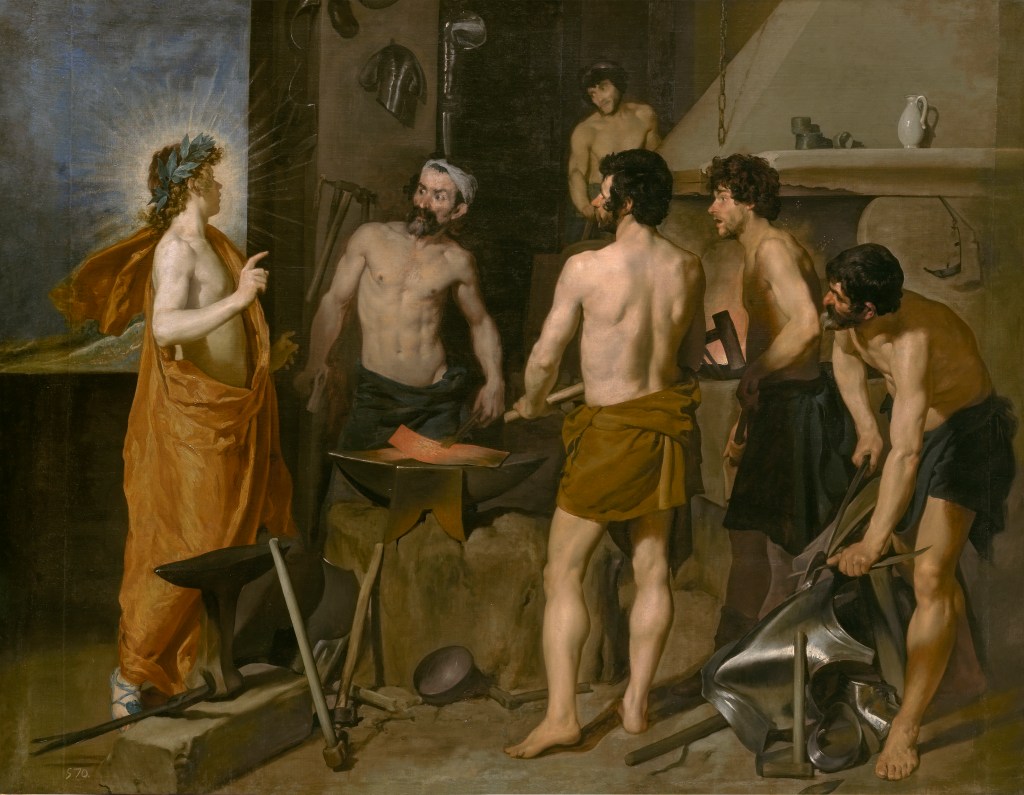
While Wemmick is a “successful” example of a split character in Dickens, I think the novel also contains a critique of this mode of living. Pip is raised by his abusive older sister and her husband, Joe Gargery, who is at times like Pip’s brother, father, and best friend. Joe is an uneducated and unrefined blacksmith, but is also kind, selfless, honest, and full of love. Joe’s home and work are almost one and the same, as the house and forge are adjoined, his wife always within hearing distance, and, for a time, his adopted son Pip working as his apprentice. He is the same at all times, whether he is hammering hot metal, enduring Pip’s sister at dinner, or smoking his pipe by the fire.
His life and work are humble, but Joe Gargery joins a collection of noble blacksmiths in literature. One such blacksmith appears in Henry Wadsworth Longfellow’s 1840 poem, “The Village Blacksmith.” He is described as a “mighty” and “brawny” man whose “brow is moist with honest sweat.” He happily toils day in and day out and is an inspiration to the speaker and the other members of the village. When I used to teach 100-level English Composition, I used vocation as a theme of sorts for the course, and I presented my students with this poem as an example of being satisfied by one’s work, plebeian as it might be. I juxtaposed it with Edwin Arlington Robinson’s 1897 poem, “Richard Cory,” in which a wealthy and outwardly-kind man admired by all goes home one summer night and puts a bullet in his head. This is not at all to suggest Wemmick is a parallel character to Richard Cory, but I think we can deduce that Richard Cory’s public and professional persona differed a great deal from his private life and inner thoughts. Furthermore, I’d suggest the difference between the blacksmith and Richard Cory goes beyond two individual temperaments to a sociological factor – in 1840, 89% of Americans lived in rural areas; in 1890, that number dropped to 65%. More and more work was done outside the home instead of at family farms and shops. This bears out in Great Expectations, as Joe Gargery lives outside of a small village amidst the marshes, while Wemmick lives and works in London.
In short, there might be something to the idea that the melding of home and work might not necessarily be to the detriment of the home, and work-life balance might not necessarily depend upon fewer hours at work or physical removal from the workplace.
This brings me to Wendell Berry, that singular American man-of-letters. In an op-ed in The Progressive magazine, Berry makes a case for easing the burden of “work” by changing the way we think about work and what kind of work we make an economic priority rather than shortening the grueling American workweek. Allow me to quote at length:
The old and honorable idea of “vocation” is simply that we each are called, by God, or by our gifts, or by our preference, to a kind of good work for which we are particularly fitted. Implicit in this idea is the evidently startling possibility that we might work willingly, and that there is no necessary contradiction between work and happiness or satisfaction.
Only in the absence of any viable idea of vocation or good work can one make the distinction implied in such phrases as “less work, more life” or “work-life balance,” as if one commutes daily from life here to work there.
But aren’t we living even when we are most miserably and harmfully at work?
And isn’t that exactly why we object (when we do object) to bad work?
And if you are called to music or farming or carpentry or healing, if you make your living by your calling, if you use your skills well and to a good purpose and therefore are happy or satisfied in your work, why should you necessarily do less of it?
More important, why should you think of your life as distinct from it?
Things get tricky here, of course. Working at Culver’s was not my vocation, but I absolutely believe I was able to honor and glorify God through that work, and when I remembered that was the case it made going to work much more enjoyable. I mostly left work at work (though I did bring home a fair amount of frozen custard), and while I mostly kept my personal life out of work and didn’t make my co-workers into friends, I did express my personality and interests at work, and, again, that made work more enjoyable (and of course the custard made home a little more enjoyable too!). But despite the spectra, exceptions, and variations, there remains the compelling notion that blurring the lines between home and work might be for our good remains.
As we gradually make a return to normalcy and begin to think about changes to be made in response to the lessons learned from this pandemic, employees and employers should both reconsider the distinctions we do and don’t make between home and work. Some workers might find that it is better for them to be able to express more of their home life at work, or that it helps if they can do a larger proportion of their work at home. Others might think now more than ever that work is work is work, and that they should keep it as removed from the rest of their life as possible. Employers should be attentive to the needs and preferences of their employees, and should make decisions based on more than just the bottom line.
Again, this varies very much from person to person and job to job, and so I hesitate to make generalizations about what we should learn from the pandemic about work and how we should change, but I think there are still guiding principles that we can take from Wemmick, Joe, and the rest of Great Expectations. They are, well, to be good. Be kind. Be faithful. Be genuine. Wemmick is not a kind man at work, but he is a devoted and reliable employee, and while he lacks compassion while on company time, his kindness wins out just as soon as he is able to get away. We might critizice Wemmick for his conduct at work, but it is clear that he is acting in the way he sees best to be able to be gainfully employed and able to be a devoted caretaker to his father, a faithful friend to Pip, and an eccentric Jack of all Trades to boot. Joe’s work is not glamorous, and it’s not even clear that he has a particular love for the work itself, but it is inextricable from his home life and he is no worse off for it. He is his good self at all times.
Sure, Jaggers should be a more compassionate lawyer, which would allow for a more compassionate clerk, and, sure, society should allow for a blacksmith’s upward mobility without the contribution of a mysterious benefactor. Rugged individualism and self-improvement should never be considered a bailout for the failing of systems and societies. But, while we strive to shape a healthier working American life in the wake of this pandemic, we would all do well to let the best in us guide both our career pursuits and our conduct at work.
This has been a trying time, but we have the power to make the most of it. As Estella says to Pip in the final chapter: “I have been bent and broken, but — I hope — into a better shape.”
Forth now, and fear no darkness.
Soli Deo Gloria
-Peter
Notes
~click the number to return to the text~
1 I know, I know, we literary types tend to oversell how “funny” books are, but Dickens is legitimately funny. Like he can actually make me laugh out loud while reading, and you know something has to be damn funny to make you do that.
2 If you’re reading this in the future, I’m writing this in the middle of the COVID-19 global pandemic. If you don’t know what that is, then we who lived through it did something very wrong. Google it and read The Plague and hopefully you’ll have some idea of what it was like to be alive right now.
3 It’s a pretty funny scene, but it’s also a tough look for our guy Wemmick. I think Wemmick is a great character and a good man, but it’s also right to criticize his behavior at work.
The family dog is dying a strange death at a strange time. I’m writing to find some meaning in that.
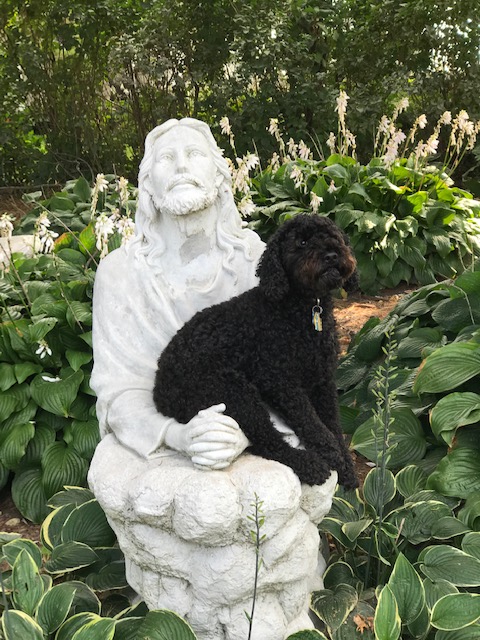
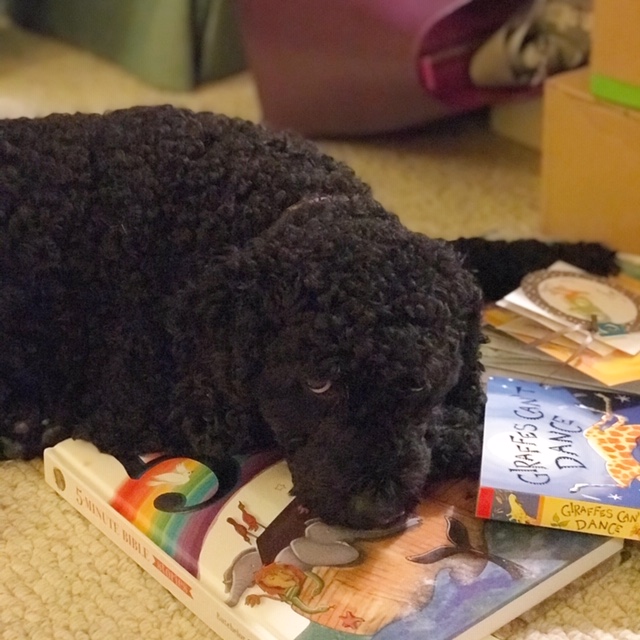
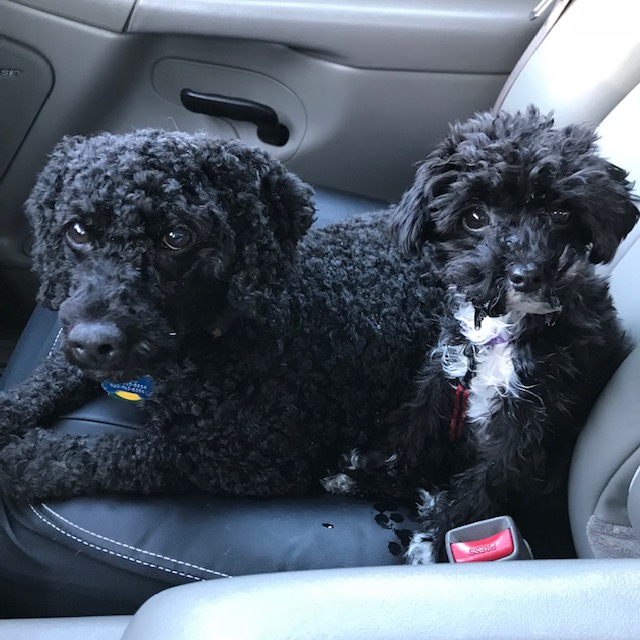
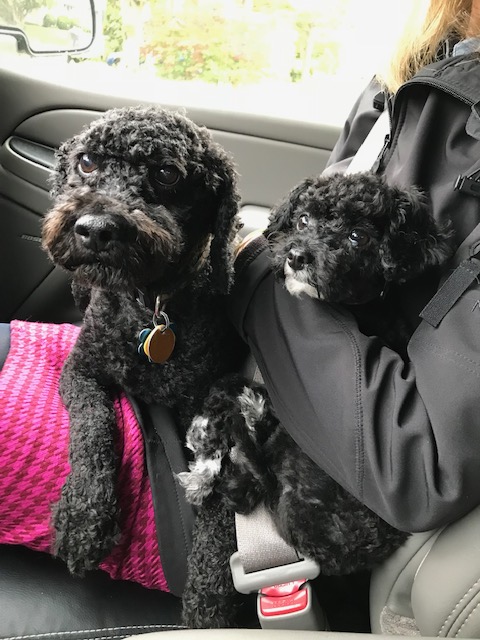
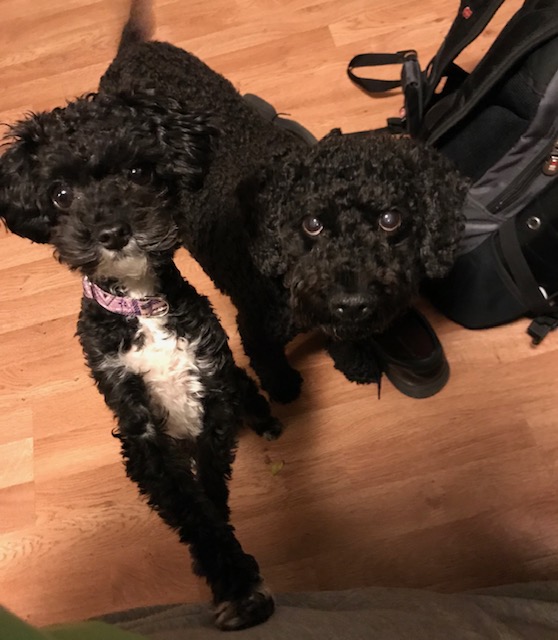
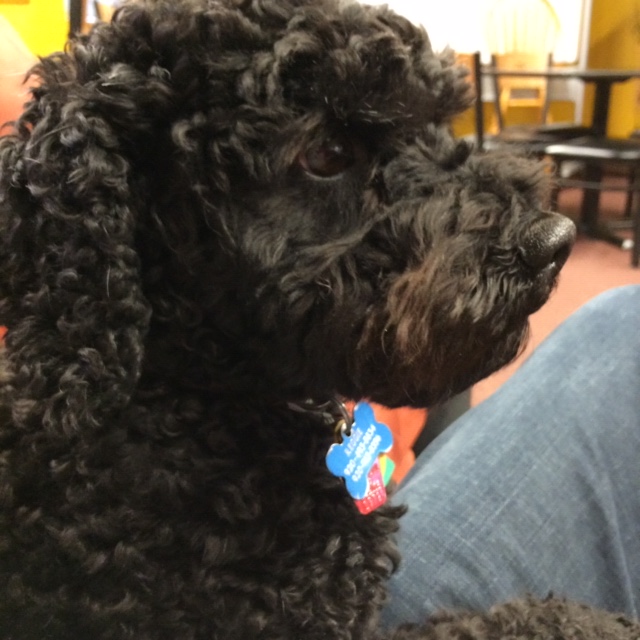
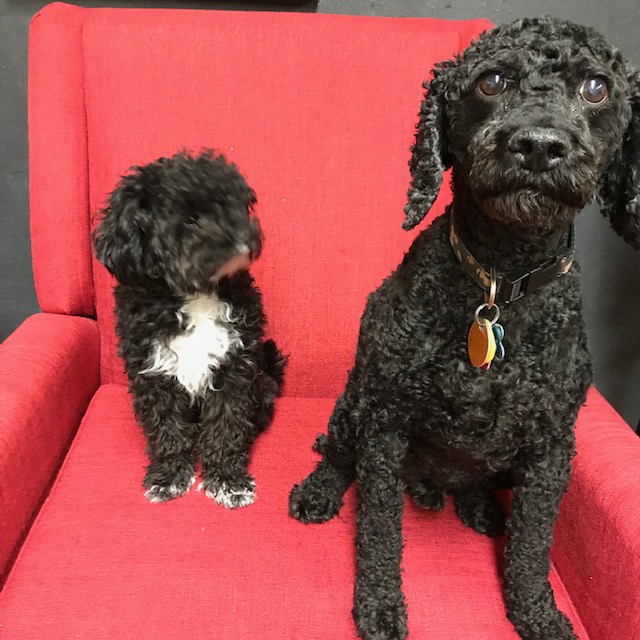
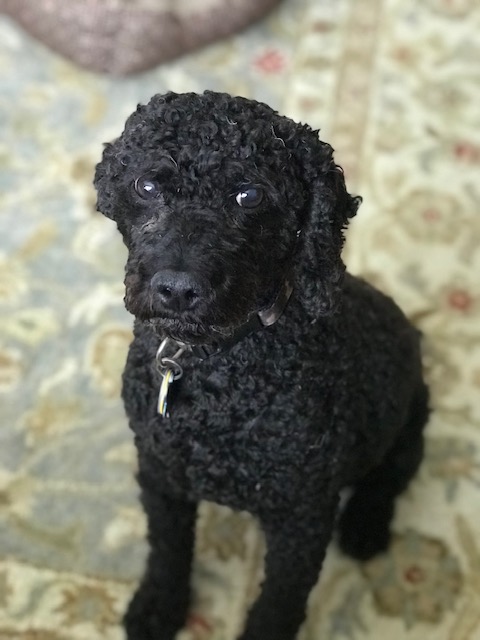
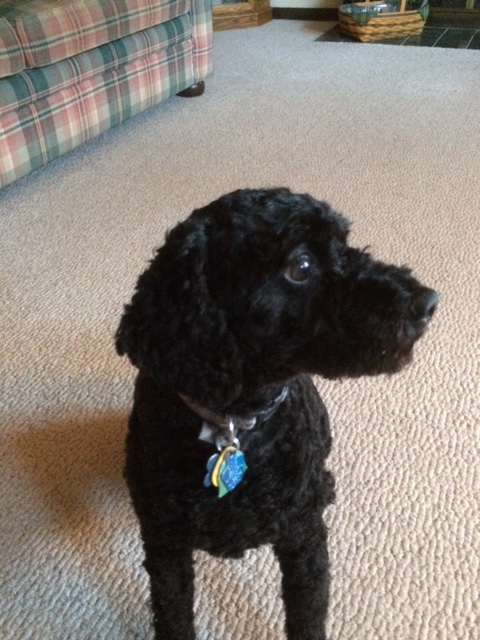
Reggie, the King. Also pictured: Lucy, the Usurper, and Benjamin, the Nephew. Click to view pictures full screen.
I’m at home with a dying dog.
Off work for the summer, I’m weathering the pandemic with my mother, father, younger brother, and two family dogs, one of whom is the real, original family dog. He’s a twelve-year-old miniature poodle named Reggie, and he’s dying. Dogs do that – they get old and sick and sad, and then many owners “put them out of their misery” at the vet’s office or behind a shed. Reggie is dying, but not because he can’t eat, but because he won’t eat. He can chew and swallow and digest and excrete, but he refuses almost all proffered provender with a disinterested turn of his head. Many things – meats, grains, veggies, kibbles, treats – he will agree to consume once or twice, and then he will add them to his list of “do not want.”
As a result, Reggie is wasting away, his once athletic hind legs deteriorating into bags of bones, his ribs and spine knobby to the touch when you pet him. In response, my mother and brother have taken to grinding up soft dog food with chicken stock and forcing him to eat using a turkey baster. He hates it, pulling away and clamping his jaws shut, but he accepts it, never fleeing before or spitting out the mix after.
Feeding him has become a daily and day-long labor of love. Do you want this, Reg? Will you try this, Reg? Repeated over and over, hopefully, plaintively, begging him to eat in an inversion of the pet/master relationship.
All his life, Reggie has been a greedy, gluttonous, insatiable eater. After our first Thanksgiving meal with him, he found his way on top of the dining room table, just about to enjoy the table scraps before we all shrieked in alarm. The six inches of the table’s edge has always been a no-fly zone for unattended food, and the kitchen floor a killing zone. He would try anything and demand everything, and he eventually developed a bizarre predilection for cardboard. Refusing to eat even the most delicious food is, in short, the last way I would have expected Reggie to go. I always thought he’d be killed by what he did eat, not what he wouldn’t.
I’m off work, my brother works from home, my mother stays at home, and we’re all here with him all day watching this happen, willing it to end, but unsure of how it will or what it will look like, at the same time as we’re home amidst a pandemic watching the world lose its mind, willing it to end, but unsure of how it will or what it will look like. My father leaves for work in the morning, his offered kibbles uneaten, and returns in the evening with a syringe for feeding and a hopeful query about what Reggie’s consumed.
His blood work is fine, he shows no signs of cancer, and he seems himself, albeit an older, frailer version. The vet and Google alike lack answers. And so, try as we might, Reggie is dying.
This would be a sad, strange way for a dog to go at any time, but especially so during “these times.” In our various states of quarantine, social distancing, and safer-at-home, we have asked and answered a host of new questions, confronted new realities, and come to fresh realizations. Our notions and experience of who we are collectively and individually have been challenged and are changing. We are, in these strange laboratory conditions, at home with our humanity in new, often uncomfortable ways. The least we could hope for would be for a pet – that great rock of stability, comfort, and familiarity – to be there, largely unfazed by these great changes. Not so with Reggie. He’s on the way out, and in a way as strange and unpredictable as the crisis playing outside his realm of comprehension.
In the past, Reggie cared a great deal about his people being home. He would often sit in the dining room waiting for the last person home to arrive. He would sprint laps around the house when my father returned from work, and jump for joy when my sister visited from college. He shadowed my mother around the house (and still does) to make sure he had an idea of where she was. The Reggie of yore should love safer-at-home policies, but even as his people stay around the house, he continues on this Mahatman hunger strike which paves his way to permanent departure.
But Reggie’s strange death march is also a dereliction of one of his great gifts to our family at a time when we want it more than ever. As the pandemic presents our notions of humanity with so much change, Reggie threatens to cease being what he was – a source of peace and stability, and a fundamental symbol for how we saw ourselves as people. My brother wrote, when Reggie appeared very near the end a few weeks ago: “He’s been one constant in a world of change. I can barely remember what life was like before him, and he was by my side as I went from a boy at the onset of puberty to a full-grown man. Reggie is a bridge to another time. He has essentially not changed for 11 years, so in him many things seem to exist which no longer do. He’s the last piece of my innocence. When he goes there is nothing left of my childhood. Somehow, in him my family still exists. Sure, my siblings and parents and I are still family, but we are no longer a family. My sister has her own family and lives across the country and my brother lives across the state. But Reggie is a living, breathing symbol of our family.”
I don’t particularly love dogs, but I still believe pets can unlock something for us, something mystical and powerful and important. It’s why we react so strongly to not only ordinary household pets in truth and fiction, but also buy into the idea of the fantastical animal companion, like the direwolves in A Song of Ice and Fire or Harry Potter’s owl, Hedwig. They come to represent something about us and become integral to our identity, and when that is threatened or taken away, it can be devastating. And, sometimes, the pain related to that loss is related to a fear of reckoning with what we stand to learn or lose about ourselves. The washed up, maimed farmhand Candy, in Steinbeck’s Of Mice and Men, sees himself in his decrepit dog, and so while he knows the dog should be put out of its misery, he can’t bring himself to do the killing. Letting another man put a bullet in the dog’s brain haunts him, not just because of what it means for the dog, but because of what it suggests about him.
And so here we are, asked to grapple with who we are, what we mean to each other, and what is going on in these strangest of times, and our animal avatar is wasting away, compounding our loss of a sense of control, exacerbating our longing for the past, clouding our murky vision of the future. And, in a perverse turn, making us ask questions about how much money a dog’s life is worth and how much grief they are owed at a time when tens of thousands of humans have died. Forcing a syringe into Reggie’s mouth must be preferable to having our brain prodded with a giant swab to detect a life-threatening disease. A sick dog seems trivial when your grandfather is isolated in a senior facility, basically the autobahn for this virus.
But all of that is “out there.” Reggie is in here, with us, all day every day. Once, he was my brother’s link to childhood, my mother’s constant companion, and my sister’s best welcome home party. He helped my father deal with bouts of depression in the most difficult time of his professional career. And now, when we want him to be those things more than ever, he has chosen this strange way to leave us. As we plead with him to eat, to live, to go on being, I can’t help but think our desperation is informed by our own fears of what’s becoming of us. Eat Reggie, so we may eat and enjoy. Endure Reggie, so we can bear all things. Age, with grace, Reggie, so I can see my parents do the same. Live Reggie. Live. So we can stop thinking about death.
And if you’re going to die Reggie, if you’re ready for the end, just make it clear. Make it clear so we can get it over with and get on with it and be done with this. All this.
In its own small way, his disdainful head turn in answer to our ardent offerings conjures the very face of God cast away from us for all our prayers and pleas. But we offer again and again with faith, trusting that he (and He) knows the appointed time. Perhaps only when we can accept that will our trial end. And when that trial ends, let it not be said that we wasted it.












 eloquent mumbler