This is one of the most pretentious things I’ve ever done as a blogger (although I used to be kind of a jerk in my nascent sports-blogging stages (“Boom! Eat it Merril Hoge! My pick for Offensive ROY just went HAM and chucked for a debut record 422 yards” (I am so embarrassed that I ever wrote something like that (but I’ve done worse (in writing (and real life too (I guess))))))). And, actually, I’m realizing that the pretentious thing could have been using seven parentheses and banking on you continuing to read. Pardon.
No, the pretentious thing I’m going to do is start this blog post with a poem that I wrote sometime last autumn:
Like a River
There’s a space inside a man which
runs like a river through mountains.
It flows from the sidereal heath
and travels a landscape of virile solitude.
It is breathtaking –
what a man finds when he can walk
within himself –
who can find his way into the halcyon valley
and take in the expanse of the starry night.
To see the mountains proud and cold,
to see the mud languishing in the
foul water that pools in ponds of neglect
and feel the sparkling stream steadily wash it clean.
What it must be to see the height and breadth
of this meandering path running from the gleaming void
to the tossing sea
where other rivers
deposit the story of a soul.
Even as I click “copy” and “paste” questions linger about whether or not you care about my poem or if it will help you to see what this post is about. And, even as I write this, I’m not certain of where this post is going – it’s actually one of the most organic posts I’ve done in a long time. I’ve been writing quite a lot, but not material for blogging. So, in a way that I haven’t always, I’m writing a blog because I want to, not because I feel I need to.
But I begin with the poem because I’m finding that, while I still believe everything I put into it, I’ve come to even better understand the pictures that I tried to paint. I’ve lived these truisms in ways I hadn’t when I first translated these ideas into a stanza.
The poem can mean a lot of things, which are not my present intention to demonstrate, but the poem is partially about where, spatially speaking, a human being exists. Yes, the Ship of Theseus that we call the self appears to occupy only one finite location in a physical body at any time – right now my 5’11” frame is seated at my desk. But if you’re reading this, then you know that where you exist is hardly limited to wherever your own Ship of Theseus might be moored, as writing and reading is an act of telepathy (ht Stephen King). In some sense, you’re existing in my mind. Or consider that just as your physical body might stand in line at the DMV until 2:18, you might find yourself in a virtual line for tickets to Hamilton that extends to 2018.
The space we occupy is much more mutable and much less defined than the physical space our bodies occupy. This space that we live in is a view within ourselves but also a boulevard to the spaces we share, metaphysically, with our fellow humans. That’s part of what writing the poem revealed to me, and in the recent months I’ve learned that all the more, and these meditations have been spurred on and guided by a variety of teachers.
First, my physical place in the world for the time being has put me in a rather unusual, and often uncomfortable, sea of consciousness. I graduated in December, and I’m going back to school (somewhere) for a Master’s degree next autumn. But, for the time being, I’m living at home. This unfamiliar territory is an unstable terrain that removes me from parts of my identity that I have grown accustomed to – I am not a student right now, I’m removed from the lives of my closest friends, I’m an “only child” for the first time, I see both my parents every day, the infrequency with which I’m substitute teaching hardly qualifies me as a working person, and, although I have a plan for what I will do next autumn, I have only heard back from one of the eight schools to which I applied, meaning that my future status as a student, friend, son, and employee is in a state of flux.
Mentally and emotionally, this makes me feel much more removed than even my physical state of being would designate. My close friend studying in England feels a world away – my friends at school feel only a little closer. Future schooling and work are so diaphanous even in rose-tinted lenses, as I am employed but hardly working, and in line to enter school but waiting on decisions.
All of this makes this time between schooling a time in which it is challenging to form my identity and just as tough to express it. Which is, I suppose, one reason I’m writing this post.
But there’s a yin to every yang. As my physical state has remained isolated and removed, and as my identity has lost or modified some of its significant traits, I have roamed far and wide among the constellations of the mind. I spend my day with ideas. I read (books, tweets, and online articles) and I observe (talk radio, music, debates, TV events, and the like) and I think and I write. And the space we share mentally, emotionally, and spiritually, can be a breathtaking space with a power to define as strong as our physical location. When I read Quiet by Susan Caine, I connected so directly with what she wrote about introverts that it made me like myself more as a person, and I have such profound gratitude for what she wrote that I almost feel like Susan is one of my friends now. Or, for another example, when I read The Souls of Black Folk, I found Du Bois’ ideas so powerful and so accurate, and so affirming in my interests and studies, it was like he had sent the book from 1903 directly to me to read. Books, TV, and the internet have pooled their resources with my mind, and each day I find myself so much a part of this human experience, removed as I am for the time being. My meditations explore these tributaries and my writing is one way in which my experience is given life.
These uncertain spaces have formed a symbiotic relationship with my spirituality as well, and once again I find the doctrine of election to be one of the most stunning attributes of God (admittedly, it causes me some angst as well, but that is a separate issue for now). I believe that God chose me before I was born (Galatians 1:15) for salvation, but also to have a purpose in life. Whether or not God controls everything I will do, I don’t know, and frankly I think too much ink is spilled pondering human free will. But I am sure, just as God planned for Paul to minister to the Gentiles, that God has a reason for calling me, and a way in which he intends to use me to glorify God and serve my neighbors. As God protected Paul against plots against his life to get him to Jerusalem, I believe God has a way in mind for me to love God and neighbor, and whatever the odds are God will see it done.
Whether you can relate or only imagine, that’s a tremendous thing to believe. But, like most Christian beliefs, it’s not something you can download into your mind like we’re plugged into the Matrix. It takes time to work through and accept. And, like most Christian beliefs, Christians always have some doubts. I’ve said that most Christians (me included) don’t actually believe they will go the heaven when they die – they do, but if they could 100% grasp and believe that they would be in heaven, they would live their lives so very differently on earth, wouldn’t they?
What this means is that living a purpose-driven life is tricky when you haven’t reached a place that seems to fit your idea of a “purpose.” I don’t think what I’m doing right now is my ultimate purpose – rather, I tend to think of “God’s plan for me” as being where I will be in, say, ten years. Then I will be doing God’s work, then I’ll be using my education to make the world a better place and glorify God. But that’s not a particularly comfortable or useful way to think. Because God has a purpose for me now, and tomorrow, and next week, just as much as ten and twenty years from now. But believe me – I wish I was doing what I’ll be doing in ten years now. That’s the work I want to do today. This attitude makes it easy to punt away spiritual work, going days at a time with little thought for God. But I’ve learned over the past couple years that ignoring daily excellence is one of the worst things a person can do (I wrote about this last year and you can follow up on that later if you wish, here).
Recently, I began to think myself very wise in the ways of theology, scripture, and spirituality. I began to think myself quite holy and righteous. But what I started to lose sight of was the way in which we must constantly turn to God, even if it means re-hearing an old truth or re-reading a letter of Paul yet again. But the truth is that, even if the words in the Bible remain the same, the truths evolve – not that they are subject to our understanding, but rather that, at each stage of our lives, the same words may be breathed in and breathed out in a different manner that attends to our situation in life while calling us to be more like Jesus every day. And even if you know everything there is to know, the way to be more like Jesus is going to be different from time to time, depending on where you are on your journey. Thus, I must continue to preach to myself.
Okay, so I know that probably felt tangential, but my musings on the bundled self, identity, and Christian living do all amount to more than an entry in my diary that you may or may not care about.
What I’m seeing is a failure for people to embrace the mutability and connectedness of our existence, choosing instead to label others and label themselves in ways that don’t make sense. When we see our soul flowing from the sidereal heath through our halcyon valleys and into the commingled sea of souls, then we can better understand ourselves and better understand and love each other, and we can move past the things that divide and conquer us.
Concerning Peyton Manning, Dan LeBatard is right: why can’t it all be true that Peyton did horrible things, Peyton is now a good guy, the journalist is not credible, the journalist has an agenda, the story is true, this doesn’t have to be about race, but yet this is about race? Those things can all be true. Why does someone find themselves saying that Peyton is totally absolved and Shaun King is a race-baiting devil?
Concerning Cam Newton’s press conference: It’s true that he should have acted differently, but can’t we all understand why he would act that way? Can’t we be fine with what he did, and try to empathize, yet still say he was wrong?
Concerning Kanye West: why does he have to be a crazy douchebag or a peerless artist? Why one or the other? Can’t we treat him like a person who’s on a journey like all of us, and say that his album, while not a masterpiece, is still pretty damn good? Can’t we appreciate the nuances that come with him and with his work?
Feeling the need to label ourselves and others inevitably leads to incorrect and overbearing labels that unnaturally warp our thinking, and in no place is this more obvious than this thing going on called the 2016 Presidential election. Fam – I fully believe that the two-party system in American politics is one of the most harmful things for our culture, our government, and our society. It creates extremism. Compromise and bipartisanship is a sham – usually when someone says that’s what they want, what they really mean is they want people on the other side of the aisle to agree with them. And this dichotomy of liberal:conservative makes people think some pretty unnatural things.
Conservatives have an overwhelmingly negative response to Beyoncé, Kendrick, DeRay, and just about anything related to race, especially when it comes to #BlackLivesMatter. Somehow it became a part of conservatism, and it is really disturbing to see the ways that conservatives predictably buck against any sort of racial protest or the suggestion that there is systemic racism, even though there is, beyond a shadow of a doubt, a serious race problem in this country. Conservatives find other labels to disparage as well, SOCIALISM being one of the most prominent. So rather than consider the merits of Democratic Socialism, conservatives discredit the ideology altogether, trampling all of the good things liberalism can bring to the social inequality workbench. In short: conservatives contort their minds to oppose things that are new, different, strange, or uncomfortable. And that’s a problem, no?
Liberals aren’t faultless either. Perhaps in particular is the liberal tendency to bash Christianity. Yes, there is a marriage between Christianity and the GOP that makes me uncomfortable, and yes, Christians often conflate religious liberty with religious supremacy. But the caricature that liberals draw up of sexist, homophobic, racist, selfish Christians is unfair, and brings to an end helpful discussions about abortion and what it truly means to be “pro-life,” or what it really means for a Christian to “hate the sin and love the sinner” or how defeating ISIS is different from defeating Islam. Some people say some pretty bold stuff about gay rights and reproductive rights that, I think, upon further review, don’t make sense. But, because someone identifies as “liberal,” they feel the need to turn into a lemming and run off the cliff to get away from being conservative. In short: liberals charge ahead at unsustainable speeds, desperate to be unlike the close-minded people of the past. And that’s risky, no?
Why can’t a conservative support the teacher’s union and environmental protection? Why can’t a liberal be pro-life and opposed to gun control?
Too many people have never learned to think for themselves, and it’s because their insistence on taking sides and fabricating labels clouds their knowledge of the self and sets up roadblocks on our common boulevards of existence. We look to cues from thought leaders and ideologies and trending topics for guidance, forcing ourselves into labels and bending our perception of ourselves and our perception of others into something that is unnatural and unhelpful. You exist someplace that is so much more free than the temporal entrenchment that you’ve assumed.
Since this post of loosely-related parts somewhat resembles The Life of Pablo, I guess I will, 2500 words in, finish with a reflection on a Kanye song. I think these ideas that I’ve been kicking around in this post rather clumsily appear, in some form, in Kanye West’s song “Real Friends.” They’ve been ruthless in keeping that song off of YouTube, but here’s a 30 second preview on Tidal if you haven’t heard it.
People tend to take friends for granted. Or, at least, people don’t think critically about what friendship really means and what it means to be a real friend or have real friends. In our insatiable need for labeling, we find ourselves satisfied with acquiring “friends,” just as we call ourselves a student, spouse, employee, male, female, etc etc. But “How many of us are real friends/To real friends, ’til the reel end/’Til the wheels fall off, ’til the wheels don’t spin,” Kanye asks. But it’s a two-way street: “Who your real friends? We all came from the bottom/I’m always blamin’ you, but what’s sad, you not the problem.” Kanye is questioning whether or not he has real friends, and also whether or not he is a real friend.
What makes this message and this song so potent, besides the stellar production (love the piano sample), is that this comes from the type of introspective and self-deprecating voice that so many people seem to think Kanye doesn’t have. He isn’t bragging about being a deadbeat cousin, hating family reunions, and spilling wine at communion – he’s criticizing himself for it. He’s coming from a dark place on this one, and in that same dark place he voices frustration over his cousin stealing his laptop and holding it for ransom, and laments the loss of friends since becoming famous.
This is one of the things that makes Kanye great – when he puts himself into this metaphyscial space in such an honest and heartfelt way, you find yourself there too, even if you can’t relate to everything he’s talking about. I’m not famous. I’ve never had my laptop stolen. I’ve taken communion many times, but have so far avoided making a scene. But, listening to this song, I can’t help but think about what kind of friend I am, and who my real friends are. I can’t help but think about if I’m a good son and a good brother, and if my family’s always been good to me. It is well to consider those things, and in this case it doesn’t happen if Kanye doesn’t put himself in that space or if I put Kanye in a box he doesn’t belong in or if I deny myself the song based on what I think of that kind of music.
I think what I just said about “Real Friends” makes sense and fits into this post, but to be totally honest I just really wanted to talk about that song because I like it so much.
I’ll leave you with this: seek that place that is removed from your physical position. Do not be bound to a finite location. Challenge what you think you know. Rebel against the labels that society wants to put on you, and be careful which labels you claim for yourself. Your heart and soul and mind exist someplace that your body can never be. Explore that place. Know yourself. And when you find a fellow human there, embrace their journey, knowing their sandals are just as worn as yours.
Forth now, and fear no darkness.
Soli Deo Gloria
-Peter

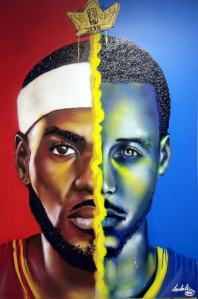 this bellicose drama is augmented by the Sword of Damocles that hangs over whomever makes it out of the East to face the Warriors or Spurs. The Cavs can’t win it all this year. Or at least it will be damn near impossible.


 eloquent mumbler