If Only this was Actually the End of the Election

“All our ignorance brings us nearer to death.”

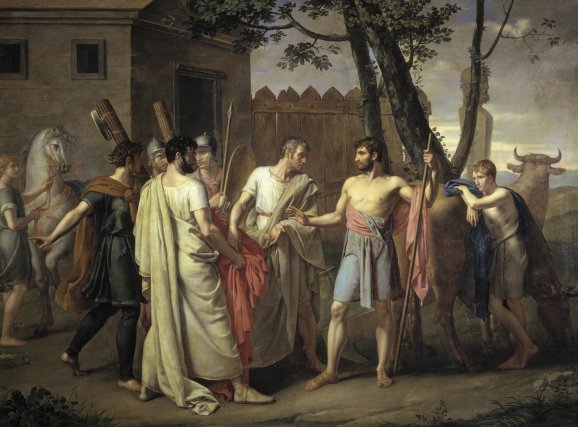
cincinnatus

“To-morrow, and to-morrow, and to-morrow,
Creeps in this petty pace from day to day
To the last syllable of recorded time,
And all our yesterdays have lighted fools
The way to dusty death.”

We watched this thing together, and together we talked our way through it, laughed our way around it, and trudged in absurdist fury to this day, this day when the thing that went too far would go no farther. And now this thing, this collected experience which tinged every area of life, has come to its finale, its conclusion, its end.

No. Of course it hasn’t really. This is only the beginning, and we’ve known – if not all along then at least for some time – that this would not end in the ballot box.

To do this, to move along like we used to, would mean to go back, to unexperience and to unknow. But we can’t. It cannot be like it used to be – not after 2016.

It’s been a year that will go down with the other big years, the digits that evoke thoughts and feelings without any specific event mentioned, like 2008 and 2001 recently, 1968, 1929, 1865 and 1776 before, and so many more. But it isn’t just a milestone like a turn of a century or an important event  like the end of a war. This thing is, like a select few years have been, a tectonic shift in society and culture in America. Our collective consciousness is forever changed – it forever exists in relation to this thing.

For some, this is not the first such shift. It is important to them – certainly – but they have done this before. But for many, me included, this is a year, a time, and a series of events unlike any other in its seismic effect on the way we see and experience the world.

It’s been a loss of innocence. The auras around leaders and institutions are gone. The frauds have struck their colors. The experts have gaffed and the newscasts have chased it all into the nonsensical void. How can any trust be given to elected officials, any faith placed in agencies and bureaus, any credence given to pundits and religious leaders, any credibility granted to the news and the papers?

Now we know that this country is much more racist, sexist, and xenophobic than we ever thought. And we know that good people will set that aside on the strength of ignorance.

Now we know that there are strings being pulled no one knows about. Now we know they’ll try to force us into choices we don’t want to make.

Candidates and parties and systems can never be seen the same.

We’ve had to hear our family and friends and anonymous trolls say things we wish we hadn’t heard them say.

We’ve been disappointed – time and again.

Wednesday won’t make things better – no matter how it goes. 2017 won’t either. It’s out in the open now. We know things now, things that will stay with us as we move forward.

But that is all we can do. We have to move forward, knowing what we know, and hoping to make it better. Hoping this sort of thing never has to happen again.

And maybe it will get better. Maybe that will be the great silver lining in this thing, and the fires it lit will fuel us to fight and win. But maybe not. Maybe it only gets worse. Maybe there’s too much hate. Maybe this awareness will only engender apathy. I wish I knew.

Maybe it is ultimately out of our hands, but let’s control what we can.

So if wherever we are – around the dinner table, at the coffee shop, on Facebook and Twitter, at the pipeline, in the streets, outside the courthouse, in the classroom, in the capital, and, maybe mostly important, within our own hearts and minds – let us make a stand for change. For faith, hope, and love.

Forth now, and fear now darkness.

Soli Deo Gloria

– Peter

As I Lay Maturing

The seasons turn and I take stock.

Timeless by t1na

Timeless by t1na

22 means very little. In seven weeks I’ll be 23, and that won’t change anything. Age is just a number, but it’s equally true that age is anything but a number. What does 22 actually tell you about me?

My age is really more accurately described this way: I’m old enough to know how young I am. My maturity has grown enough to support an introspective vision of my immaturity. Before I was blinded by the bliss of youth, and someday I’ll be old enough to know I’m old enough.

My first year in college, when I thought I knew more than I know now, I read a little book about young love called Green Wheat, by Collette. Class discussion presented me with the idea that perhaps young people are actually tuned into the truth of some things, and that maybe maturity shrouds that understanding. I had believed that adults knew everything and that young people lacked the experience to have true understanding, but maybe it wasn’t always true that youth was wasted on the young.

As much as Green Wheat made me think, it didn’t eradicate my idea of adulthood being something I would gradually work towards and eventually arrive at when I reached a certain age. I had (and have) this image of what I’ll look like when I’m 28 or so, when I’m an adult and I know it. But once I asked my brother-in-law when it was that he realized that he was an adult and how I might know it, and he told me that, not only was he still becoming more adult all the time, but I was too. “You’re already an adult,” he said. He wasn’t just referring to my increasing responsibilities and privileges – he also meant that I was growing as a person into someone who could handle these responsibilities and privileges.

So on the one hand I am, most certainly, in possession of adult responsibilities and privileges, and, as I think my oeuvre indicates, adult thought-processes. I could convince you that I’m a grown man.

But, on the other hand, I feel overwhelmed by my responsibilities and constantly call for help, I neglect or abuse my privileges, and I’m painfully aware of naivete in my thinking.

This all comes to a head now as I enter a new phase in life as a graduate student as well as a graduate instructor. I’ll be engaging with complex ideas and making complex arguments as well as taking responsibility for some of the education of undergraduates. These changes in education and employment come just after moving out on my own.

This is the peculiar burden for this time of life. It’s the great haunting thing which confronts and confounds me every day – this ambiguous adulthood. I don’t know how to measure it or control it, and certainly not how to conjure it. Sometimes I don’t even know where to find it. Appearing and disappearing, sometimes it emerges from within my spirit and other times it foists itself upon me.

I’m an adult, but it feels like I’m in single-A ball, not the Majors.

And this brings me back to this limbo, in which I know I’m not a child even as I don’t feel like an adult, and this struggle, this trapped feeling, presents me with a question, a question that would be tough for anyone, but especially for a writer.

Does what I say matter?

I have ideas on myriad different things. About 90% of my life involves observing things, thinking about them, and then, hopefully, sharing those thoughts. I’m being asked to do that for a job now, as well as a part of my studies. And, in my best moments, when I’m feeling the message of Green Wheat and I remember my brother-in-law’s words, I think that maybe what I say does matter, and matters quite a lot, because I’m pretty good at saying things. And I have a lot of people, some of them very close to me, that positively build me up in this regard.

But then that number floats past me. 22; or, everything I haven’t done. 22 means I’m too young to have seen so much from the past, and it means I’m too young to have experienced so much of the future. And I’m a young 22 – when it comes to worldly experience, trust me, my students will be more cosmopolitan than I am in a number of ways.  They’re kids, but I’m just a kid with bills who can legally buy and smoke weed. What do I know?

When I get to thinking like this, I fall back into looking forward to the 28-year-old version of me. Then, and only then, will I really know what I’m talking about. Then my opinion will matter. Then I can change the world, at least in a few small ways. And there are plenty of older folks who would rather I wait until I’m older before I pretend to know something.

Maybe, then, I should just keep quiet.

Or maybe not? By now you see the quandary of my age.

My middle school English teacher had a quote on the wall of her classroom, something that her husband, my middle school social studies teacher, had said years before: “They say that we are young and the world has much to show us. We say that we are young and have much to show the world.”

That quote barely registered in my pubescent brain. It came from a world that was foreign to me. I was young, but the kind of young that lacks self-awareness. But I’m there now.

And maybe I have something to show the world.

Just because I vacillate between feeling like a hopelessly immature adult and a decidedly mature child doesn’t mean I have to revert to childish ways or work my way towards the adult arena in order to have a relevant voice. So I will speak in a way befitting a man of my station, and what I say will be a reflection of this season, for better or for worse.

As I go through the daily exercise of responsibility and discovery, millions of other twenty-somethings face the same gauntlet of aging expectations. Which is comforting. But also not – because the experience of people my age has been distilled to cranky hit-pieces on why millennials are the worst and recycled Buzzfeed lists about things we all have in common. So in the end I guess I’m just reminded that 75% of adulting involves not being an adult.

But this distracts, if not outright denies, young people from their proper place. A fear and uncertainty about this middle ground between adolescence and adulthood shrouds this age bracket from within and without. This time in life becomes caricatured by its awkwardness, its naivete, and its precarious position that resembles a lifter just strong enough to carry something just heavy enough to hurt someone. And so we are asked to put on this fear and doubt and do a delicate dance in a maturity masquerade.

Nonsense, I say. If we wait until then to be real people, we’ll be waiting all our lives. Yes – we are the future, but we exist now, and we have been given just enough powder to go boom. So make noise, whatever noise that is well and good for a young adult to make.

I imagine it sounds like whatever noise a platypus makes.

Forth now, and fear no darkness.

Soli Deo Gloria

– Peter

David, Rizpah, and the Sons of Saul

2 Samuel 21 is an example of the beauty and complexity of the Old Testament – and a reminder of why Christians should still read it.

Rizpah keeps watch in the tranquil night over the decaying bodies of her sons - painting by Joseph Turner

Rizpah keeps watch in the tranquil night over the decaying bodies of her sons – painting by Joseph Turner

I’ve been simultaneously reading the Psalms, Luke, and 2 Samuel. And, recently, I found myself flipping back to 2 Samuel feeling a little defeated. I was unsure of what I was really getting from reading through Old Testament histories, other than just knowing what’s in the book that I claim to follow.

It’s not that I don’t enjoy 2 Samuel – on the contrary, the book is lit. 1 Samuel is probably more well-known, what with David vs Goliath, David vs Saul, and David’s ascension to the throne of Israel, but 2 Samuel goes full of Game of Thrones as we follow more of David’s military exploits, his destructive affair with Bathsheba, his son Absalom’s rebellion, and more. General Joab’s repeated appearances in the book are enough on their own to make it compelling, and he’s far from being the only memorable character.[1]

So it’s not that I don’t find the accounts interesting or affecting, because things like the loyalty of David’s men, Hushai’s subterfuge, and David mourning over the death of Absalom are all moving or memorable for one reason or another.

But, to get back to what I was saying – just recently, as I was flipping back to 2 Samuel with the feeling that I was doing little more than reading stories, I came to 2 Samuel 21, which has given me more pause than any other scripture recently, and reminded me of why I should read the Old Testament. You may want to read the first 14 verses.

Basically, there’s a famine in Israel and David asks God what’s wrong. God answers that the famine is happening because of the way Saul, years before, wrongly attacked the Gibeonites. So David goes to the Gibeonites and asks what they want to settle the old score, and they make the bold demand of executing seven descendants of Saul. David complies, and the seven are hanged (which could mean by a rope, or it could mean impaling or crucifixion (yuck)). The bodies are not buried immediately, as would normally be custom, and are left to rot (perhaps until the rains came and the famine ended). Rizpah, one of Saul’s concubines and mother of two of the executed men, sits in sackcloth by the bodies of the seven and day and night fends off birds and beasts who would come seeking carrion. David is moved by this action, and he goes and gets the bones of Saul and Jonathan, and, together with the bodies of the seven, he has them all buried properly, together.

Then, and only then, does the author tell us that “God responded to the plea for the land.”

There’s any number of ways you can focus in on this text, and what I assume many readers will do first is consider the vengeance and punishment. This seems like a harsh decision from David, who turns over seven (probably) innocent men to atone for the sins of their father, something that seems in conflict with the book of Deuteronomy as well as some of David’s past actions. Taking this a step further, we might attribute this blood-debt-human-sacrifice thing to God, which seems to be another example of the OT God being kinda vengeful and terrifying. However you focus this particular lens, this aspect of the text becomes a commentary on sin, atonement, and God’s righteous wrath, which is pretty run-of-the-mill when it comes to the violent passages of the OT.

But then why all the fuss about Rizpah and the proper burial? And why does the author wait until after the burial to say that God ended the famine?

There’s a tendency among readers, Christians and non-Christians alike, to either over-simplify or over-complicate the Old Testament. Given the situation, it can help us come to grips with the mass amounts of violence, the sins of our heroes, and all of the WTF stories. You might have to breeze past or carefully maneuver through things like Elisha’s she-bears and the medium at Endor in order to avoid coming away from the OT discouraged and confused. But simplifying or complicating our readings can distort or displace the messages that might be found in a more…oh, we’ll say, “theatrical” approach.

So, in this story, when does God appear?

  1. At the beginning, when God tells David why the famine is happening, but doesn’t tell him what exactly he needs to do.
  2. Throughout the story, as David and the Gibeonites mention carrying this atonement out “before the LORD.”
  3. At the end, when God ends the famine after David has properly buried the seven, Saul, and Jonathan.

The author makes the two explicit references to God saying or doing something at the beginning and the end, which makes me think that, after defining the problem Israel has in the beginning of the story, God does not see the problem as solved until the very end. This could mean that God didn’t need an execution to satisfy his wrath in the first place. Maybe there was something else that happened that really led to God ending the famine.

So let’s, in a sense, take God out of the middle part of this story and replay with what we have to work with, as well as free of complicated symbolism and allusions:

David goes to the Gibeonites and asks them what they want. We know from the famous Gibeonite Deception that the Gibeonites were not your average -ites, and here they have a not-so-average demand. They demand a steep price – that sons should die for their father’s crime. David, apparently without directly consulting God, agrees.

Imagine now what this looks like for David, the Gibeonites, and the seven. David loved Saul and Jonathan, and has made certain to show mercy to Saul’s grandson Mephiboseth. Now, in order to end a famine, he feels he must hand over seven innocent sons of Saul. The Gibeonites aren’t seeing this as God’s prescription – they’re sensing an opportunity to satisfy a desire for overdue vengeance. And the seven? They are, quite unexpectedly, informed that they are to be executed for something they didn’t do. And so the three parties meet up at a mountain, and the seven relatives die next to each other.

That’s a pretty gut-wrenching scene, yes? You can almost see David and some of the Gibeonites turning away as brothers and half-brothers die a gruesome death together.

God isn’t so squeamish as we are, but still God does not appear – the famine has, apparently, not ended.

The Gibeonites don’t give the seven a proper burial. Perhaps they are waiting for the famine to subside before they do so, or maybe they’re just adding an insult to the house of Saul on top of their vengeance. As David and the Gibeonites go home, probably satisfied that their business has concluded and the famine will end, the stage is cleared for Rizpah, whose actions led me to think so much about this story.

Rizpah bore two sons to Saul as his concubine, and they have just been executed. It’s possible she was there when it happened. When everyone else leaves and the bodies of her sons and five others lay rotting, she stays. She stays and mourns, fending off not only the birds that come by during the day, but the “beasts of the field” at night. Beasts of the field? This woman is not only mourning the loss of her two sons, but she’s fending off beasts of the field? At night?

This doesn’t have to be in the Bible to be moving. That’s a beautiful expression of a mother’s devotion and a horrific consequence of humanity’s violence, with or without fitting into the framework of scripture. And this is what you might miss in the Old Testament if you breeze through it or pedal too hard – the pain and beauty that resonates with readers as humans. The Bible is, at its most basic, a story, and stories should be felt in the same way that we might feel a novel or a poem or a film. Don’t miss this.

I’m not the only one who was affected by Rizpah’s devotion – it moved King David to action as well. David went home after making his deal with the Gibeonites, but he heard about what Rizpah was doing. His response was to go get the bones of Saul and Jonathan, which had been buried in haste to stop the Philistines from desecrating them. Once he has these, he has the remains of Saul, Jonathan, and the seven sons of Saul taken to a proper burial ground and put to rest. It’s an act of kindness to Rizpah, a posthumous nod to his dear friend Jonathan and his master Saul, and probably a weight off of his mind.

And then God ends the famine.

Maybe God did require that Israelites die to atone for Saul’s sin and bring about the end of the famine. And maybe this story, like many others, calls us to account for this in our view of God and corresponding doctrines of sin and atonement. But, in this case, that would actually be imputing our narrative onto the scripture, because this passage doesn’t say that God called for this action. What it does say is that God acted (implying that Saul’s debt was paid) after David buried the bones.

So what does this tell us about God? It could suggest any number of things – God holds life sacred, God is more concerned with loving hearts than with robotic obedience, God is merciful even in vengeance.

But I think looking at the story this way tell us much more about us – and isn’t understanding God, the Bible, and theology fundamentally connected to understanding ourselves and how we fit into these beliefs? We can gain these insights by examining what humans do between God’s actions in the story.

Doesn’t this story teach us that we can be cruel, vindictive, and unjust? Doesn’t it show how savage our own ideas of vengeance can be? Isn’t there something here about the sacredness of motherhood? Shouldn’t it teach us about the beauty of human life and the evil of desecration? Can’t it move us to reflect on loyalty, family, brotherhood, and honor?

Perhaps, above all, this is a reminder to heed Micah’s words to “Do justice, love mercy, and walk humbly with God.” God doesn’t appear pleased when the vengeance has been satiated – rather, in this story, God appears pleased when Rizpah and David are just, merciful, and humble.

By taking a step back and taking this story as a story, by actively watching it rather than passively reading it, we can avoid the usual pitfalls of OT reading. And you won’t always find that approach in commentaries.

Reading the Old Testament is hard work. Thankfully, the meticulous study of theologians and scholars is good and helpful while illuminating many mysteries and raising further important questions. But sometimes, when we read, we make the difficulty of the OT into a burden that we’d rather avoid, either because it is challenging reading, boring, or disturbing. Sometimes it messes with our idea of God, and other times it is unclear how it should teach us anything about God or being a Christian.

The solution to these common problems might not necessarily be as complicated as you think.

Read it. Wrestle with it. Let it play out in front of you and move you.

Its complexities will unfold into great and terrible beauties and truths – sometimes in the most unexpected places.

Forth now, and fear no darkness.

Soli Deo Gloria

– Peter

Notes

1 Seriously, Joab is a colorful, crazy, brutal, bad-ass general. My favorite Joab scene is when David is mourning the loss of his son Absalom (whom Joab killed, btw), and Joab gives him a good-ol-fashioned “What’s the matter with you?” (like Robert De Niro in Goodfellasbecause David’s mourning makes it look like he doesn’t care about his soldiers who were killed in the war with Absalom.
Squad Goals of a Fragile Millennial

Misunderstanding of young liberals is making some conservatives unreasonably nervous.

dope butterfly

The cover story for the most recent edition of the National Review pairs features by David French and Emily Ekins with the headline “The Kids Aren’t Alright: The Problem with the Sanders Youth.”

Being a youth and one who voted for Bernie Sanders in my state’s primary, and being acquainted with many so-called “Sanders Youths,” I was compelled to pick up the conservative magazine and read what Mr. French and Ms. Ekins thought was so wrong with us.

If the two featured articles are any indication of the current conservative zeitgeist, then it’s clear to me that some conservatives have had a reaction to the phenomena associated with Sanders that is not only unfair and uniformed, but cowardly and ill-equipped to cope with the challenges of the times we live in.

“It’s hard to doubt that legendarily entitled Millennial social-justice warriors will finally go too far, and not even The Onion will be able to sufficiently parody their aggressive fragility.” When French began his article, entitled “Fiercely Frail Millennials,” this way, I wanted to discount everything he was about to say. Not only did he use the entitlement straw man, but he used “social-justice warriors” as a pejorative, which is usually a good indication of either an ignorant or mean person.

But I kept reading. To French’s credit, he lays the blame for the fragility of Millennials at the feet of a tangible source – bad parents. Some have tried to bash Millennials without also shouldering the blame for raising them, but decrying the faults of parenting becomes French’s main point. His claim is that fragile Millennials are “formed largely by parents who’ve loved their children into the messes they’ve become,” protecting them from hurt and disappointment by trying to make the world a big safe zone.

French longs for the good old days of conservative parenting, recounting how his his parents instilled character in him by not helping him: “I once told my dad that my coach threw a basketball at a kid’s head when he was talking during practice. My dad laughed…If parents ever intervened in playground conflicts, the shame was deep and enduring.” Not only does it seem French and his father wouldn’t mind Mike Rice’s tough coaching methods, but they also think the wimpy kid will gain confidence even as the big bully beats him senseless.

The article concludes with French deriding parent/child friendships, and claims that being adrift in life without helicopter parents or the security of college is what has driven Millennials to Sanders: “Responding to the fear and uncertainty, a geriatric socialist…steps in with his call for free health care and education…and protection from the rough-and-tumble world of liberty and markets.”

There are some valid points in French’s article, for without a doubt there are many parents who place too much value on comfort and not enough value on learning life’s lessons. Life is not a safe space, and children should be taught how to confront life’s challenges and grow from them.

There are, however, many problems with French’s argument. He assumes this problem only creates weak, fragile, liberal Millennials. It is absurd to suggest that Millennial conservatives do not also face the same upbringing, or that conservative parents do not exhibit such behaviors. I would think that French, being a former basketball player, would know that to complain about coaching is to be a parent in sports. And the majority of these complaints do not stem from an egalitarian perspective, but rather the very capitalistic notion that my child has earned this – they worked hard and they deserve more playing time. At no point in his article does French allow for the possibility of fragile conservative Millennials.

But French’s greatest failures is his misunderstanding of who liberal Millennials are, what they do, and what motivates them. He uses extreme anecdotes to highlight the fruit of these poorly cultivated children, but this is not just an unfair use of straw men as he, again, fails to mention the results of extreme conservatism in young people. At one point he claims that “in the name of their own alleged vulnerability and fragility, [Millennials] engage in dramatic protest, seek conflict, and relentlessly attack opponents.” Besides revealing that French is yet another conservative incapable of grasping the basic concepts of protest, he reveals that he doesn’t actually know any liberal Millennials.

Many of the liberal Millennials I know were, like me, raised by more conservative parents, not fruit-loop hippies. But, as we got older, rather than huddle in the safety of mom and dad, like French suggests we do, we started forming our own ideas and rebelled against our parents’ ideologies, bringing not closeness but tension in our relationships. We learned more about the world and found America isn’t so perfect as we were raised to believe. We learned about social and economic inequality. And so we changed – we adapted.

Me and my young Millennial friends are entering adulthood in a country that isn’t perfect by any measurement, and we want to make it better. So how do we do that?

Well, one of my friends decided to head up an environmental club on campus and do the hard work of passing a Green Initiative Fund while raising awareness of different environmental issues. He didn’t ask his parents for help. He just did it.

Another one of my friends led the effort to plant a garden on campus to help educate people about sustainable living practices. The same friend organized a campus event that would give students and faculty the chance to share stories of marginalization. She didn’t attack people – she invited them to listen.

These are just two of many young liberal Millennials who have decided to be the change they wish to see, and their attitude and mindset is the kind I generally find among this demographic. It’s an ethos focused on helping others much more than it is about protecting our fragile feelings. We aren’t here for handouts and pristine happiness – we’re here to work for change. We don’t want to make America great again – we want to make America better than it’s ever been.

Emily Ekins examines a specific ill associated with the Millennials of French’s world – support of Bernie Sanders. In her article, “The Sanders Youth,” Ekins examines what “socialism” mean to Millennials, and why they are so ready to support a socialist candidate. She writes that, “The time has come to start explaining to the next generation how socialistic economic planning hurts people.” While we can do without the condescension, I appreciate that Ekins actually walks through what she thinks socialism really means.

Like too many pundits, she makes the mistake of bringing up the Soviet Union and the government oppression that supposedly comes with socialism. Using Joseph Stalin to discredit socialism is like using Mussolini to discredit conservatism. However,unlike many commentators, Ekins actually bothers to address how “socialism” in American terms relates to the examples of Scandinavian countries. Her conclusion is that countries like Sweden aren’t socialist, but instead have socialistic tendencies. And she’s right.

But Ekins, like French, misunderstands what Millennials are looking for.

We ain’t here for the socialism.

It’s just a word. What socialism actually means and however socialist Sanders actually is do not matter. Young liberal Millennials, in all of our cowering fragility, want Sanders and his socialism because we believe he is the one candidate in the field who is honestly committed to working towards some of the changes we want to see. If a Republican had real plans to invest less in the military and more in health and education, and voiced concerns over the environment, and used progressive rhetoric concerning various types of discrimination, then, yah know what, I’d probably vote for him/her. If they talked about getting money out of politics, all the better. It just happens to be that the candidate with these types of objectives is a loosely-defined socialist.

So I’m not really sure what it is that frightens French and Ekins. Yes – there are some wacky liberals out there that Jessie Watters tracks down for his segment on The O’Reilly Factor. But that’s hardly a representation of the so-called “Sanders Youth.”

Why react to these young people with condescension, anger, and even fear? Why declare that the kids are not alright? I would hope that the people running the National Review would look at this movement, this liberal youth movement behind Senator Sanders, and see not an army of whiny snowflakes, but instead a demographic that is thoughtful, hopeful, educated, and a little pissed off. Why not consider what these people want, and in what ways they are working to achieve it? Is it that impossible for a bunch of kids to have some valid ideas?

Of course it is – if you, like David French, are deluded by the conservative utopia.

It’s easy to call Sanders’ vision a fantasy, but, for whatever reason, the ideals of conservatism don’t face the same scrutiny. Ekins claims that “the way forward is not through increased government management of the economy but through the free-market model.” Again, she’s right. That is, she would be right in an ideal world. If the rich play nice, and no one cheats, and everyone is generous, then yeah – yeah the free-market model would be the best. But that’s never going to happen. French longs for a world where kids could sort it out on the playground themselves, but apparently he doesn’t know that some kids just aren’t built to fight. And I can’t help but question whether or not Mr. French would be so supportive of black children sorting out their problems with violence, or if he might read into that a little differently. It would be great if kids could just fight and build character, but I think we all know that this kind of foisted machismo isn’t good for anyone – our culture’s notion of masculinity is the source of all sorts of problems.

In the conservative utopia, American history shimmers with glory, discrimination is an excuse, and anyone can advance themselves through some rugged individualism. It would be great if the isms and phobias were dead, and I like the idea of true meritocracy. But. These. Things. Aren’t. True. The conservative utopia is every bit as fallacious as the visions of sugarplums dancing in Bernie’s head. How is it that conservatives can continue to deride liberal America for its vision of change all the while building up a fortress around a keep that doesn’t exist?

It’s the insistence on this utopia, this illusion of Americana, and the fear of having that dream taken away, that makes some conservatives fearful and hateful of young liberals. We are a loud voice calling them to get woke. And no one likes to be rousted out of bed. That’s what makes us seems so threatening.

I admire much of the libertarian vision. I respect many of the policies of conservatism. I know that conservatives protect what good the past held, and that this good needs to be a part of America’s future. But things have got to change, and I look forward to working with both liberals and conservatives who reject the notions of utopia and instead are prepared to work for a future that is not great like we used to be, but better.

If you want to call us snowflakes, go ahead.

But just know that winter is coming.

Forth now, and fear no darkness.

Soli Deo Gloria

-Peter