Travelling the Uncharted Self

This is one of the most pretentious things I’ve ever done as a blogger (although I used to be kind of a jerk in my nascent sports-blogging stages (“Boom! Eat it Merril Hoge! My pick for Offensive ROY just went HAM and chucked for a debut record 422 yards” (I am so embarrassed that I ever wrote something like that (but I’ve done worse (in writing (and real life too (I guess))))))). And, actually, I’m realizing that the pretentious thing could have been using seven parentheses and banking on you continuing to read. Pardon.

No, the pretentious thing I’m going to do is start this blog post with a poem that I wrote sometime last autumn:

Like a River

There’s a space inside a man which
runs like a river through mountains.
It flows from the sidereal heath
and travels a landscape of virile solitude.
It is breathtaking –
what a man finds when he can walk
within himself –
who can find his way into the halcyon valley
and take in the expanse of the starry night.
To see the mountains proud and cold,
to see the mud languishing in the
foul water that pools in ponds of neglect
and feel the sparkling stream steadily wash it clean.
What it must be to see the height and breadth
of this meandering path running from the gleaming void
to the tossing sea
where other rivers
deposit the story of a soul.

Even as I click “copy” and “paste” questions linger about whether or not you care about my poem or if it will help you to see what this post is about. And, even as I write this, I’m not certain of where this post is going – it’s actually one of the most organic posts I’ve done in a long time. I’ve been writing quite a lot, but not material for blogging. So, in a way that I haven’t always, I’m writing a blog because I want to, not because I feel I need to.

But I begin with the poem because I’m finding that, while I still believe everything I put into it, I’ve come to even better understand the pictures that I tried to paint. I’ve lived these truisms in ways I hadn’t when I first translated these ideas into a stanza.

The poem can mean a lot of things, which are not my present intention to demonstrate, but the poem is partially about where, spatially speaking, a human being exists. Yes, the Ship of Theseus that we call the self appears to occupy only one finite location in a physical body at any time – right now my 5’11” frame is seated at my desk. But if you’re reading this, then you know that where you exist is hardly limited to wherever your own Ship of Theseus might be moored, as writing and reading is an act of telepathy (ht Stephen King). In some sense, you’re existing in my mind. Or consider that just as your physical body might stand in line at the DMV until 2:18, you might find yourself in a virtual line for tickets to Hamilton that extends to 2018.

The space we occupy is much more mutable and much less defined than the physical space our bodies occupy. This space that we live in is a view within ourselves but also a boulevard to the spaces we share, metaphysically, with our fellow humans. That’s part of what writing the poem revealed to me, and in the recent months I’ve learned that all the more, and these meditations have been spurred on and guided by a variety of teachers.

First, my physical place in the world for the time being has put me in a rather unusual, and often uncomfortable, sea of consciousness. I graduated in December, and I’m going back to school (somewhere) for a Master’s degree next autumn. But, for the time being, I’m living at home. This unfamiliar territory is an unstable terrain that removes me from parts of my identity that I have grown accustomed to – I am not a student right now, I’m removed from the lives of my closest friends, I’m an “only child” for the first time, I see both my parents every day, the infrequency with which I’m substitute teaching hardly qualifies me as a working person, and, although I have a plan for what I will do next autumn, I have only heard back from one of the eight schools to which I applied, meaning that my future status as a student, friend, son, and employee is in a state of flux.

Mentally and emotionally, this makes me feel much more removed than even my physical state of being would designate. My close friend studying in England feels a world away – my friends at school feel only a little closer. Future schooling and work are so diaphanous even in rose-tinted lenses, as I am employed but hardly working, and in line to enter school but waiting on decisions.

All of this makes this time between schooling a time in which it is challenging to form my identity and just as tough to express it. Which is, I suppose, one reason I’m writing this post.

But there’s a yin to every yang. As my physical state has remained isolated and removed, and as my identity has lost or modified some of its significant traits, I have roamed far and wide among the constellations of the mind. I spend my day with ideas. I read (books, tweets, and online articles) and I observe (talk radio, music, debates, TV events, and the like) and I think and I write. And the space we share mentally, emotionally, and spiritually, can be a breathtaking space with a power to define as strong as our physical location. When I read Quiet by Susan Caine, I connected so directly with what she wrote about introverts that it made me like myself more as a person, and I have such profound gratitude for what she wrote that I almost feel like Susan is one of my friends now. Or, for another example, when I read The Souls of Black Folk, I found Du Bois’ ideas so powerful and so accurate, and so affirming in my interests and studies, it was like he had sent the book from 1903 directly to me to read. Books, TV, and the internet have pooled their resources with my mind, and each day I find myself so much a part of this human experience, removed as I am for the time being. My meditations explore these tributaries and my writing is one way in which my experience is given life.

These uncertain spaces have formed a symbiotic relationship with my spirituality as well, and once again I find the doctrine of election to be one of the most stunning attributes of God (admittedly, it causes me some angst as well, but that is a separate issue for now). I believe that God chose me before I was born (Galatians 1:15) for salvation, but also to have a purpose in life. Whether or not God controls everything I will do, I don’t know, and frankly I think too much ink is spilled pondering human free will. But I am sure, just as God planned for Paul to minister to the Gentiles, that God has a reason for calling me, and a way in which he intends to use me to glorify God and serve my neighbors. As God protected Paul against plots against his life to get him to Jerusalem, I believe God has a way in mind for me to love God and neighbor, and whatever the odds are God will see it done.

Whether you can relate or only imagine, that’s a tremendous thing to believe. But, like most Christian beliefs, it’s not something you can download into your mind like we’re plugged into the Matrix. It takes time to work through and accept. And, like most Christian beliefs, Christians always have some doubts. I’ve said that most Christians (me included) don’t actually believe they will go the heaven when they die – they do, but if they could 100% grasp and believe that they would be in heaven, they would live their lives so very differently on earth, wouldn’t they?

What this means is that living a purpose-driven life is tricky when you haven’t reached a place that seems to fit your idea of a “purpose.” I don’t think what I’m doing right now is my ultimate purpose – rather, I tend to think of “God’s plan for me” as being where I will be in, say, ten years. Then I will be doing God’s work, then I’ll be using my education to make the world a better place and glorify God. But that’s not a particularly comfortable or useful way to think. Because God has a purpose for me now, and tomorrow, and next week, just as much as ten and twenty years from now. But believe me – I wish I was doing what I’ll be doing in ten years now. That’s the work I want to do today. This attitude makes it easy to punt away spiritual work, going days at a time with little thought for God. But I’ve learned over the past couple years that ignoring daily excellence is one of the worst things a person can do (I wrote about this last year and you can follow up on that later if you wish, here).

Recently, I began to think myself very wise in the ways of theology, scripture, and spirituality. I began to think myself quite holy and righteous. But what I started to lose sight of was the way in which we must constantly turn to God, even if it means re-hearing an old truth or re-reading a letter of Paul yet again. But the truth is that, even if the words in the Bible remain the same, the truths evolve – not that they are subject to our understanding, but rather that, at each stage of our lives, the same words may be breathed in and breathed out in a different manner that attends to our situation in life while calling us to be more like Jesus every day. And even if you know everything there is to know, the way to be more like Jesus is going to be different from time to time, depending on where you are on your journey. Thus, I must continue to preach to myself.

Okay, so I know that probably felt tangential, but my musings on the bundled self, identity, and Christian living do all amount to more than an entry in my diary that you may or may not care about.

What I’m seeing is a failure for people to embrace the mutability and connectedness of our existence, choosing instead to label others and label themselves in ways that don’t make sense. When we see our soul flowing from the sidereal heath through our halcyon valleys and into the commingled sea of souls, then we can better understand ourselves and better understand and love each other, and we can move past the things that divide and conquer us.

Concerning Peyton Manning, Dan LeBatard is right: why can’t it all be true that Peyton did horrible things, Peyton is now a good guy, the journalist is not credible, the journalist has an agenda, the story is true, this doesn’t have to be about race, but yet this is about race? Those things can all be true. Why does someone find themselves saying that Peyton is totally absolved and Shaun King is a race-baiting devil?

Concerning Cam Newton’s press conference: It’s true that he should have acted differently, but can’t we all understand why he would act that way? Can’t we be fine with what he did, and try to empathize, yet still say he was wrong?

Concerning Kanye West: why does he have to be a crazy douchebag or a peerless artist? Why one or the other? Can’t we treat him like a person who’s on a journey like all of us, and say that his album, while not a masterpiece, is still pretty damn good? Can’t we appreciate the nuances that come with him and with his work?

Feeling the need to label ourselves and others inevitably leads to incorrect and overbearing labels that unnaturally warp our thinking, and in no place is this more obvious than this thing going on called the 2016 Presidential election. Fam – I fully believe that the two-party system in American politics is one of the most harmful things for our culture, our government, and our society. It creates extremism. Compromise and bipartisanship is a sham – usually when someone says that’s what they want, what they really mean is they want people on the other side of the aisle to agree with them. And this dichotomy of liberal:conservative makes people think some pretty unnatural things.

Conservatives have an overwhelmingly negative response to Beyoncé, Kendrick, DeRay, and just about anything related to race, especially when it comes to #BlackLivesMatter. Somehow it became a part of conservatism, and it is really disturbing to see the ways that conservatives predictably buck against any sort of racial protest or the suggestion that there is systemic racism, even though there is, beyond a shadow of a doubt, a serious race problem in this country. Conservatives find other labels to disparage as well, SOCIALISM being one of the most prominent. So rather than consider the merits of Democratic Socialism, conservatives discredit the ideology altogether, trampling all of the good things liberalism can bring to the social inequality workbench. In short: conservatives contort their minds to oppose things that are new, different, strange, or uncomfortable. And that’s a problem, no?

Liberals aren’t faultless either. Perhaps in particular is the liberal tendency to bash Christianity. Yes, there is a marriage between Christianity and the GOP that makes me uncomfortable, and yes, Christians often conflate religious liberty with religious supremacy. But the caricature that liberals draw up of sexist, homophobic, racist, selfish Christians is unfair, and brings to an end helpful discussions about abortion and what it truly means to be “pro-life,” or what it really means for a Christian to “hate the sin and love the sinner” or how defeating ISIS is different from defeating Islam. Some people say some pretty bold stuff about gay rights and reproductive rights that, I think, upon further review, don’t make sense. But, because someone identifies as “liberal,” they feel the need to turn into a lemming and run off the cliff to get away from being conservative. In short: liberals charge ahead at unsustainable speeds, desperate to be unlike the close-minded people of the past. And that’s risky, no?

Why can’t a conservative support the teacher’s union and environmental protection? Why can’t a liberal be pro-life and opposed to gun control?

Too many people have never learned to think for themselves, and it’s because their insistence on taking sides and fabricating labels clouds their knowledge of the self and sets up roadblocks on our common boulevards of existence. We look to cues from thought leaders and ideologies and trending topics for guidance, forcing ourselves into labels and bending our perception of ourselves and our perception of others into something that is unnatural and unhelpful. You exist someplace that is so much more free than the temporal entrenchment that you’ve assumed.

Since this post of loosely-related parts somewhat resembles The Life of Pablo, I guess I will, 2500 words in, finish with a reflection on a Kanye song. I think these ideas that I’ve been kicking around in this post rather clumsily appear, in some form, in Kanye West’s song “Real Friends.” They’ve been ruthless in keeping that song off of YouTube, but here’s a 30 second preview on Tidal if you haven’t heard it.

People tend to take friends for granted. Or, at least, people don’t think critically about what friendship really means and what it means to be a real friend or have real friends. In our insatiable need for labeling, we find ourselves satisfied with acquiring “friends,” just as we call ourselves a student, spouse, employee, male, female, etc etc. But “How many of us are real friends/To real friends, ’til the reel end/’Til the wheels fall off, ’til the wheels don’t spin,” Kanye asks. But it’s a two-way street: “Who your real friends? We all came from the bottom/I’m always blamin’ you, but what’s sad, you not the problem.” Kanye is questioning whether or not he has real friends, and also whether or not he is a real friend.

What makes this message and this song so potent, besides the stellar production (love the piano sample), is that this comes from the type of introspective and self-deprecating voice that so many people seem to think Kanye doesn’t have. He isn’t bragging about being a deadbeat cousin, hating family reunions, and spilling wine at communion – he’s criticizing himself for it. He’s coming from a dark place on this one, and in that same dark place he voices frustration over his cousin stealing his laptop and holding it for ransom, and laments the loss of friends since becoming famous.

This is one of the things that makes Kanye great – when he puts himself into this metaphyscial space in such an honest and heartfelt way, you find yourself there too, even if you can’t relate to everything he’s talking about. I’m not famous. I’ve never had my laptop stolen. I’ve taken communion many times, but have so far avoided making a scene. But, listening to this song, I can’t help but think about what kind of friend I am, and who my real friends are. I can’t help but think about if I’m a good son and a good brother, and if my family’s always been good to me. It is well to consider those things, and in this case it doesn’t happen if Kanye doesn’t put himself in that space or if I put Kanye in a box he doesn’t belong in or if I deny myself the song based on what I think of that kind of music.

I think what I just said about “Real Friends” makes sense and fits into this post, but to be totally honest I just really wanted to talk about that song because I like it so much.

I’ll leave you with this: seek that place that is removed from your physical position. Do not be bound to a finite location. Challenge what you think you know. Rebel against the labels that society wants to put on you, and be careful which labels you claim for yourself. Your heart and soul and mind exist someplace that your body can never be. Explore that place. Know yourself. And when you find a fellow human there, embrace their journey, knowing their sandals are just as worn as yours.

Forth now, and fear no darkness.

Soli Deo Gloria

-Peter

Melekh HaKavod

And do you trust your king?

autumn bruh

Even if you find this post ponderous, nerdy, esoteric, or gender non-inclusive, at least you get to see this dope picture, right?

Kings hold such a grip on our imagination and our history books that we have stopped wondering why they’re so important.

I’m not in the business of telling people what they already know, but forgive this reminder: kings are everywhere. Our movies, our books, our card games, our expressions, our artwork – no position in human history is so famous, so recognizable, so revered as that of king. And because of this saturation of kings, ranging from Babar to Elvis, we don’t stop to ask ourselves why we care so much about kings, and what our idea of kings reveals to us about ourselves.

Despite the astounding number of bad kings in world history, and even considering the number of times a king has been the bad guy in works of fiction, the human imagination remains enraptured by the good and noble king.

The groundwork for these concepts of kingliness might be laid out by examining the glorious amalgamation of J.R.R. Tolkien’s The Lord of the Rings and The Hobbit and Peter Jackson’s screen adaptations of these works. These stories contain a number of kings, of which I believe Aragorn, Thorin, and Theoden to be the most important.

One of the biggest storylines in The Lord of the Rings that gets set aside when people oversimplify the story to “short guys who smoke and eat a lot go on a walk to chuck a ring into a volcano” is Aragorn’s journey to claim his right as the king of Gondor. This oversight is a little silly, considering the fact one of the books is entitled The Return of the King. But, nonetheless, the importance of Aragorn becoming a king, resuming a bloodline long bereft of lordship, extends beyond his importance of being a hero who takes care of his friends. Hunting orcs with Legolas and Gimli is one thing, but taking his place in a great line of kings is on another level entirely. At first, Aragorn’s place in the story might appear as simple as a good guy with a swift sword, but a more careful reading and viewing makes it pretty clear that it really matters that he is the heir to the throne. That’s part of what makes Boromir’s oath to him so powerful, it’s why the men in the mountain follow him to Minas Tirith, and it’s why his march to the Black Gate and his pre-battle speech are so meaningful.

It’s a similar story for Thorin, King Under the Mountain. Jackson subtly wove Aragorn’s lordship into the first trilogy, but in the Hobbit films he pulled no punches in emphasizing the potential monarchy of Thorin, heir to the throne of an exiled people. In An Unexpected Journey, when Balin recounts the Battle of Azanulbizar, and ends by saying of Thorin, “There is one I could follow. There is one I could call king,” it matters that Balin endorses Thorin to be a king, specifically. Like Aragorn, this is not about being a general, or a captain, or just a really cool guy. Generals and captains have their own legacy and lore, but it isn’t the same as saying king. As a result, Balin’s line is one of the movie’s first nods at what will become perhaps the defining moment of that trilogy – Thorin’s charge out of the mountain in The Battle of the Five Armies. Look, if Thorin leading his company out of the mountain, Dain yelling “To the king! To the king!” and Gandalf telling Bilbo “They are rallying to the king,” doesn’t evoke some sort of emotion in you, I’m sorry to hear that you’re missing out. It’s moments like that that make me believe in the Stendhal Syndrome. And, again, it matters that Thorin is a king – not just a really cool guy. It’s why a charge led by 13 dwarves turns the tide of a battle – it’s a charge led by the king. And, if you think that scene is a pandering Hollywood/Peter Jackson-big-screen-fanboy moment, think again. Just what do you think Tolkien had in mind when he wrote:

Suddenly there was a great shout, and from the Gate came a trumpet call. They had forgotten Thorin! Part of the wall, moved by levers, fell outward with a crash into the pool. Out leapt the King under the Mountain, and his companions followed him. Hood and cloak were gone; they were in shining armour, and red light leapt from their eyes. In the gloom the great dwarf gleamed like gold in a dying fire. Rocks were buried down from on high by the goblins above; but they held on, leapt down to the falls’ foot, and rushed forward to battle. Wolf and rider fell or fled before them. Thorin wielded his axe with mighty strokes, and nothing seemed to harm him.
“To me! To me! Elves and Men! To me! O my kinsfolk!” he cried, and his voice shook like a horn in the valley. Down, heedless of order, rushed all the dwarves of Dain to his help. Down too came many of the Lake-men, for Bard could not restrain them; and out upon the other side came many of the spearmen of the elves. Once again the goblins were stricken in the valley; and they were piled in heaps till Dale was dark and hideous with their corpses.

That scene is not the unfaithful work of Jackson (though there are plenty such scenes). And it works precisely because Thorin has completed his journey to take up a long-lost throne.

To draw one more example from Tolkien, King Theoden may actually be the most impressive of all. When we first meet Theoden, he is a weak and failing old man, but he is a king nonetheless. But even after being freed from the curse on his mind, his aging mind and body must grapple with tough decisions that will directly affect the fate of his people. And it’s a bleak situation, but Theoden’s people trust him –

“Who am I, Gamling?”

“You are our king, sire.”

“And do you trust your king?”

“Your men, my lord, will follow you to whatever end.”

And in the events that follow in Theoden’s story, he validates this trust in moments that call for unparalleled valor, first leading them for wrath and ruin at Helm’s Deep and then playing the central role in my personal favorite moment of the third movie – the charge of the Rohirrim at the Battle of Pelennor Fields. Again, these moments are not all total figments of Jackson’s imagination – read the books. And I think it’s because Theoden is such a heroic king that his character has been one that has kept a special place in my love of Tolkien’s works. It matters that an aging man, with everything stacked against him, and a bunch of people counting on him, steps up when it matters and leads his people with courage in a way that only a born king could. It’s why Eomer says “To the king!” when they charge into the valley at Helm’s Deep, not “Charge!” and it’s why I end my articles with “Forth now, and fear no darkness!”

But this extends well beyond the world of Tolkien. Other creative minds have utilized the power of a king bravely leading his men into battle, inspiring them to do more than they ever thought possible. We are not far removed from St. Crispin’s Day, on which Henry V rallies his men with one of Shakespeare’s most famous speeches (“We few, we happy few…”), coming in the same play as “Once more into the breach.” It matters that the freaking King of England is saying those things to his men, rather than some other military leader. Even in a movie like 300, you can’t tell me it doesn’t matter at least a little that Leonidas is the King of Sparta, not just another badass. It’s one of the (many) reasons that Themistokles is not nearly as compelling in Rise of an Empire as Leonidas is in the first movie.

But there’s even enough aura around the idea of a king that the king might not even have to demonstrate this martial skill in order to inspire.

For example, the character of King Baldwin IV in Ridley Scott’s Kingdom of Heaven, portrayed by Edward Norton, strikes a particularly kingly figure in a surprising fashion. It’s implied that Baldwin has had great victories before, but by the time of the film’s events, he is a masked leper that might seem more suited to the chess board than to the battlefield. But yet his character still commands respect, and there’s a very clear sense in that movie of how important his role as king is. So much so that it’s pretty freaking boss when he gives the order to assemble the army and he leads the men out to meet Saladin. So much so that Baldwin’s character has a few YouTube tributes – pretty remarkable considering he’s a fairly minor character in a movie widely regarded as a bust.

And, as Henry, Leonidas, and Baldwin show, these notions don’t just come from the minds of fanciful writers. History continues to tell the story of great kings and their heroic deeds.

So, to recap before we take this to the next level:

  1. Kings are ubiquitous in our imagination and have a very potent effect on our mind and emotions
  2. The inspiring traits of a good king are particular to kings; kings are inspiring in different ways than captains, generals, etc.
  3. Part of the reason for this is that king’s are “meant” to be kings – not just anyone can put on a crown and fulfill the role of monarch
  4. Courageously leading men into battle is perhaps a king’s finest hour
  5. But even just a strong presence can inspire

Now what I’m about to do will upset you if you’re one of those people who can look Dostoevsky in the face and say “Your overt use of Christianity to resolve Crime and Punishment undermines the rest of your genius.”

I think we were made to be this way. I think our admiration of the great and noble king tells us something about ourselves that points us to the message of the King of Kings.

From a literary and historical standpoint, the Bible is very concerned with kings, both good and bad. The lives of a number of kings are well-documented, including their heroism in war. The Bible’s authors write of how King ____ went out to face King _____, emphasizing the ruler’s place as commander in chief. When they became discontented with judges and prophets, the Israelites stopped trusting in God’s plan and demanded that the prophet Samuel anoint a king, a move that changed the course of Israel’s history.

Despite Israel’s disobedience, the authors of the Bible describe ways in which Yahweh guided kings to great victories, and gifted some of these men with the ability to inspire greatness in others. However, kings ultimately fell short – some had famous vices and sins, some were flat out bad men, and in the end Israel and Judah were conquered by foreign rulers. But, as Biblical prophecy and history shows us, ruler after ruler eventually meets their end. The Babylonian Empire gave way to the Persians, the Persians to the Greeks, the Greeks to the Romans, and so on and so forth.

Yet the Jewish people still expected the Messiah to come in the form of a great military monarch, one who would ride into Jerusalem on a mighty warhorse. Instead, they got a humble Jewish carpenter, who walked about Judea preaching a message of love and forgiveness. They got a savior who rode to the sight of his greatest victory on a donkey. Instead of a crown of gold and jewels, he wore a crown of thorns.

But he is no less a king. In fact, the Bible calls Jesus the King of Kings. For he, like the kings we so admire, fills a role that no one else could, he takes on the toughest of challenges and the heaviest of burdens, he conquers the most dangerous of enemies, he speaks words of inspiration and calls us to be courageous and have faith, in his name is power, great deeds are done in love for him, and, as a nice added bonus, he’s part of a long lost line of kings.

So what do I think we learn from Tolkien, Jackson, Scott, Snyder, Shakespeare, Branagh, Caesar, the chroniclers, the Gospel-writers, the Apostle, Lewis, Mallory, Charlemagne, and Jesus of Nazareth?

We long for a king. We are made for a king.

As much as we yearn to be free and to celebrate our individualism, I think there is an equally powerful force in the human spirit to be ruled. Not to be subjugated, or oppressed, or captivated, or ordered about by a tyrant – indeed, I think the bad king is one of our most potent fears – but to be led by someone that is greater than we could aspire to be. To be guided by one who assuredly leads the way. To serve someone worthy of honor and glory and praise.

We might go to the ends of the earth for an inspirational leader like Jeanne d’Arc or Richard Winters, but we would try to go even further for a leader born to wear the king’s crown.

But, just as the people of faith in Hebrews 11 were longing for “a better country, that is, a heavenly one,” we are longing for a better ruler (that is, a heavenly one). This impression upon our souls leaves us with a recognition of great earthly rulers, and these men instill in us a version of the inspiration received from Christ. And this innate love for great kings points to the love and to the king that can overcome anything.

It is when a person casts off their desire to be the master of their fate and the captain of their soul, when they recognize the futility of their efforts, when they deny their longing to rule over their own life, that they cast their eyes to heaven and see the one true king, the king of glory, and say,

“There is one I could follow. There is one I could call king.”

Forth now, and fear no darkness.

Soli Deo Gloria

– Peter

Emotional Confirmation and the Addictive Beauty of Art

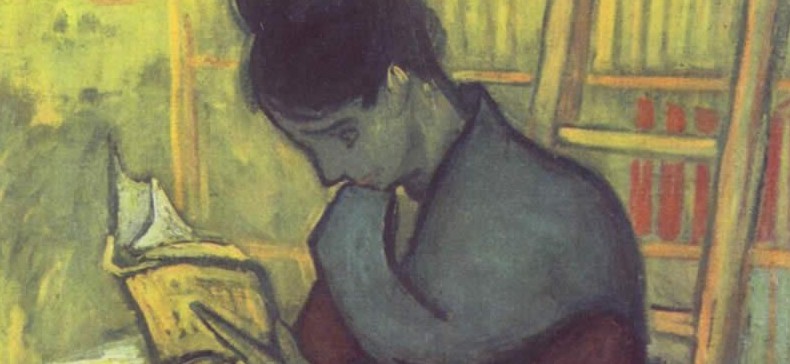
The Novel Reader

The ideas in this blog post may one day be used as the building block of an academic work (a professor’s suggestion, not mine). If for some reason you want to take some idea from here and run with it, please give credit where credit is due. That goes for all content on this blog, but perhaps especially this one. Thank you.

At times, the consumption of literary, performing, and screen arts has been reduced to mere escapism; some believe that people read books, go to plays, and watch television shows and movies in order to distract themselves from real life in a world that is imaginary. Glib pessimism aside, this might be so. The working person turns on the movie channels to relax after a long day at work. The elementary boy gets lost in fantasy books to forget about bullies. The teenage girl binges on Pretty Little Liars to escape high school drama. It’s not so hard to see how people, for a variety of reasons, turn to various arts in order to transport them away from reality, particularly if that reality is difficult and often if the art is…. less strenuous on the mind.

However, to term this reality-shifting mechanism as escapism – certainly a reductive moniker –  is to overlook what might be a more directed, revealing, and beautiful function of art in dealing with the ups and downs of life. In a sense, to call it escapism belittles the utility of art from something that enhances the mind and emotions into something that tranquilizes them.

Aristotle’s metaphor of catharsis in Greek drama reveals art to be aimed with intent at doing much more for the mind than providing an alternate reality. While scholars disagree on some of the finer aspects of Aristotle’s work, the main idea is that the emotions produced in a play could help purge the audience of their own emotions. The audience’s place in the performance would act as a release of emotion that could provide relief from certain emotions, such as fear. So, seeing something horrible happen to a character on stage, though upsetting, would ultimately act to, by the end of the play, cleanse the audience of their own fears and apprehensions as they felt the character’s fear and trauma but came away unscathed. Aristotle’s theories of catharsis support the idea that art’s work in the human mind is much more than a distraction.

I believe that an aspect of art – in literature but perhaps especially in visual, performed arts like the stage and screen – that makes it such a powerful drug in the human mind is what I will call emotional confirmation. This post is, more or less, an outline for an idea that requires much more expansion and research.

Emotional confirmation depends upon two basic principles of human emotions. They are that 1. humans are emotional creatures that must feel emotions inwardly and express them outwardly and 2. humans have an imperfect sense of what emotions feel like, what they look like, and when they should feel or express them.

The first part is simple enough, right? If you’re reading this then you’ve felt and expressed your own emotions and interpreted others’. In I, Robot, one of the things that Dr. Lanning gave Sonny was emotions, and while they are difficult for him to learn, it is his expression of emotions that make him significantly more human than the other robots. (By the way, that has to be one of the most underrated films of the last 15 years).

But, as Sonny finds, emotions are difficult. This is the second part of the two principles. First, how do you know what an emotion feels like? How do you know when you are scared or just nervous? Amused or elated? Infatuated or in love? Second, how do you interpret the emotions of others? Can you be sure that they are as happy as they seem? Are they depressed or just quiet by nature? What does it really look like when someone is angry, happy, or sad? But what really mystifies all of this is our social conditioning regarding emotions. In short, culture and society teaches us what emotions we should feel as well as how we should display them. (Men don’t cry, for example).

For an emotion to properly accomplish its purpose, it must be correctly recognized by the subject, correctly displayed by the subject, and properly received by the audience. If the emotion is unrecognized, misidentified, suppressed, blunted, ignored, or misunderstood along the way, then at least one human is going to be left in a state of confusion and/or frustration. This confusion and frustration is augmented by the first principle: if humans have an innate sense of emotions and a desire to express and understand them, any failures or ambiguities involved will be stressful and uncomfortable.

Art provides a remedy for this with emotional confirmation. In art, a subject can, with certainty, recognize a character’s emotions. More than this, they can identify with that character and feel that character’s emotions as their own, knowing that they are feeling the proper emotion as well as being in a setting where it is acceptable to feel that emotion.

The certainty of emotions in art rests on the premise that the audience can be sure of what they see. Plainly, this accomplishment is not just a side effect of good art, but a prerequisite. If an author cannot use words to describe emotions, they are probably not going to connect with the reader. Prestigious awards are given every year to actors/actresses that can most vividly portray emotion. Great writing and great acting leave little room for uncertainty. When Shakespeare writes King John as saying the following, there is little question what the king is feeling:

“France, I am burn’d up with inflaming wrath;
A rage whose heat hath this condition,
That nothing can allay, nothing but blood,
The blood, and dearest-valued blood, of France.” (3.1.349-52)

The written communication is almost too easy in this sense. It even works to some extent in bad writing: “He was mad.” The portrayal of emotion in acting is rather certain as well. The following scene, basically on its own merit, won Anne Hathaway an Oscar, mostly because of the sheer power of the emotion she conveys:

To make matters easier, performance can benefit from music, visual effects, and so forth. Side note: I left the above video playing as I continued to write, and when she sings “He took my childhood in his stride” my mouth literally dropped, the chills hit, and I teared up a little.

Whereas in real life, emotions are tough to discern and interpret, in art the emotions are made plain. This alone would be enough to make art desirable; watching movies, seeing a picture or painting, and even reading a book that allows the viewer/reader to accurately perceive someone else’s emotions is, for lack of a better word, fun. It’s healthy. Humans spend all of their social time hazarding guesses and jumping to conclusions about someone else’s emotional state, as their mind works at a million miles per hour trying to interpret myriad signals. Having the chance to safely and correctly view emotions is part of what makes Emotional Confirmation so addictive. Not only that, but the viewer/reader does this subconsciously. They begin to feel sad or angry or happy naturally as they view the art.

However, there is another dimension to Emotional Confirmation that makes the experience so edifying, and it is related to Aristotle’s ideas of catharsis.

Art heals our emotions as it prompts and guides us to emotional clarity, bidding us to emote in a certain way and reaffirming our efforts to do so.

This all depends upon the great mystery of how humans come to identify with fictional characters. This identification is what makes us affected when something happens to a character, and it is what makes us keep reading to find out what happens next. Have you ever stopped for a moment when watching or reading something and asked: “None of this actually happened, so why do I care so much?” It’s because you’ve subconsciously put yourself in the story. That’s one of the first things anyone praises about an author – the ability to put the reader in the story. This is, in part, why we care.

This gives us an astounding amount of immediacy to art. We can find ourselves actually taking the place of one of the characters, or standing in very close to them. When a character gives a tearful farewell speech, we imagine they are giving it to us, not just the other characters on screen. When someone wrongs the main character, we get angry because we feel as though they did something wrong to us.

Identifying with characters allows us to cheer for bad guys. Some of the most popular characters in recent television history have been bad guys, or at least guys who do bad things (Walter White, Tony Soprano, Dexter, Stringer Bell). The reason we can want these bad men to succeed is because we’ve taken their side; we’ve come to identify with them and with their cause.

This means that, in many cases, when a character displays an emotion, and a viewer/reader accurately identifies it, the viewer reciprocates the emotion as if they were in the character’s shoes, or at least standing right besides them as a close friend.

Why is it so powerful when Samwise says to Frodo, “I can’t carry it for you, but I can carry you!” and then picks him up to walk the final distance to Mount Doom? It’s because we have put ourselves on the journey with Sam and Frodo (and Gollum). It’s as if Samwise is picking us up, not just Mr. Frodo. That’s part of why it’s so powerful. Also Howard Shore’s score.

The coup de grace: the art tells us its okay to feel that way.

Perhaps some social situations will still prevent some people from displaying some emotions while viewing art. This is probably why, and I know I can attest to this, the affects of art are usually augmented when viewed in solitude (that may be another paper).

But, generally speaking, art gives the viewer/reader a safe place to feel and express emotion. Not only that, but it encourages it. Art draws our emotions from us, and makes it so that we can do so easily and willingly.

And that experience, of clearly seeing and feeling an emotion, and being free to express it, is a powerful drug. And, according to Aristotle, upon realizing it is all fictional, our emotions are healthfully cleansed in catharsis.

Of course, all of this may be significantly more nuanced, detailed, researched, and supported. And, of course, there are exceptions in art that confuse or contradict my assertion. For instance, what of character’s like Hamlet, whose emotions are much more difficult to identify?

But for now, I stand by my outline of the concept of emotional confirmation. Entertainment in the form of movies, plays, television, books, and even music (though that’s another thing) is much more than a distraction. It is a place to settle the tumult of emotion that we live in every day, elucidating these troublesome variables and giving us a safe place where we are encouraged to be hit in the feels, as they say.

Forth now, and fear no darkness.

Soli Deo Gloria

– Peter

The Fantastic Fiasco

Lupe tells the story of my transition into summer.

Lupe

I tend to speak in quotes.

SpongeBob, films based on Tolkien, random YouTubes and Vines, Tarantino movies, The Big Lebowski, and numerous other sources find their way into my speech pattern (but mostly SpongeBob – and that’s not a joke; my friend Ethan and I spit SpongeBob lines like we’re Stephen Hillenburg’s Uzi).

I also think in quotes with regularity. Often these prepackaged sentiments and phraseologies  come from songs, especially rap songs. Very frequently, lyrics (of any genre) fill my mind whenever I’m not focused on something in particular. And sometimes when I’m being very intentional about focusing my thoughts into words, they get translated as lyrics.

As I gathered my thoughts for this post, thoughts which will inform and reflect on my current state of mind, I found myself tossing around a lot of Lupe Fiasco lyrics. I tend to see writing with section headings as a cop-out, or at least a significantly easier way to compose a long piece, but sometimes the unicorpus essay doesn’t fit the bill (I made that word up by the way).

So, let’s do it. Oh, and you might notice it’s been eleven days since I posted. While I probably had a few days where I could have written, it was the end of the school year and mental faculties and writing time are generally needed elsewhere.

Never Forget You (ft. John Legend)

Take me to that old familiar place, take me to memories we won’t erase
Take me to all that we had, good and the bad
I’ll never forget you, I’ll never let you go
I’ll never forget you, I’ll always remember, I hope you know.

Like I said, it’s the end of the school year.

I think, more than any year of my life, I’ve reflected on the unfortunately brief nature of college relationships. When you go to college, they tell you all about making great friends. They don’t say anything about leaving them four years later. Four years, and that’s only if they’re in the same class as you. Four years, and that’s only if you put in the work to maintain the friendship as you become a sophomore, a junior, and then a senior.

They tell you all about the new and different people you will meet and the memories you’ll make and the new ideas you’ll be introduced to. They don’t tell you about the day the memories and the ideas are all you have left.

They tell you about meeting someone special – because, as a homeless Army Ranger in San Diego and a Macy’s worker in Minneapolis have both told me, college is where you find the girls – they don’t tell you about thinking you found someone special only to see it all blow up. They tell you about finding love. They don’t tell you that personal chemistry is harder than Organic Chemistry.

They tell you about those intellectual types called professors. They tell you about the liberals, the atheists, and the self-loving and self-righteous doctors with little or no time for the needs of students. They don’t tell you what it means to be a name and not a number, what it’s like to have someone so educated care about your work. They don’t tell you what it’s like for your instructor to be your fan and to be your friend. They don’t tell you how freaking cool those people are.

I’ve learned all those things now (except Organic Chemistry).

I have one semester left at St. Norbert, and while I’m going to take a nearly unbearable weight from this place I’m not going to be able to take the actual people with me. But what I shared with those people will stay with me forever, and I won’t let a grad school here, a job there, or a better market for graffiti art way out there take those people away and prevent me from maintaining some of those relationships.

I’ve spent a lot of time at St. Norbert bemoaning everything I don’t like about it. I’ve overlooked a lot of good things. I’ve missed out on or taken for granted a lot of great times with friends. And now we’re right down to the wire.

Just know this, Norbs people: I’ll never forget you. I’ll never let you go.

Words I Never Said (ft. Skylar Grey)

It’s so loud inside my head
With words that I should have said
As I drown in my regrets
I can’t take back the words I never said.

Somewhere along the way I became a social activist. I also became pretty liberal. A lot happened this year that changed the way I see the world. I’m a feminist, I’ve worked through my feelings on the LGBTQ community (post on this coming soon), and I’ve become deeply moved by the plight of darker-skinned Americans. I don’t know where you put me on the political spectrum. If a concern for the poor, minorities, women, the environment, and education makes me a democrat, so be it. If support of local governments and the protection of the unborn makes me a republican, then fine.

Truth is, I give fewer damns about politics than Rhett Butler. (BTW as someone who leans left but has previously voted right, can anyone give me a reason to like any of the Republican Presidential candidates? And what’s up with Hillary? She doesn’t sound so good either. If I use my right/privilege to vote in 2016, are there any dope third-party candidates?).

No, I’m not really concerned with politics. I’m concerned with people. I’m here to talk about the tough things in life that make us uncomfortable. If you’ve ever taken a look at the About Me section on the blog, you’ve seen that I call myself an Establishment Saboteur and a Cultural Provocateur. I’m here to call out mistakes and provoke change. And hopefully I continue to add actions to words. I won’t let myself regret words I didn’t say, even if it makes half of my Facebook friends uncomfortable.

My changing worldview has been working in a sort of yin-yang with my Christian faith. Although I’m a follower of Christ first and everything else second, my understanding of Christianity – how I “do” it and how Americans “do” it – can evolve as I continue to listen and learn. It is my hope that my voice can help the Christian church do a better job of living the Gospel and representing Christ as it exists in a country that is much more than a hive of WASPs. This is going to make up a series of posts coming over the next couple weeks (along with a number of other religion/theology themed posts). And maybe this liberal fundamentalist can change the way you (as a Christian or non-Christian) sees my faith and my religion.

I only have one life to live before moving on up, and I can’t take back the words I never said.

Til I Get There

I’mma keep it cool, and I’mma do me
It is what it is and that’s how it’s gon’ be
Until I get there, until I get there.
And yeah I got flaws, I know I’m not perfect
But all the ups and downs, will soon be worth it
When I get there, when I get there.

I’m returning to Culver’s to work this summer. This will be my third summer there, along with two Januaries and a few other breaks thrown in. It can be a really tiresome job, like anything in food service, and I’d really rather be doing something else. But it’s a job, and for that I’m thankful. Sometimes you just have to make money, and even a job like mine can glorify God (KB gave a talk on that idea at last year’s Legacy Conference. Absolutely merked it). While I’m a pretty darn good cashier and dining room cleaner person, I actually struggle with a lot of the other tasks. My bagging skills have been compared to that of a blind monkey’s. But the job is a chance for me to learn and improve and grow and do things even when they’re tough and/or not fun.

There are truly some nice things about working at Culver’s besides a discount on food. I have plenty of strange, pleasant, and fun interactions with customers, I learn a lot about people, I work for good managers, and I enjoy my co-workers. I’m actually kind of a celebrity with the high school kids there. I’m not really sure why.

However, the job is going to wear on me, and that, combined with the other jobs, responsibilities, and events I’ll have this summer, could make this a tough few months.

Or it could make this a terrific few months. If I approach things with a positive attitude, enjoy the good things about Culver’s, savor the occasional beers and/or smokes after a long day, take in the beautiful weather when it isn’t too humid, spend quality time with family and friends, play a bunch of basketball, and invest in reading and writing, this could be a great summer.

But it is what it is and that’s how it’s gonna be. Until I get to late August.

Superstar (ft. Matthew Santos)

If you are what you say you are, a superstar
Then have no fear, the camera’s here
And the microphones, and they wanna know
If you are what you say you are, a superstar
Then have no fear, the crowd is here
And the lights are on and they want a show, yeah

I’m a writer. Whether or not writing ever earn’s me a living, I’ll continue to do it.

I think I’m a pretty decent writer. And a lot of people have told me they think so too, especially since the blog became eloquent mumbler.

There’s two important things to do with this:

First, I have to stay humble. I think one reason I’ve gained fans is my voice, and that voice almost never brags or boasts. So call me out on that if I ever come off as self-important, self-righteous, or condescending. I intend to remain honest, self-deprecating, and humble-bragging.

Second, I have to make the most out of whatever talent I have. Maybe I have what it takes to be great and maybe I don’t, but I won’t find out unless I put in the time and effort necessary. If I am disciplined, I should have time enough this summer to make major leaps and bounds in my writing ability.

I can’t let a lack of effort or a lack of confidence cut my dream short. If I’m a superstar then I should have no fear. If not… well, only one way to find out if I’m not.

The Show Goes On

Alright, already, the show goes on
All night, till the morning we dream so long
Anybody ever wonder, when they would see the sun go
Just remember when you come up
The show goes on.

I guess I don’t really have to explain this one too much, right? Not a bad theme song, especially when thinking about people you’ll never forget, speaking words that are tough to say, moving on through daily life, and working on a career, all while moving into the summer months.

Soli Deo Gloria

– Peter