L.I.T.W. – Race

The third installment of “Love is the Why” features the next great issue that American Christians must meet with love – or fuel with inaction.
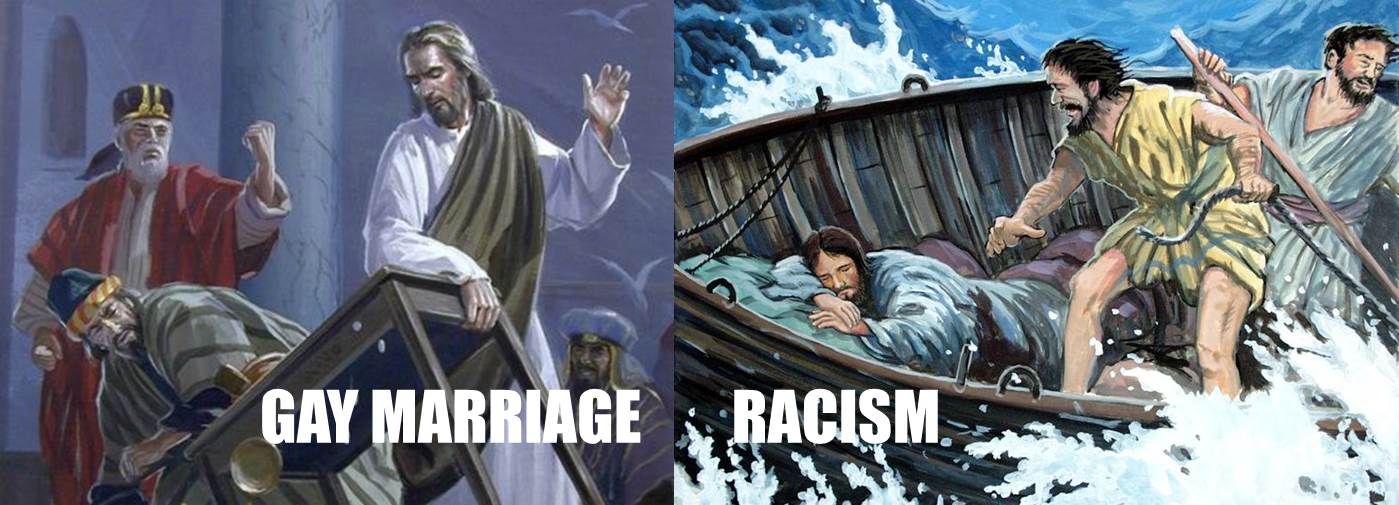
Christians be like....

Christians be like….

Most Christians are not racists.

Which is, of course, a very good thing, considering that few things are so diametrically opposed to the Gospel as racism.

But there are some racist “Christians.” And some “Christians” who use Christianity to justify racism.

And many Christians are racenorant (too ignorant to be just racist, too racist to be just ignorant). And just about every single Christian (including this writer) suffers from some degree of subconscious racism.

American Christians live in a nation that is racist. And racial tensions are as high as they have been in some time. The last 300 days have seen the rise of a powerful movement of protesters that has especially focused on police brutality against black Americans. Their efforts have shed light on systemic injustices that go well beyond the guns of the police.

Race will be one of the most important issues in America in 2015 and beyond. And my heart longs for my generation be the one to finally be the change I wish to see.

American Christians are a part of this struggle. How will we acquit ourselves?

Because, so far, our participation in this issue has been pitiful. And unless we act, the 21st Century Church of AC will stand next to slaveholders and the KKK in a tradition of Christians that chose which people counted as their neighbor.

This topic, like gay marriage, is worth considerably more than a couple thousand words. Again I find myself needing to narrow the scope of my writing in order to take on something a little more manageable. In just the first 250 words of this post I have already set off numerous alarm bells and made many statements that might need clarification or justification.

First thing’s first: this Scandinavian-American perspective will comment on white American Christians and their place in this issue. Obviously black American Christians can also be racist and can also fail to live out the Gospel in race relations, but it’s not quite the same. I hope I don’t have to explain this any further.

Second, we can’t dwell on the history for now. It’s just important that you understand that, while the Christian message is unequivocally anti-racism, Christianity has in its history had some pretty big racial issues. Your idea of Christianity’s place in history might be just a tad misguided (for instance, John Newton didn’t give up slaving right after his conversion. Yikes.).

And, lastly, it’s important to understand that this is, in fact, a big deal/problem/thing/issue.

And it’s because many white American Christians either refuse to believe this is a problem or ignore the problem altogether that brings us to our place in this discussion.

Christians facing this issue have tended to use five different responses:

  1. “This is just a bunch of media fodder. There’s not really a problem to worry about.”
  2. “There’s a good explanation for all this.”
  3. “Those people have problems.”
  4. “Christ is the answer.”
  5. “My brothers, sisters, and neighbors are crying out in pain and I must listen and act.”

The fifth option is the only acceptable response. Walk with me here.

“There’s not really a problem….”

This the response in which the Christian avoids showing love by denying that an object in need of love even exists. The person who ignores this issue and pretends racism doesn’t exist somehow manages to be blithely ignorant of their surroundings. Or, they truly do live in a bubble that appears free of racial tension, and when some tension is introduced to that bubble, they react by playing it off as a non-issue. Because this is the most ignorant of the four responses, it is hard to call this type of response un-loving. But it is self-absorbed. I believe Christians should constantly have their ear to the ground. While we are supposed to have our beliefs and convictions, some of which we would gladly die for, we should also be always listening and considering the views of others. For an individual to think that their view of the Gospel, the Bible, God, and the rest of the world is the immaculately correct view is all sorts of obtuse. Christians should always be listening for voices that sound different from theirs, while also seeking close community with people echoing what they believe to be true. So, as a Christian, if you hear a black person saying “I’m being oppressed because of my skin color” or “The police are unfairly targeting me,” shouldn’t you take some time to listen and consider? Might there be a problem even if you hadn’t ever given it much thought?

“There’s a good explanation….”

It seems to me that white Christians are quick to explain away or justify racial injustices, perhaps especially when it comes to police brutality. Where is the love in rushing to the side of the people holding the power and the badges and the guns? How is it loving to use mental gymnastics to explain why the young unarmed black man lying dead on the street was in the wrong? Why does a crime make someone deserving of death? I wonder: if Jesus was walking through a park in Cleveland and saw Tamir Rice dying on the ground, what would he have done? I can’t speculate, but I don’t think he would have brought up how much the toy gun looked like a real one. I think he might have John 11:35’d.

“Those people have problems….”

This is the most unloving response that Christians seem ready to use. This line of thinking attributes the Baltimore Uprising to misguided anger, exploitative thuggery, moral depravity, cultural deficiencies, and urban brokenness. Essentially it seeks to bring up all the problems in the black community, and it uses those problems to mask the issues that protesters are bringing to light. Christians should have open hearts and minds. Rather than criticizing a black person for smashing a window, why don’t we ask what could have possibly made that person so mad in the first place? We can try to understand these things without condoning them. What is the Christian response? “Shame on those people. How dare they break the law.” Or “Those people are hurting and I don’t understand why they’re doing this but I want someone to help them.” Rather than creating this figure of the poor, uneducated, hip-hopping, drug-dealing, angry black person, why don’t we ask “What has made them so upset?” Why do we rush to the side of those in power? Why don’t we sympathize with the protesters?

“Christ is the answer….”

Yes. Of course Christ is the answer. I believe that with all my heart. But what does that look like? What do Christians think will be accomplished by only speaking the Gospel? I believe in the power of the Gospel, and I believe as Paul writes that the Gospel is to be proclaimed first and foremost, and I echo Lecrae’s sentiment “Lord kill me if I don’t preach the Gospel.” But since when does sitting around shouting “Jesus saves” solve anything? I am not, for a moment, minimizing the power of the Gospel and the Holy Spirit. I’m maximizing the ability of God to work through Christians who go forth and live out the Gospel in their actions as they preach it. The Gospel has equipped us to join in issues of social injustice with hearts full of love as we live to glorify the name of above all names. Sitting at home and in our segregated churches is not what preaching the Gospel is about. What is masked in this response is a desire to just keep things the way they are and avoid controversy. Where in Jesus’ ministry did he avoid controversy? And, if we are to keep things the same, how is that going to do anything but just make the issue worse? And, finally, being angry is not sinful. We as Christians should get angry when we see injustice. Not rageful or hateful, and our anger should not drive us to sin, but it is okay for injustice to make us angry.

“My brothers, sisters, and neighbors are crying out in pain and I must listen and act….”

“He has told you, O man, what is good; and what does the Lord require of you but to do justice, and to love kindness, and to walk humbly with your God?” Micah 6:8

“We are not to simply bandage the wounds of victims beneath the wheels of injustice, we are to drive a spoke into the wheel itself.” Dietrich Bonhoeffer

If you are a Christian, you should be listening for the cries of the oppressed. And when you hear those cries, you should act. Perhaps this means acting against the government. Maybe it means causing a stir or creating controversy.

If you don’t think there is a race problem in America, you are tragically mistaken either as a result of colossal unawareness or close-minded unkindness. And if you recognize that there is a problem but decide to explain it away when it is inconvenient or just ostrich the situation altogether, then you are not acting in a loving manner.

To my brothers and sisters in Christ: please, please, make racial relations a priority in your life. Get educated in the history of black America. Seek out black perspectives. Become aware of your own racism. See the media’s racial bias. Recognize white privilege. And love. Not just those black people who wake up on a Sunday morning to get dressed up for church, but the ones marching and holding signs and even the ones who smash windows, run from the police, steal, or reach for the officer’s weapon. The Gospel message is so fundamentally opposed to everything racism stands for, and when we refuse to act against racism on the personal and systemic level, evil prospers. And to explain away or ignore an issue when fellow Christians of darker skin speak out is the type of self-centered Christianity that destroys church communities. If a Christian won’t try to believe a fellow Christian about an issue like this, there is something quite wrong.

The battle to defeat racism in America is intensifying and it will endure. No justice no peace. The movement lives. It will continue and, Lord willing, it will one day be resolved. If AC lives out the Gospel, and bears in mind the words of Micah 6:8 and Dietrich Bonhoeffer while trying to follow Christ’s example, Christians will naturally end up at the front of the charge that brings this reign of fear and hatred to an end.

But if AC continues in its current course, others will take our nation to a more progressive and humane condition while Christians waste time chasing other issues. Christians will have failed, but at least the racial situation will be better.

Or maybe the issue won’t get better. Maybe it needs Christians to heal racial wounds and bridge racial gaps with the love of the Gospel. And maybe, when white Christians are needed to step up, they will be nowhere to be found.

Just as Nero fiddled while Rome burned, perhaps Christians will carry on singing Chris Tomlin songs as the body of Black America hangs smoldering on a liberty tree.

Soli Deo Gloria

– Peter

L.I.T.W. – Sinning

In the wake of the findings of the Pew Research Center, I’ve been compelled to share my heart on some of the shortcomings of American Christianity (AC). This is the first installment in a series called “Love is the Why.” For more information on this series, see the previous article. This topic, sinning, should work well to set the stage for some of the future posts, as a misunderstanding of sin and sinning is at the root of many of AC’s failings.

pharisee and tax collector

Luke 18:9-14

One of the most important traits of religion is the renunciation of evil ways. In just about any religion you will find adherents instructed in “good” things to do and “bad” things not to do. Oftentimes these rules are really just a codification of what humans, for the most part, accept as good and bad behavior.

Christianity works in a similar way. Part of becoming a Christian involves repenting of evil, and going forward a follower of Christ is expected to do some things and not do other things. This creates a language of “sin” and “not sin,” and considering that according to the Christian tradition sin is a pretty big deal and the penalty for sin is death, it makes sense that Christians would be concerned with whether or not they are being sinful.

However, non-Christians have come to see this lifestyle and worldview in a fairly negative light. Stressing over sin has made Christians appear as socially irrelevant, uninteresting, goody two shoe, self-righteous, legalistic, holier-than-thou rule followers. Of course, the Christian life is supposed to look strange – in some respects – to the rest of the world, but much of this condition does not have to be so. Christians have distorted the idea of sin and sinning in a way so as to not only impede their own spiritual growth, but to give fuel to anti-Christian fires. By splitting hairs over legalistic rulings over what is sin and what is not sin, Christians have not only distorted their own goals but alienated non-believers.

I’ll get into the specifics of how this works out later, but first it’s important to outline what I believe to be the important misunderstanding that leads to this issue.

Sin is not so much something you do as it is something you are.

I’m just now realizing that I’m going to spend only a couple hundred words explaining the doctrine of sin, which has taken up innumerable pages of work by Christian thinkers. I’ll give you the ground rules that will help us move forward and you can do more research on your own if you’re so inclined (I’m open to being wrong).

Sin is separation from God. God is perfect, people are not, and therefore we are separated from our creator. In our imperfection we dishonor God through our actions, and this puts us at odds with God. In fact, we are bound to be punished through death and eternal separation from God. In order to save us from this fate, God came in the form of a man (Jesus) and died to pay the penalty for our transgressions, and then he rose from the grave to conquer death. By accepting Jesus as lord and savior, a Christian turns from their sin and gives their life over to God.

Okay so where does sin work into this picture?

The important thing to see here is that before accepting Christ, human beings live on their default setting, which is sin. This means we do bad things and we keep doing bad things (and yes I know the “good” and “bad” thing is really big issue, and I will be writing about this in the next couple weeks. Bear with me for now). After accepting Christ, the new Christian now becomes able, through the power of the Holy Spirit, to not be in sin. Every Christian still does bad things, but they are no longer under the dominion of sin and are able to experience spiritual freedom in Christ.

Okay, that’s a lot of theology in two paragraphs. But hopefully you see a little more clearly what I mean by sin being something you are and not something you do, and it’s a lifestyle more than it is an action.

This is why, if you look at Paul’s letters in the Bible, when he refers to someone as being sinful or in the wrong, it generally refers to someone who is living in sin, not living and committing sins. Paul writes that he continues to do the things he does not want to do instead of doing the things he wants to do (Romans 7:15). Christians go on sinning even after receiving the Holy Spirit. But this is not a license to sin at will, as Paul writes earlier in Romans 6. Sin is a very serious thing, and violent imagery is used to describe the Christian struggle with sin (spiritual warfare, Make War (Tedashii song), armor of God, die daily, etc etc). As John Owen said, “Be killing sin or sin will be killing you.” However, the condition which Paul repeatedly condemns is more likened to a state of continuous and unrepentant sin. Christians are covered by the blood of Christ and take on Christ’s perfection when they accept his death and resurrection. Christians are no longer under the dominion of their flesh and the rule of evil. So while they will, without a doubt, continue to sin every day, even every hour, the peril lies most plainly in habits of sin, and most dangerously in habits of sin that the Christian carries out knowingly and in rebellion against God and the sacrifice of Jesus Christ that they claim to embrace.

Okay that’s yet again a lot of theology. Here’s what I think are the problems Christians have in living with the doctrine of sin and the ways in which they alienate and offend non-believers in a way that is unhelpful and unloving.

Christians have converted sin into acts that can be adjudicated to be sinful or not sinful and then categorized into acceptable or unacceptable Christian behaviors. Instead of examining the condition of their hearts and minds and earnestly striving to live in a way that is pleasing to God each day, Christians justify themselves by examining their activities and determining whether or not they were sinning or not sinning.

So when we talk about sins, we talk about them as items of activity. In almost all Christian circles, you sinned if you:

  • swore
  • broke the law
  • had sex with your girlfriend/boyfriend
  • watched porn
  • masturbated
  • drank alcohol illegally
  • used illegal drugs
  • physically hurt someone
  • stole something

Just to name some of the big ones. Of course there are more, and in some Christian traditions there are a lot more.

This itemization of sin has two major negative side effects. The first is that it turns Christians into Pharisees, the people Jesus spent a lot of his time torching for their self-righteous superiority. If someone can not do the things on this list, they may think of themselves as being a good Christian while considering people who do these things to be wicked sinners. It’s only a matter of time before that way of thinking makes someone think of themselves as being a better human being. All you have to do is read through the Gospels and you will see how outrageously un-Christian this mindset is. But it exists all the same. Drug users and prostitutes are looked  at as yucky and scummy, and many Christians would like them ushered out if they showed up on a Sunday morning.

Seriously. If you claim to love Jesus and follow his teachings but you look down on the drug dealer, the pregnant high schooler, and the foul-mouthed drunkard, you have some messed up theology.

The second effect of the itemization of sin is an arbitrary masquerade of self-justification that looks a lot like earning your way to heaven and nothing like picking up your cross daily and following Jesus. Let’s go through some examples that reveal the problem with asking “Is it a sin if…?”

Some people think it is sinful to drive even one mile over the speed limit because that means knowingly breaking the law. Most Christians hear this and roll their eyes (side note: as long as you think something is sin and still do it, it is sin for you. Regardless of the “right answer,” if you do something thinking it is sin, it is). But then here’s my question for the Christian rolling their eyes: Is it sinful to drive 50 miles over the speed limit? I imagine the answer is probably yes. If you drive 75 in a 25, you are putting other people in serious danger and blatantly breaking a law.

Checkmate.

Because if driving 50 over is sinful but one mile over is not, here’s what I’ll ask next: 49? 48? 47? 46?

Eventually you will reach an arbitrary number that is, for you, not sin.

Next example: Christians spend a good deal of time worrying about the media they consume, and what media they should let their kids consume. And of course they should, as Christians should be mindful of what they are focusing their minds on, but these questions often create opportunities for absurd loopholes and self-justification gymnastics. Here’s how this works with R-rated movies.

Let’s say a Christian family wants to watch an R-rated film. Well, until the kids are a certain age, the R rating alone probably rules the film out.

The first hurdle is sex. Is there a sex scene? Throw it out. Bare breast? Toss it. Bare backside? Probably okay. But… if the breast is only visible for a quick second, that might be okay. And, if the sex scene is under the covers, that might be fine. And, the scene is really pretty quick anyway. And the couple love each other very much. The family probably just fast-forwards through the scene and tells the youngest ones to close their eyes, but the teenage boys watching Enemy at the Gates probably get really quiet when Vasily starts thrusting on top of Tanya and conveniently forget to fast-forward.

So how about violence? Well some Christians just refuse to watch violent content. But most are more concerned with the way the violence is portrayed. Is it historical violence? Oh, then that’s fine once the kids are old enough to not have nightmares. Is it just a ridiculous action movie? Well there’s nothing malicious about that. It really doesn’t take long before the only wanton destruction of images of God that Christians stay away from is the horror movie genre.

What about profanity?

Pardon my French, but I don’t know where the fuck Christians get their rules for swearing.

These decisions, in all facets of a Christian’s life, so often come down to arbitrary rulings subject to personal whims and cultural influence. There is nothing in the Bible explaining which movies are okay to watch. There is nothing drawing a line of sin in the sex scene: bare backside? bare breast? moaning? orgasm? Christians can loophole their way past sin in ways that make a mockery of their beliefs. Let me really mess with your mind: If you try to come up with a case defending masturbation as a Christian, you should find it to be really, really easy.

This itemization process creates disproportionate attention for the outward actions instead of the inward condition of the heart. Rather  than asking themselves if they are gracious and merciful and loving and seeking purity and desiring God, Christians keep an unofficial scoreboard of legalistic rulings. A wall is built between thoughts and actions. Tell me who sinned: The Christian who flipped through the channels and for a brief moment caught a glimpse of a porno on HBO, or the Christian who got aroused watching the passionate kiss in the PG-13 movie?

Being a Christian is about waking up every day ready to live for God and not for yourself. It’s about wanting to sin but restraining. It’s about knowing God still loves you even when you do sin. And it’s about filling the space in your life that you might fill with sin with extreme love for your neighbor.

Christians sin. A lot. And all sins, even a quick fantasy over the Hannah Davis DirecTV commercial or a slanderous word of gossip about your ex-boyfriend are punishable by death.

But Jesus Christ died and to pay the penalty for every single sin, and he rose from the grave to defeat the reign of death. The Gospel, the greatest demonstration of love in history, should cause Christians to be filled with joy because of their redemption, to celebrate being a new person in Christ, to fight each day to defeat sin, and to find comfort knowing that although God does not withhold the battles he still grants the victories and lifts his children up when they fail. The Gospel should fill Christians with radical love and joy that causes them to love all of their neighbors, and perhaps especially the ones engulfed in sin, neighbors who are no less worthy of salvation than the Christian was before accepting Christ. Christians living in this way should be honest with themselves and see how they still continue to fail, and never think of themselves as being more righteous than others. Rather, they should humble themselves and speak of the mercy and grace of God while showing mercy and grace to others.

This understanding of sin should also provide a freedom for Christians; they should be unburdened by the self-governing adjudication of sin and not-sin. Dear brothers and sisters: if you are reading the Bible and praying regularly and are involved in a healthy Christian community, you will know what is sin and what is not sin. You do not have to rely on arbitrary rules. In fact, those rules will more often than not be your own sinful flesh’s way of justifying something you know to be unhelpful for your spirituality. Or it may be that your reasoning is really just a means of making yourself feel more holy. Stop asking, “Is it a sin if…?” Because if you are living each day in pursuit of knowing God better and finding joy in the love of Jesus, you will know. And, if you are more focused on what you should be doing, particularly loving your neighbor, than on what you should not be doing, that will also be to your immense benefit.

If you believe the Gospel, then your life should not be about what not to do. Rather, it should be about knowing what God did for you and does for you, and how that affects your life. If you grasp even the beginnings of the height and breadth of God’s love, mercy, and grace in spite of the size of sin, then you should not only pursue a life of daily growth over arbitrary answers, but you should feel that much more love for every other human being. Freedom from sin does not make you better than other humans. Rather, freedom from sin makes you better equipped to love other humans.

Soli Deo Gloria

– Peter

Love is the Why

Gandhi and Christians

Much ado has been made about the findings of the Pew Research Center regarding religion in the United States. I recommend that you take a few minutes to look over the study to find a number of interesting trends that appear in this year’s survey, the first done by Pew since 2007.

Pew’s sub-title for the release of their research is, “Christians Decline Sharply as Share of Population; Unaffiliated and Other Faiths Continue to Grow.” There’s a clear story being told there: The number of people identifying themselves as Christian has seen a noticeable downturn since 2007, and the number of people claiming no religion – classified as “nones” by Pew – has increased substantially.

Furthermore, the decline has been caused, in large part, by the fact that while the older generations (read: people who are dying) are overwhelmingly Christian, millenials are not even 60% Christian and have significantly higher rates of “nones.” In other words, young people are moving further and further away from Christianity and religion in general.

Of course this has caused a stir in a nation where 7 out of 10 people identify themselves as Christian. And, without a doubt, it should provoke us to ask tough questions and have earnest discussions.

There are reasons why this happening. Very good reasons. And no, Bill O’Reilly, you can’t blame this on rap music.

And, while many Christians will use this as the reasoning, this is not about America’s moral depravity.

This isn’t about Jersey ShoreGame of ThronesFifty Shades of Grey, marijuana, social media, Lady Gaga, liberals, feminists, Richard Dawkins, Kim Kardashian, Obama, the gays, Muslims, or college professors.

It’s not about putting so much emphasis on the individual that our society neglects community. It’s not about everyone having it their way. You can’t blame entertainers, educators, religious thinkers, or “the media.”

This is about Christians.

This is about Christians failing.

People are leaving the Christian faith for a life of theism, deism, agnosticism, or atheism, because the church of American Christianity (AC) is failing. Having grown lazy and complacent in a position of power in the most prosperous nation in human history, numerous problems have taken root in AC and choked out the light of the Gospel. Legalism, moral superiority, homophobia, racism, greed, conformity, scientific ignorance, sexism, religious bigotry, isolationism, revisionist history, child molestation, God Hates Fags, financial scams, archaic adherence to tradition, the gun-toting pseudo-religion of American Christo-Patriotic Conservatism, and more have all contributed to the decline in AC’s adherents and the effectiveness of AC in general.

Why?

Love. Love is the why.

Faith, hope, and love, but the greatest of these is love.

Love your neighbor as yourself.

A religion built on love and mercy and grace has become built on being right and being successful.

Feeding the five thousand has become a means of creating dependency. Kill and eat has turned into trash the planet. The righteousness of foreign wars comes down to who happens to be in office. Finances, political ideology, and personal freedom have pushed away the priority of radical love.

Of course, AC is still doing a lot of great things and showing a lot of love. There isn’t a number that can measure the positive impact that Christians have had on their communities, whether that be organizing community projects, giving to the poor, or reaching out to touch the hearts of the broken and down-trodden. Locally and internationally, Christians are doing great things for people. There are, most certainly, many many Christians going hard for the Gospel and loving when it would be easier to hate.

But there isn’t one Christian who can’t do better. And many Christians are doing next to nothing for anyone outside themselves or their church community. If 70% of the country were as loving as the 1,000 most loving people in the nation, we’d live in a pretty amazing place. Because, and maybe this is the kicker, it’s not just people of faith who are doing great things in the world. Many of the most loving people out there doing things for their fellow human are people who do not claim any religion. I know many good people who are not Christians. So imagine if all Christians did what Christ calls them to do and joined their efforts with those who are concerned just out of being a decent human being.

And love is why I’m doing this. I’m not a doomsayer here to condemn the world of Christianity. I’m not looking to get a rise out of the conservative Christians that I know are going to object to some of the things I say over the course of the next couple weeks. I’m not here to make myself more superior, tout the rightness of Christians, or criticize non-Christians. Love is the why. I know that Christianity is not the religion of white supremacists, snake handlers, grandmas with kitsch in their front yard and living room, and Ned Flanders. I know it’s more than that, because, in a way, it’s less than that. It’s about Jesus Christ. And that means it’s about love, mercy, and grace. Jesus says that the greatest commandment is to love the Lord your God with all your heart, soul, and mind. The second greatest, Jesus says, is to love your neighbor as yourself.

I want us to ardently pursue these two commandments. I want my fellow Christians to love God by loving their neighbor. I want them to assess their Christian life and accept that they might not be doing everything right. I want them to love. As Dietrich Bonhoeffer said, “Your life as a Christian should make non believers question their disbelief in God.” The best way to hate the sinner’s sin is to love the sinner.

And I’m doing this because I love God and I love people, and I want all people to know God. I’m not out to crusade against non-believers and convert them with a doctrinal sword. I’m not here to shout fire and brimstone and demand that they turn from their ways and repent. Non-believer, I want you to know God because I love God and I love you. One day this world will pass away and all things will be made new. I want to dance with all of you in eternity. And I know that, as it stands right now, AC isn’t making a particularly compelling case to join the dance.

Allow me now to preface this series of posts that will be coming over the next couple weeks, as well as any religiously concerned posts that appear on this blog.

I believe I am right, but I would never claim to be inerrant. I’m open to being wrong. I may someday change my mind as I learn more. But I do have some theological training and I have read the Bible and kept up with modern Christian thought, so I know a few things. I have been a Christian most of my life, but most of 21 years is not very long. For what it’s worth, I am part of Evangelical Protestantism, the branch of Christianity that has, from a numbers standpoint, fared the best since 2007. In that time, it is the only branch of Christianity to have more converts than departures, although the overall number is slightly down but at a lesser rate than other branches. I certainly have room to grow too, a lot of room, as a Christian and as a human being that actively seeks to make the world better. Far be it from me to claim I’m any better than you. Most importantly, I implore you to seriously consider the things I say. Please do not outright accept or reject my ideas. Rather, carefully consider what I suggest, and carefully consider where your own heart and mind are.

Let’s do it.

Soli Deo Gloria

– Peter