Some thoughts on the creations and creators of 2023.
Being an artist is scary.
Yeah, I’m an artist. I’m only just getting comfortable calling myself that and it’s been beautiful to embrace it. You might disagree, but probably not if you’re reading this.
There is much in the artistic process that is scary, no matter which of the myriad mediums you favor, and no matter how much of the art you’re creating versus recreating (a songwriter versus the instrumentalist). But one of the scariest parts is asking people to care.
The vast majority of artists ply their craft as a hobby, often paying rather than being paid to produce it, and many will not ever share their art with a wide audience. We make art because we love it, because it demands to come out, because holding it in would be a tragedy.
But almost all artists will, at some point, try sharing their work. We work for hours and hours on something, finally satisfied (mostly) with what we’ve come up with, and then we have the audacity to be such a great bother and ask other people to take the time, energy, and (maybe) money to experience it.
Imagine giving a final presentation to a class – one of the more nerve-wracking things almost everyone goes through. Only what you’re presenting on is something immensely important to you (you dork). And actually it was not even required – you spent your time and energy on it just because you were interested in it (you try-hard). And your classmates? They weren’t required to show up. You asked them to come in on a Saturday (you presumptuous jerk). And, actually, there are literally thousands of other people already presenting on a similar topic, but you thought you were smart enough to try your hand anyway (you pretentious asshole).
That’s what asking people to care about your art feels like.
Oh, and just like a letter grade in school, you might actually have a very, very concrete idea of how your art is received. Views, streams, purchases. So, yeah, every kind word makes you feel over the moon, but at the end of the day you can still pull up your Amazon reports and see you’ve sold 40 copies of your book. As a former instructor I can tell you feedback is more important than grades, but a C+ is still really hard to take when you tried for an A.
This is – of course – intensely personal to me, but this anxiety is one of the key themes of 2023, not just for me in my own artistic journey but for all of us in contemporary culture. It’s what the best film of the year is about and it makes its way into some of the best television and literature, too.
You’ve seen, The Office, right? Of course you have. S3:E17, “Business School,” is one of my favorite episodes, and probably one of the most memorable. Yes, it’s the one where there is a bat in the office, which Dwight captures, all while being “pranked” by Jim that Jim has *checks notes* turned into a literal vampire. But that’s not what the episode is about. It’s about the convergence of the other two storylines: Michael’s insecurity as a boss who is focused on people and is both unskilled and uninterested when it comes to spreadsheets, market projections, and business analytics; and Pam’s insecurity as an artist asking her friends and coworkers to come see her work in a small art show. If you haven’t seen the episode, the show is an unmitigated disappointment for Pam until Michael appears at the last minute.
It’s a beautiful scene, really showcasing the heart of the writer’s room and the immense talents of Carrell and Fischer. I love it so much I even based a scene off it in that novel that only sold 40 copies.
Because Michael is the central character of the show and Carrell is one of the most endearing actors to ever walk the Earth, this scene might be remembered primarily for what Michael does. In fact, the title of the video above puts the focus on just that: “Michael Brings Pam to Tears at Her Art Show.”
But his kind gesture and kind words in this scene do not tell the full story. It’s really just the emotional payoff of what the episode had set up to that point. Pam has spent the episode asking people to come to her show and has gotten so many disappointing responses, and then at the show she has waited and waited and been disappointed again. Almost none of her coworkers and friends show up (including Jim! Super bad look, Jim!) and those who do are there for the wrong reasons. I’m sure Pam’s storyline moves anyone who watches, but if you are an artist this hits especially close to home.
Meanwhile, Michael has had his world flipped upside down by Ryan, who has set him up to be embarrassed in front of a class at business school. The crux of Michael’s embarrassment is that he is uninterested and unschooled in most aspects of business. He’s a genius salesperson who got promoted to the point of incompetence, but what made him a great salesperson is also what makes him a – in his own way – successful boss. He cares about people. He loves people. “A good manager doesn’t fire people. He hires people and inspires people. People, Ryan. And people will never go out of business.”
Sometimes, the different storylines in a given episode of The Office fit together to support a common theme, and this is one of those times (minus the bat storyline). Because, more and more, people are going out of business. The world is becoming more automated, more artificial, more fleeting. And as everything becomes streamlined and optimized to maximize profits and justify existence in late-stage capitalist systems, there seems to be very little room for art, whether it is Pam’s water color paints or Michael’s personalized human touch.
Mike Schur, one of the last sensible human beings on Earth, is one of the creators of The Office, and was also one of the chief leaders in the recent WGA/SAGAFTRA strike. It’s easy to see the connection here (though Schur is not the primary writer of “Business School”). Perhaps the most important point in that strike was protecting writers against artificial intelligence. In short, the writers wanted protection against computer systems taking their jobs. We may still be a hundred years from ChatGPT being able to write a good television series, but when Love Island and The Bachelor are two of the most popular franchises in the world, I think we know people will settle for shows that are less than good (I get the appeal, guys, but you all know it’s a great big fucking waste of time).
It’s a horrifying existential crisis for artists. What if our creativity can be replaced by a computer who will do the work faster and for free? And, in some ways, the computer might do the job “better” – that’s why we have computers do all kinds of things, like call balls and strikes (oh, wait lol). If in 20 years ChatGPT can write an emotionally-gripping novel about sad men and resilient women and spiritual crisis, what am I even working towards?
One way for creativity to survive is to embrace the machine and dive headlong into a world of speed and optimization. Technology has given artists the means to become an overnight sensation on platforms like TikTok. Through some combination of compelling presentation and algorithmic compatibility, your song, poem, recipe, dance, or painting is just hours away from becoming a global sensation viewed by millions.
That sounds a lot easier than trying to get an agent to represent you. All you have to do is optimize your art to capture attention in less than three seconds (three seconds is basically the point where viewers continue to watch or continue to scroll. Three. Seconds). And it really better stand out, because if the average time spent on TikTok per day is about 90 minutes (I’m not making that up), that’s enough time to watch 1,800 videos 3 seconds at a time.
There are three disturbing trends here. The first is the reworking of our brains to consume things 3 seconds at a time. We’re supposed to use that kind of quick-thinking part of our brain to do things like keep us safe from harm (that car is changing lanes! my child is about to touch the stove!) or move efficiently through mundane tasks. It’s not meant to be used for anything related to pleasure and gratification. How does three seconds of sex sound? Three seconds of you favorite meal? Three seconds of good conversation? We don’t consume anything like we consume social media. We are creatures who are built to be able to engage for lengths of time with sensory experiences.
The second is that the creation no longer has to be any good. It just has to be momentarily stimulating. I saw a Reel yesterday (which I assume was a TikTok first) of a guy crushing a golf ball with his driver, and his buddy just feet in front of him catching it in his hand. Impressive. Watch a little closer and clearly – clearly – you can see the golf ball whizz past him and a second golf ball in the buddy’s hand. They barely tried. Doesn’t matter – 20 million views. And I’m sure we’ve all found that if you’re hot and create a video of you doing just about anything – no matter how lame the dance is or unfunny the joke is – you’ll get a few hundred thousand likes. We’re tolerating bad creativity because we’re consuming literally thousands of things per day. Oh well if some of it’s bad – you just move on!
And the third is that, in a sick inversion of Michael’s belief that “people will never go out of business,” the product is not the art at all. The product is us.
The thing being mass-produced and sold on social media is not the creativity, not the art. Those are just ploys to keep us around and surveys to find out what we’re into. We are the product. What resource could there be more inexhaustible than human attention? Not human focus, not human retention, just attention. Just minutes spent staring. The music and the jokes and the hotties and the genuinely beautiful and interesting things that all make up our feeds serve one purpose, and that is to make other people wealthier and more powerful. The machine may seem benevolent, sorting through millions of pieces of content to find the ones you are most likely to enjoy, but this is all part of you telling the machine how you are best sold to, how you are most easily captivated.
Creators who shape their art and its presentation to succeed on social media might just make it big. But they may also be working to appease a machine that does. not. give. a. fuck.
I should disclaim that I am not above all this. I still spend time scrolling through Reels. I’m on Facebook because I don’t know how else to share my writing. I’m not judging you if you spend time on TikTok everyday. But I really think our lives would be better if TikTok would go away.
So what’s an artist to do when the economy of attention (not to mention just, like, the actual economy) plays so heavily into the creation, distribution, and consumption of art? It’s a tough question, and one that is explored in such compelling fashion by Gabrielle Zevin in her novel, Tomorrow, and Tomorrow, and Tomorrow. It was actually released in 2022 (and was on many best books lists), but books tend to have a slower burn and longer tail; many people – me included – read it this year.
Zevin explores many topics and themes (too many, imo, one of my few nits to pick) in the novel, and one which it keeps running into is the conflict between art as passion project and art as business entity. It’s a familiar story: artists originally make art out of supposedly pure intentions, and then when the art takes off they adapt to be able to maximize sales, and then they reckon with how this changes the art and changes them as people. But, among Zevin’s updates is the medium of art – video games. The video game is one of our newest art forms, and one that is especially influenced by capitalist demands. There will be a new Grand Theft Auto game in the next couple years. Why? Because it’s going to make a gazillion dollars. In some ways, GTA is the poster child for the lowest form of modern gaming. A violent, morally bankrupt game, coming out with new versions every few years to capitalize on pre-existing interest, rather than expanding any sort of storytelling (the more prolific example would be Call of Duty).
However, most of the individuals working on a game like GTA are doing so because they love the art, and if I had to guess, most would rather be working on something more obviously artistic like The Last of Us franchise if they could.
It’s not a zero sum game; artists are not asked to choose passion or profits. But it is a balance that every artist will at some point have to make if they are ever so fortunate enough to turn their art into a source of income.
I’ve risked losing the thread in the above paragraphs – which I understand are very gloom-and-doom and Marxist – because it is not possible to understand art and artists in 2023 without reckoning with the conditions of the earth we till. This is the world we live in, the world we create in. The platinum-certified artist and the soprano in school choir are both affected by these circumstances.
So let’s zoom in again to the artist and that very scary act of asking people to care.
This was a good year in film. For a few months this summer, it felt for the first time in several years that film really mattered, thanks to the Barbenheimer phenomenon (although that portmanteau is insulting to Barbie, which drew a significantly larger audience and had a much greater cultural impact than Oppenheimer). But then a Scorsese masterpiece bombed at the box office and and it feels like we’re back to square one.
But the best film of the year is not Barbie, or Oppenheimer, or Killers of the Flower Moon. It’s Showing Up, the latest film from Kelly Reichardt, one of the greatest living American filmmakers.
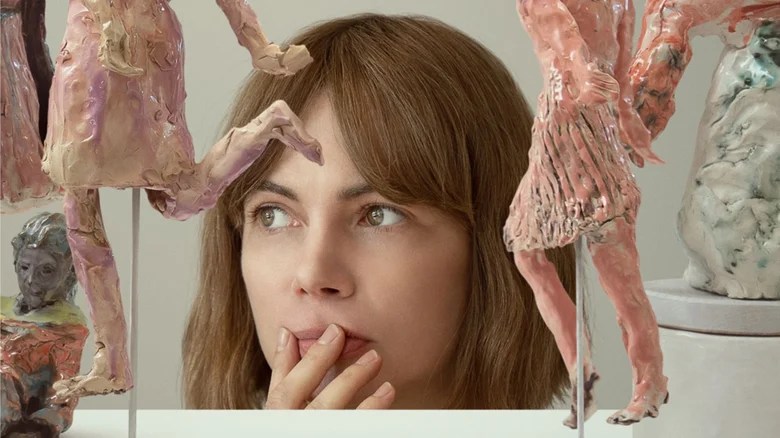
Showing Up, starring a superb Michelle Williams (and featuring a number of other great performances), is about a sculptor preparing for an art show exhibiting her most recent collection. As usual with Reichardt, it’s not particularly plot-driven, but that isn’t to say there’s not a story, because Lizzy’s experience is the story of putting your heart, your time, your energy into something and then stepping back to see how it does out in the world.
This might seem like self-righteous insularity from Reichardt and from me. A film about art? Oh, really? That’s the best movie of the year? You might recall I picked Tár as my culturally-relevant film of 2022 and Mank as my culturally-relevant film of 2020. Here I go again, right?
But Showing Up is not so myopic. It’s actually very self-aware, jabbing at the arts/artists at several points through the film. But it is sincere, and it is sincerely about much more than visual arts. It’s about creation, cultivation, and care, no matter what it is we’re working with.
It’s such a brilliant move from Reichardt to make Lizzy’s medium clay sculptures. Clay takes a long time to work with. It requires a strong but steady hand. And then, when you’re ready, it gets a literal trial by fire, sometimes to devastating effect, as Lizzy finds when one of her sculptures is ruined in the kiln. It’s a long process and inexact science, especially when we could 3D print the same thing in a matter of hours. The result for Lizzy’s show is a number of sculptures of women in either joyful or agonized postures. The sculptures are not eye-catching, in the sense that if you walked past them in a shop window, you might not even notice them. They’re small, and, at first glance, somewhat crude. It can take time to study them, an open mind to be receptive of them. They are nuanced and subtle.
They’re the type of art that would make it so, so hard to ask people to come see your show. The kind of art that wouldn’t last three seconds on TikTok.
But again, it’s not really all about the sculptures. It’s about the wounded bird Lizzy begrudgingly takes care of, her friendship/rivalry with her landlord and fellow artist, Jo, her relationship with her parents and with her socially anxious brother.
Isn’t life an art, really? Aren’t we all, in some way, artists? This is why “Business School” resonates with everyone – not just self-described artists, and it’s why Showing Up is for everyone, not just fans of A24 who are artists themselves. Of course, the film is also just brilliant. Performances, writing, cinematography, editing. Reichardt really is one of the greats, and I sincerely hope this film finally gets her an Oscar nomination, which she should have had for First Cow if not for one of her older films.
But there’s another sticking point here for artists and anyone else pursuing their purpose: what am I supposed to do next? And what if they don’t like it?
We find a response to this question in two other pieces of art from 2023.
One of the films I feel to be in contention for the film of the year is Wes Anderson’s Asteroid City. There is, near the end of the film, one of the best scenes Anderson has ever put together.
“Do I just keep doing it?”
“Yes.”
“Without knowing anything?”
“Yes.”
“Isn’t there supposed to be some kind of an answer out there about the meaning of life?”
“Maybe there is one.”
“Right, well that’s my question. I still don’t understand the play.”
“Doesn’t matter. Just keep telling the story.”
This brought me to tears in the theater. But the scene isn’t done. Following this conversation, Augie has a conversation with another actor across the balconies behind their respective theaters. In the background, one of the other theaters advertises for The Death of a Narcissist. It’s not very subtle from Anderson, but it is poignant. In recent years, one of the popular opinions to have is that Wes Anderson movies are just parodies of other Wes Anderson movies, and that he’s lost his fastball. I agree to some extent – Isle of Dogs and The French Dispatch are two of his worst films. But here, Anderson bites back, telling us he’s not a narcissist, that he’s not just in love with his own genius, that he’s not just making films to win awards or sell tickets. “All my pictures turn out,” says Augie, and it may as well be Wes. He believes in the art. He’s doing the art he wants. So get off my back, he says, because do you have any idea how hard it is to make movies your way for three decades and continuously hope people will like it even as expectations grow for each subsequent project?
It is possible for an artist to get in and get out when they’re able to gain a certain amount of fame. One big contract, one big album, one big tour – it is possible to strike a hot iron and come away financially set for life. And, for some creators in some fields, the artistic life expectancy really isn’t very long. You just have to go viral a few times, gain some sort of following and then…well, you do something else. If you adapt to what the audience wants, maybe you can hold on a little longer, but if you stop appeasing them, you may go on in obscurity or stop altogether.
But for most artists, art is something they have to keep doing. They must always have the next song, the next sculpture, the next film, the next book. And in pursuing that next work of art, they will find over and over that they aren’t quite sure what to do next. They will doubt themselves, doubt their worth and capability. But they go on creating, and, scary as it is, they must continue to ask people to show up.
And, again, this is for more than just conventional artists. Consider one of the best scenes from one of the best shows of the year, Blue Eye Samurai. Master Eiji, the swordsmith and adoptive father of Mizu, shares his wisdom on artistry, whether that art be making swords like him or using swords like Mizu (or helping people like Ringo): “An artist gives all they have to the art, the whole. Your strengths and deficiencies, your loves and your shames… Perhaps there is a demon in you, but there is more. If you do not invite the whole, the demon takes two chairs, and your art will suffer.”
“Then what do I do?” asks Mizu.
“I only know how to make swords. Each morning, I start a fire and begin again.”
Blue Eye Samurai is fantastic for many reasons, and one of them is this attitude towards art. Watching it, you can feel just how much the art means to the artists who created it, how much care and attention went into it. It is authentic and sincere and full of pain and joy. Mizu is an artist of violence and death. It is what her life has been dedicated to, and she is better at it than just about anyone. But her art was imbalanced. It was so full of anger and hate, of lust for revenge, of singular-minded purpose. She had lost sight of what her art could and should be used for in a world where a skilled sword can shape the paths of nations. She needed to give of all herself – not just the demon of revenge – to unlock her full potential.
This is what artists and non-artists alike must do. We must continue to give all of ourselves to the things that matter to us. As the misattributed quote goes, “Whatever you are, be a good one.” In our culture, perhaps it has never been easier to be anything, but never more difficult to be the right thing.
Whether people show up or not, we have to start a fire and begin. Again and again.
So! With the New Year comes Christmas, and in this New Year I hope to release another novel. I’m very, very excited (and scared) to share it with you. It is not about Christmas, but it begins around Christmas, and so I’m taking this opportunity to share a short excerpt from the second chapter that takes place following a Christmas Eve service. Happy Holidays, and thank you for showing up.
~~~~~~~~~~~~~~~~~~~~~~~~
Silas wakes up on the Axe and Doritos couch. He checks his phone and sees he’s only been asleep for a few minutes. He’ll go home soon, after he’s had just a few more minutes to sit and let his thoughts run themselves out. Punch themselves out.
As he replays the service over in his mind, his thoughts continue to dwell on one particular space in time, about midway through the service, when they sang “Oh Holy Night.” Such a difficult song to sing – he considered removing it from the service. But sometimes when church folk take on too much they prove their best.
That particular hymn, or song, or carol, depending on who sings it, builds and builds in waves of melody and harmony and lyrical earnestness. The chorus – a refrain at the end of each verse with slightly different words each time – rises and swells in a way that is euphoric – orgasmic, even – in the way religious experience can sometimes be. And with each verse, the congregation grows in confidence as the melody reaches higher and higher and the harmony becomes deeper and richer.
Christ is the Lord!
O praise His name forever!
His power and glory evermore proclaim.
His power and glory evermore proclaim.
The congregants sang this as a true choir of the faithful masses. The piano rumbled in its accompaniment. Many sounds and one sound at once. And the voices of two, maybe three, women soared above the rest like stalwart ladies of our divine savior, their tones twinkling in the snow outside, glittering in the window dressings.
The Lord says the Lord is where two or three are gathered in their name. The Lord was certainly in those moments, in that room, in some mysterious and ancient way.
It was the first time since he started preaching that Silas felt something so pure, so untainted by anything else, any of the other things that come with churches and pastors and the act of gathering for worship.
He’s glad he left it in the service. And as he falls asleep on the couch, he replays that blissful moment over and over, wondering if there was someone else in that room who felt it too, someone who could also say they had heard the very voice of God.
Forth now, and fear no darkness.
Soli Deo Gloria
Peter
 eloquent mumbler
Great job, Pete. Because I am not too techno savvy I’m not sure my comments to you will get through. Best of luck in your future endeavors. I hope that somehow you are sharing your writing and thinking skills with today’s youth. Be well, buddy!
Coach Brunswick
Sent from my iPad
Thanks so much, Coach 🙂 I hope you’re doing well!