I went to India and brought back a superpowered straightjacket.

One of the things that makes growing up a boy relatively easy compared to growing up a girl is the smaller number of lessons to learn and expectations to meet. I’m pretty sure I was 21 before I learned that every girl knows to take her keys out before she walks to her car, and that one technique is to put four keys between your fingers like Wolverine so you can stab a possible attacker in the eye and incapacitate him.
It’s undeniably harder to grow up a girl. But the overwhelming range of lessons and expectations does also come with certain areas of freedom amid all of the restrictions. For instance – how one dresses. Not necessarily how well or how modestly one dresses (still restricted there!), but what options women potentially have for styling their outfits.
Take, for example, the three most famous players in the 2024 WNBA Draft. Caitlin Clark, Cameron Brink, and Angel Reese each wore very, very different outfits and each looked stunning in their own way. At least as they contend with all the limitations facing women’s sports, they’ll be able to express their unique senses of fashion. A matching white double satin shirt and skirt from Prada, along with a sparkly rhinestone mesh top underneath and black brushed leather slingback pumps? Hell yeah, Caitlin. A black-and-white asymmetrical Balmain gown featuring a thigh-high slit, a bodice cutout, and a rosette appliqué at the shoulder? Mercy, Cameron. A backless Bronx and Banco silver knit dress with a plunging V-neck and hood and coordinating Christian Louboutin pumps? Okay, Angel, Okay!
A few weeks later, the NFL Draft kicked off with three quarterbacks selected, three new faces of the league. The first was Caleb Williams, one of the most “eccentric” prospects in recent years (excuse me while I unroll my eyes from inside my skull). And he wore…
A suit. A navy suit with a double-breasted jacket that featured a zipper fastening instead of buttons.
He was followed up by Jayden Daniels, who wore…a suit. And then Drake Maye. Who also wore a suit.
You grow up as a boy with fewer rules and more freedom. You will not be held to the same impossible range of (sometimes contradictory) standards as your sisters, but what you find out later is that despite your developmental largesse, some paths are chosen for you, and those paths are narrow, and the ground outside them is rocky indeed.
From adolescence into adulthood, there is a small but crucial set of criteria for American boys. Some of them can be helped and others can’t. Some actually make you more attractive to women (and/or men) and others don’t. Most of them are silly. The list is manageable because it’s so short. It’s daunting because it’s so limiting. Beginning with puberty, you want to become one of the taller in the class, grow body hair faster and better, get bigger and stronger, develop an above-average-size penis, and speak with a low voice. You get a little older and you must remain physically virile, prove to be sexually adept, exhibit confidence at all times, land on a stylish haircut and facial hair combo, maintain a good job, and dress professionally.
Quite remarkably, this already narrow scope can be focused onto one simple signifier:
Yeah. The suit.
The suit is the panacea for manliness; with a good suit, you can check all the boxes.
This is something you learn from a young age as a boy. Just one example: I remember watching an episode of Jimmy Neutron where Jimmy wears a suit to the wedding of Jet Fusion and Beautiful Gorgeous, and Cindy – his frenemy – goes absolutely googly-eyed. When a character voiced by Michael Clarke Duncan (RIP) asks “What did we all learn today?” Cindy replies “Clothes make the man!”
Boys grow up knowing there are many things they will be expected to do to remain respected and admired by men and women (and let’s not pretend this is all about straight men wanting to be desirable to women). You learn about deodorant, and undershirts, and manscaping, and beard balm, and aftershave, and scotch, and cigars, and golf, and [redacted because my grandma reads this] – again, a shorter and less onerous list than girls are given. And you learn about suits. You know you will have to wear one because you’ll make good first impressions, command respect, demonstrate your professionalism, and look really hot.
Thing is…suits suck.
I know – I know – that many men feel most comfortable wearing a suit, but they are deluded if they’re telling you they’re comfy. They’re not – especially if you’re wearing a necktie. They’re also hot, sweaty, inconvenient in the bathroom, a task to put on and take off, high maintenance, and expensive. And the real kick in the inseam? It’s tough to look good in one.
That’s not contradictory to the premise that everyone thinks men look great in suits; rather, it is an extension of it. Men who are heavier might still look professional or powerful, but as often as not they might find themselves in an outfit that is either too tight or too baggy, especially if their weight fluctuates, and in the cultural imagination the fat man in a suit is sometimes symbolic for wanton greed or organized crime. Men who are slight can hardly win, because either a fitted suit will draw attention to how thin and bony they are, or they will swim in a suit that is too big for them.
And maybe some will insist that skinny and heavy men do still look good in suits – “you just have to be confident!” As if confidence is something one can simply drum up when they want a promotion or a date. The little black dress (a la Audrey Hepburn in that really good really racist movie) is about the best thing ever, but I would never tell a woman “oh just be confident! You’ll feel good wearing it I promise! It’s all in your head!”
Even when a man does find a suit that fits him right and makes him look good and feel confident, the resulting signifiers are startlingly narrow. What do you project in a suit? Wearing a suit basically says three things: “I am taking this event seriously,” “I am a successful person,” and “Look how hot I am.” There’s only so much room to expand on this: vest and no jacket and you’re a groomsman at a hipster wedding. Switch the tie for a pocket square and you’re a groomsman at a metro wedding. Maybe you can get a little zany with the colors and patterns, but there is very little middle ground between “normal” and “Craig Sager” (RIP). Most variations on color and style either shunt you into a cliché or stereotype (white suits = Miami Vice) or they just double down on the aforementioned signals (for me, an all black suit (pants/shirt/tie/jacket) says “I’m really taking this seriously and I’m really hot”). Really, for the most part, men fall in line with what’s in with suits. Just think of the fads for light brown dress shoes or white soled black dress shoes, or how you could watch the halftime report of a Champions League match on Fox and see four or five sets of sockless ankles.
Conversely, those ankles would be accompanied by the goddess Kate Abdo (who is basically the studio host Andy Murray to the Joker/Rafa/Federer of Rebecca Lowe/Michelle Beadle/Ernie Johnson), who has a plethora of options for expressing herself while looking professional and damn good. Again, think of the W draftees; Caitlin, Cameron, and Angel all expressed a lot about themselves beyond “I am taking this big event seriously and also I am hot.”
And yet, despite its many and obvious limitations, men have bought into the idea that the suit really does give them superpowers. It might not be a coincidence that we call what superheroes wear “suits,” and in almost any Marvel/DC movie the suit channels or augments the hero’s power (or grants it whole cloth!). There is clearly something alluring about the idea of putting on a costume and gaining access to incredible powers, especially if they are an extension of your pre-existing talents and skills. So too is the idea of looking dapper while being a badass – examples abound of this, perhaps with James Bond as the ur-text. The two combine to some degree in John Wick, who wears fantastic-looking suits that also grant him super-powered upgrades (namely, being bulletproof). Well-dressed, skilled in combat, dog lover? John Wick is basically the ideal American man – thank goodness he is played by someone as kind, gentle, and unproblematic as Keanu Reeves.
I’ve been thinking about all this and am now writing about it because I recently acquired a couple nice suits. How and why I got them, how I’ve felt wearing them, and how other people have reacted to them have made me feel a lot of things and given me lots to think about. And, in recent weeks, my body dysmorphia has gotten pretty bad again, and unpacking how I feel about suits might help me in reckoning with why I can’t go get a donut in the break room right now or miss a workout tomorrow. Yeah I’m gonna tell you about India but if you think you can get through a blog post without me oversharing and being an English Major you’re clearly new here.
~~~~~~~~~~~~~~~~~~~~~~~~~~~~~~~~~~~~~~~~~~~~~~~
I’m a developmentally-imbalanced male, and the areas I have most typically been slow in are anything related to the body and physicality. A late bloomer, I guess. So, naturally, I didn’t wear a suit until I was 20 years old.
It was the first suit that was ever “mine” (although I didn’t have to pay for it) and it was for my sister’s wedding. Gray with a white shirt and purple tie. We took some measurements and ordered it and then took it in to be altered so it would fit right. I remember being at the seamstress hating every minute of it. I didn’t want to wear the suit and I didn’t much care how it fit me. My go to style at the time was cargo shorts and Christian rap tees with cross trainers, and I had – for years – avoided wearing dress clothes whenever possible. They made me feel like a dog wearing people clothes.
It was fitting that at that point in my life the suit didn’t fit. I had never been uncomfortable with my physique, opting to distort and hide the slight frame of my body in loose pants and large tees, and trying never to show more skin than necessary – I always wore a t-shirt under my basketball jerseys and shorts to below my knees. I was also just not confident in being an adult man yet. Sure, lots of 20-year-olds don’t know how to tie a tie, but that grew out of my disdain for having to do anything an adult would need to learn – especially if it was a traditionally “male” thing.
So I went to the wedding (which was beautiful) and begrudgingly wore the suit and had someone help me tie the tie and to my surprise people thought I looked great. I had never ever been complimented on my appearance the way I was wearing that suit. Maybe there was something to this suit thing after all?
But when I looked at pictures from the wedding later, I didn’t see myself the same way. Yes, I had successfully hidden my hips and ass and every other contour of my body, but the result was that while the other groomsmen looked like they were wearing suits made for them, I looked like someone draped their suit on me.
I don’t know if I was seeing myself accurately, but at the time it was enough to confirm my mistrust of dress clothes and hide the suit in the closet. A few years later, actually wanting for once to wear a suit for a formal occasion, I got the suit out to see if maybe I had misremembered, but sure enough I still felt like I swam in it. It wasn’t an option, and spending hundreds of dollars on a new suit wasn’t either, especially when most future groomsmen duties promised to come with a pricey rental picked out by someone else. Plus it was looking like I would never have a job where a suit was required. So fuck it – no more suits.
Last year, I went to five weddings. I went to the first in my English adjunct blazer with my girlfriend. The next two I went to newly-single in slacks, button up, and tie, in weather so hot that I wouldn’t have worn a suit even if I had one.
The fourth was the one I was most excited for because it was between two of my good friends whom I love. And it was the one I was most dreading, because I was at the very bottom of my singleness depression and we’re in a beautiful friend group of four couples and me. It was in chilly October, so I put an argyle sweater over a white shirt and a tie with maroon chinos – a look I really, really like.
And then I went to the wedding and every guy there was in a suit. Every. Fucking. One. And most of them – maybe all of them? – had a date, too. I felt like I had missed something. Why didn’t I know that of course you were supposed to wear a suit to something like this? And was that somehow connected to why I was single? Not like oh if I just had a suit I would have a girlfriend but like does my lack of both come from the same flaws in my personality? Perhaps there was something fundamentally lacking in me that could be fixed just by putting on a suit.
When I went to India the first time this year, I didn’t put too much thought into what clothes to pack. Most days at work I wear a polo or quarter zip embroidered with the school’s logo and “Admissions.” So that’s mostly what I packed, and for the first half of the trip my main regret was not packing more casual clothes for the little downtime we were afforded.
Later in the trip, working with a man I’ll call Vik, we had the opportunity to be interviewed by a local Telugu newspaper. Vik asked if I had a suit or blazer to wear. I was a little embarrassed not to, but also confused. Why would I need one? I’m an admissions counselor and dressed like one. I told him I’d bring my English adjunct blazer next time and chalked it up to him being old school (he wears a suit every day).
When I returned to India a few weeks later, I brought my blazer. Vik texted me while I was en route that I should wear it on the first day for another press appearance. As we posed for photos, I felt like I had done exactly what I needed to. Indians love a photo-op. Like I can’t overstate it. Every visit has to have a picture documenting it, and if you wander around a shopping mall you’ll see young people everywhere posing for the ‘gram. So by looking sharp for some pictures and answering some questions, I was doing a great job!
But that wasn’t the case. Vik was happy I brought my blazer, and asked me to wear it to most visits we made, but he asked if I had a proper suit. I told him maybe next time.
A few days later as Vik and I were discussing the itinerary for the following week, he mentioned there would be a number of very important meetings. I told him I’d be sure to wear my blazer. He countered:
“I’m going to buy you a suit.”
Vik is a generous man who wants to take care of his partners. He’s not hurting for money and almost everything in India costs a fraction of what it does here. And yet I was mortified. I tried to refuse, because I hate when people ever spend money on me, but also because I was ashamed that my associate was so disappointed in what I had to wear that he would go so far as to buy me a tailored suit. He insisted it was a gift he wanted to give and wouldn’t take no for an answer.
The city we were in – Vijayawada – is known primarily for rice, temples, extreme heat, and textiles, and Vik took us to one of the more well-known purveyors. A couple women helped us pick out fabric. Vik asked me what color and design I wanted and I was at a bit of a loss. I wanted an all black suit, but the black fabric selections were more charcoal, rather than the jet black the world’s most badass football managers wear on the touchline.
“How about blue, like the one I have?” suggested Vik. “Or maybe gray?”
“Sure, blue or gray might be good.”
The women set out several rolls of blue and gray fabric. I pretended to look at them closely, a little disappointed I wasn’t going to get to look like Diego Simeone or Roy Kent.
The younger woman set out dark blue roll with large but subtle checks. She said it would look really good. Vik was not so sure, and was eyeing up a couple of the gray ones. “But it is your choice. Any one you want – they’re all about the same price.” He told me later that the fabric came from one of the top clothiers in India. “If you say you got a Raymond suit in Vijaywada, people will know what that means.”
We narrowed it down to two of them – one of the grays and the blue one – and Vik told me to choose.
I looked to the younger woman and asked, “Which one do you like?” and without hesitation she pointed at the blue one she had set out. I guess I don’t have to tell you which one I chose.
I was already feeling a lot of emotions as we got in the car to head to the tailor. I was grateful and embarrassed by Vik’s generosity, and I was feeling pretty good about myself because of the way the young woman had said the suit would look good on me. The suit had not even been put together yet, and already you can see how the resulting effect of the suit would be to basically a) make more look more professional and b) look good for women.
It was getting into early evening, and the sweltering city was bustling as usual. The driver dropped us off by a side street. Vik had a particular tailor he liked, but couldn’t quite remember where he was located. In India, it’s common for alike businesses to cluster, so on a single block there might be several tailors. We walked past a number of them, and Vik asked for directions a couple different times.
Finally, he stopped outside a super sketchy-looking alley of sorts between two buildings. “I think this is it,” he said. Then he pointed to a sign hanging from the second story of one of the buildings. “Yes! Here he is.”
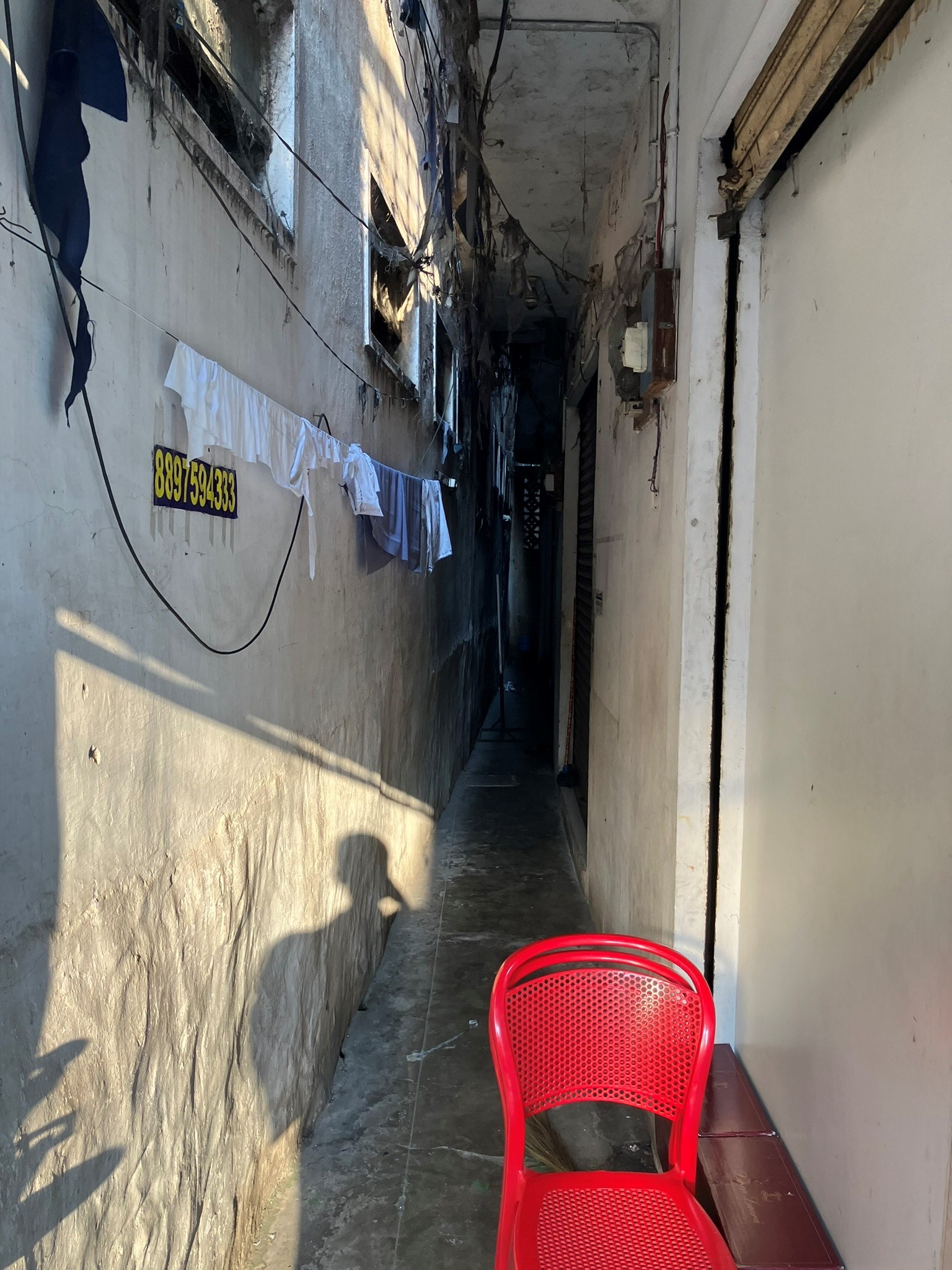
He led me down the alley and into a narrow, winding stairwell with all sorts of spots and stains. “I remember the first time coming here I wondered ‘oh dear where have I gone to,'” said Vik.
We found the tailor and an assistant (or maybe just a friend who was hanging out?) in a small room cooled only by a fan and any breeze coming in the open windows. He glanced up now and then to see what was happening in the IPL (cricket) match on the small TV.
A couple days later, we went back to the tailor to pick up the finished suit. It took us less time to find the sketchy alley (“Ah,” said Vik, “the filthy stairs. We are certainly in the right place.”). I tried on the suit and…and I instantly felt incredible.
It was the highest quality, best tailored suit I had ever put on. And it was mine.
Vik approved and we headed out. I overthanked him and told him I’d be sure to wear it at our important meetings coming up in Indore and Hyderabad, many of them meetings with new potential partners. “First impressions do count,” I said.
“Why do you think I got you this?” said Vik.
I laughed at the time (Vik is very funny), and I still was overwhelmed by his generosity, but it reinforced for me the main point why I was given this suit: my clothes were insufficient for my work. And it doesn’t really take most of us long to feel like if our clothes are insufficient that we’re insufficient.
Still, I felt pretty awesome in my new suit, and I wasted no time in sending out pictures of me in it. The affirmative reviews made me feel that much more awesome.
I wore the suit the rest of the week as I took many more meetings with Vik and his delightful associate Soum. It absorbed several liters of my sweat and thankfully did not smell by the end of the week.
And I felt…well, great. My trip was exhausting, but it was very fruitful and mostly enjoyable and I could feel how much I had grown up in the last few years of my life – certainly since the time I wore that oversized gray suit to my sister’s wedding. I felt confident and accomplished.
I thought at first I would write about how those two suits – the one for the wedding and the one for this trip – symbolized my maturation from an awkward boy turning 20 to a more confident and capable man of 30. But in the last few weeks, my feelings on the suit have started to change.
For one, I still think suits suck. They are still uncomfortable and hot and sweaty and high maintenance. I’m in no rush to make wearing one a regular thing.
Two, I still don’t have a suitcase mentality when it comes to work. My role has changed in some significant ways with these trips to India, and I’m embracing that, but the fact is when I’m going to business meetings and making sales pitches and being interviewed by Telugu news outlets, I don’t really feel like myself. I like this job, and foresee myself doing it for a while, but someday I want my work to be more closely associated with my identity again. And in no scenario does that involve me wearing a suit to work every day.
Three, I don’t like that a suit has the potential to so affect the way people see me. As someone who is not confident in their appearance, eschews most masculine stereotypes, and generally lacks professional ambition, it is a little uncomfortable to put on a costume that symbolizes all that I discussed above. It is uncomfortable to get praise for wearing a costume I don’t want to be wearing in the first place, especially when the things I’m being praised for aren’t things I want to rely on. Plus, as someone who checks just about all the privilege boxes, I don’t like that an object gifted to me acts to further those privileges.
And four…the suit stifles my own chosen methods of self-expression. Like I mentioned above, it does not allow me to really make my own fashion choices, but it also covers up all of my tattoos. My tattoos are really important to me. I have a lot and am going to get more and I want people to be able to see them. They make me feel confident and say something about me that is unique. The suit hides them. Sure, so does anything I wear with long pants and long sleeves, but after a recent incident at a box office where I was offered the student (high school student) rate, I’ve seriously considered getting hand tattoos so that even in jeans and a sweater I can signal I’m not a damn teenager. But now, if a suit is something I’m going to be wearing more often, I don’t know that hand tattoos are an option anymore. Most people in suits with hand tattoos are David Beckham or a bad guy in a John Wick movie. I’m obviously not either of those, but maybe there is the risk that even “SOLA FIDE” across my knuckles would detract from the professionalism evinced by the suit.
Maybe my feelings about this suit are also affected by my feelings about the other suit I got in India.
While in Vijayawada, Vik offered to take me on a Sunday morning to major Hindu temple, the Kanaka Durga. I asked him if that was okay since I’m a practicing Christian, and he said it was perfectly fine (almost all Hindu temples are open to all faiths).
“But you will need to wear something different. Did you bring anything besides t-shirts?”
I object to classifying polos as t-shirts but fair enough, Vik.
Vik took me to another clothier where we could buy some traditional Indian “ethnic” garb. I insisted on paying this time. Clothing and apparel is often what I like to get as a souvenir anyway.
Vik helped me pick out two sets. One was a kurta for everyday wear (“You could wear it if you ever go to an Indian event in America”). A long-sleeved-collarless tunic with buttons at the top, and a light and loose pair of white trousers. The other set was for formal occasions and was what I would wear to the temple (“You could marry a nice Indian girl in this”). The top was similar but in purple. The pants were a dhoti, billowing and white in a sort of cross between trousers and a skirt. The outfit was completed with a long white and gold stole.
It was unlike anything I’d put on before, and I felt some of those feelings any of us get when we wear a type of garment for the first time, with the added pressure of not wanting to get it dirty in the dressing room. I looked at myself in the mirror and shrugged because I thought it looked nice but I didn’t know if it looked the way it was supposed to. I stepped out of the dressing room, and instantly Vik, Hari (the driver), and a man I’ll call Mo all lit up. Vik tends to have a neutral expression in our many pics, but in the one we took with me wearing my dhoti he is beaming.

The reaction I got wearing the dhoti was much like the ones I got any time that I did something “Indian.” It would start with a smile that I would try any food they put in front of me, happily-raised eyebrows when I voluntarily ate with my hands, and then a big smile when I expressed how much I enjoyed what I was eating. So too when I would ask a good question about the culture, or when I didn’t hesitate to get in a tuk-tuk, or when I greeted someone with “namaste.”
They also insisted I looked awesome in it, too. “You are looking like…superhero,” said Hari. I couldn’t help but text out pics of me in this, too.
On paper, maybe it seems like the effects of the Western suit and the kurta/dhoti are fairly similar. Both are special/formal attire that cover up my tattoos while earning me respect and admiration. Though the dhoti is more comfortable, it is not practical, and I nearly tripped over it several times.
But I felt very different wearing them. In the suit, I give up parts of me in order to exalt myself. In the dhoti, I give up parts of myself to humble myself. The suit says “You’re lucky I’m here.” The dhoti says “I’m lucky to be here.”
Maybe that’s not the effect for an Indian wearing it, but for me it was a way to signal to those around me that I was treating their culture seriously and with care.
I went to the temple the next morning with Vik, his wife, and another one of our associates and his wife, all of us in our temple best. I was properly attired besides my shoes – I came to India without sandals or slides but you can be sure I didn’t leave without any because when your shoes come on and off as much as they do in India, it’s a real pain to have to sit or hunch over every time. After removing our shoes, we washed our feet and proceed to the gate, tall and colorful and bright in the hot morning sun.
It was fairly busy but not uncommonly so, and most who we met were dressed similarly. Some had shaved their heads, too.

We entered the temple and approached the deity. Depending on the time, day, and temple, supplicants may spend hours or even days waiting to catch a glimpse of the deity (here it was Durga, a powerful goddess), at which time they will say a short prayer – less than 30 seconds! – before moving on. I was moved by this dedication, this commitment to ritual and procedure. I was also conflicted, too, as someone whose religion teaches there are no longer any holier, more effective, more powerful places to pray. I certainly believe God is everywhere – even inside us – but could the physical spaces we’re in help us to pray the right way? In making it possible to physically approach God, are Hindus somewhat paradoxically making God more distant? It also made me think again about how I wish Protestants had more rituals and constructed spaces that made much of the beauty and grandeur of God, as Catholics do.
After leaving the inner sanctum, our small group was allowed to gather before some priests who would confer a special blessing. They sprinkled dry rice on top of our heads, gave us small boxes of sweets and a stole, and then sang and chanted a blessing in unison.
I felt something in that moment. Yes, I was running on empty in the heat of the day, in a country where I don’t speak the language (yet), overstimulated at all times, so any little thing might have set me off, but what I felt was what I can only describe as a mystical experience. These don’t always have an explicit connection to religion – I’ve had them watching Everton and embracing my friends and dancing at concerts and looking at art and [redacted because my grandma reads this]. I felt it sitting there in the temple with these men singing at me. It was brief, but I felt it.
The priests gestured towards me and said something to Vik. He turned to me and smiled.
“You have made them very happy wearing that today.”

~~~~~~~~~~~~~~~~~~~~~~~~~~~~~~~~~~~~~~~~~~~~~~~~~~~~~~~~~~~~~~~~
So now here I am, home with these suits. The Western one is still sitting in the garment bag, and I really hope it dried out in the last hotel otherwise it’s gonna be gross when I take it to the drycleaner (but first I have to figure out how to do that). I don’t know when I’ll wear it again outside of future business meetings in India. Maybe not until the next wedding I go to dateless.
The dhoti will remain unworn until then, too. I will bring it next time I go to India, as I am hoping to visit more sacred places, in particular the Tirupati Balaji temple between Vijayawada and Chennai.
But perhaps I will wear the kurta much sooner. I’m working up the courage and humility visit the gurdwara just south of Milwaukee, and it would be just the thing to wear along with a head covering of some sort. It has occurred to me that perhaps a lone white man in western garb might cause some alarm or at least discomfort after what happened there in 2012. Yes, the kurta will somewhat suppress aspects of my individuality. It will signal that I am a reverential person taking the space seriously. As a non-South Asian Christian it will be in some way like putting on a costume. Maybe I will even look handsome in it.
But while a suit is a walking handshake, a firm hand extended in a greeting that means business, maybe the kurta will be received more like steepled hands and a slight nod. Maybe before I am ever able to speak aloud in greeting it will say, “Namaste: The sacred in me recognizes the sacred in you.”
And maybe, if only for a few moments, I will be more concerned with the Holiness within and less concerned with the decaying temple built around it.
Forth now, and fear no darkness (Namárië, Bernard Hill).
Soli Deo Gloria
Peter
 eloquent mumbler
OK Pete, just so you know, I did not wear a suit or sport coat to look hot for the women, though my wife always has liked the look. I continued to wear a sport coat until a certain head coach a couple years ago said I had to wear “the official coaching pullovers”. Me being an old guy, who feels that I missed the memo when basketball coaches were supposed to start looking like wrestling coaches. Anyway, I fell in line, being a good assistant. I missed the sports coats and suits!😢. Anyway, I am going to start sending you Dr. Alan Zimmerman’s Tuesday Tips which I think you will enjoy. As your old coach I’m going to remind you that you don’t need a suit or a gurka, or tattoos to make you a great guy. You have been that for a long time and you just need to believe that. All the best, my friend!
Thanks, Coach! Haha yes the basketball coach dress code has plummeted in the last couple decades! I think the NBA COVID Bubble might’ve been the unofficial end.