Announcements first, since this isn’t a recipe blog post:
- Book signing in Sturgeon Bay at Novel Bay Booksellers is a go! It will take place December 5. Save the date, more info to follow!
- Afterparty for the book release party will be at Burnhearts, a neighborhood staple walking distance from Lion’s Tooth
- There has been a delay in shipping my books…fingers crossed they get here in time, but if not I will be sure to have book plates instead *anxiety intensifies*
If I was forced to choose between writing a story with no alcohol or one with no swearing, my brain would probably fold itself into an origami crane and fly into the sun.
I find it difficult to write a story without alcohol (meaning the story has no alcohol, not that I don’t have alcohol (it’s nice but I write better with coffee or tea)), and it’s only partially because of the Wisconsin settings. When you write with as much dialogue as I do, it can be challenging to add meaningful or interesting action to a scene when the most important part of the scene is the conversation. At times, my writing verges on reading like a script or screenplay, and that is not effective in a non-visual medium, so the onus is on me to at least fill the space and hopefully enhance the scene through simple actions and descriptions. It’s a lot of fun to come up with something interesting for your characters to do while they’re talking, and in Lives We Might Have Lived my favorite is a game of catch in the backyard. That kind of active, maybe even kinetic, dialogue scene can really breathe life into a story, but I rely on so many individual conversations that it’s not realistic to always have something for the characters to “do.”
The easiest things for your characters to do are: change what they’re looking at; change their expression; light, smoke, or put out a cigarette; roll their eyes; agitate or arrange their hair; cry; stop crying; start crying again; stand up, sit down, or pace; pet an animal; sigh; fidget with something; and, of course, drink something.
Coffee, tea, water, anything can suffice. Coffee can help set the tone for the characters’ day, tea reveals their shattered nerves, water replenishes them after sweaty activity. Soda is nostalgic, orange juice is sober. For whatever reasons, drinking milk always comes across goofy.
Same goes for 21+ drinks, too; there’s plenty of associations with every particular adult beverage, and because of the effects of alcohol these drinks can catalyze action much more than their softer counterparts (give your character a couple shots of whiskey and now the scene has changed without you doing much at all).
This is maybe a lot of inside baseball you didn’t ask for, but the Brewers are up 2-0 in the World Series, so…batter up.
Because alcohol is such an easy way to fill out settings and characters, it is really easy to overdo it (I’m talking about writing but the same is true in real life). Surely not all traumatized detectives are stealing sips from their flask on rainy nights, and not all bored, unsatisfied housewives are drinking wine by the bottle, and not every poor kid with big dreams is held back by an alcoholic father. But it’s tempting to employ the vice as device until the characters’ way to cope becomes a well-worn trope.
I’m saying this because Lives We Might Have Lived features a lot of drinking and I want you to know it’s intentional. Yes, as I said above, my writing is dialogue-heavy and I need natural ways to keep readers grounded in the scene, and putting the conversation in a bar is a good way to do that. But the ubiquity of alcohol is not a product of laziness or a self-serious, maudlin, contrivance (I walked a fine line with Silas’s drinking in Other People’s Pain). And I’m not even primarily using it symbolically – though I do think about how a character’s drink order says something about them and I am getting skilled enough at symbolism to do this without being ham-handed.
Instead, the use of alcohol in this novel is supposed to be something wholesome, if you will allow that word to encompass an activity that kills close to 200,000 people every year in the U.S. (remind me again why we treat smokers like pariahs and marijuana isn’t legal in every state?).
Wholesome in the sense that it contains the word “home” (I mean this in the Merriam-Webster “kangaroo word” concept, not in the Liam Rosenior “man-age” sense). By having characters drink alcohol as often as they do in this novel, I’m trying to paint a picture of home, and how the drinks we choose to share with one another can build that space, enrich it, commemorate it.
There are a number of different drinks in the novel, but the three most common are Old Fashioneds (the classic cocktail, Wisconsin style), Pabst Blue Ribbon (the cheap blue collar standard with a miasmic past), and Spotted Cow. For those of you not from Wisconsin, Spotted Cow is like Yuengling if Yuengling was good and still local. And maybe that reference is lost on you; put simply, Spotted Cow is brewed by New Glarus Brewing in New Glarus, Wisconsin. It’s a good, down-the-middle ale that you can find just about anywhere in the state, though some regions will favor their even-more-local products (in Milwaukee, you’ll find Lakefront’s Riverwest Stein on tap just about everywhere). It is simply the quintessential Wisconsin beer.
When you share a Spotted Cow with someone – be it at a bar, a wedding, a restaurant, a picnic, a ballgame – there’s an implied acknowledgement of where you are. Maybe it’s a generic white wedding, maybe the bar is appropriating five different cultures, maybe you’re surrounded by FIBs at the picnic, maybe there’s nothing else especially Wisconsinny about it, but tipping a Cow reminds you and the friends and strangers around you that there’s only one place in the world this could be. (By the way cowtipping isn’t a real thing and anyone who says they’ve done it is lying. And if they have really done it they should be punched in the nose. Don’t fuck with cows).
It’s not fancy, not really all that unique, not even a top-tier award-winning brew. You can get a local brew just as good pretty much anywhere in this country, and maybe even pay a few cents less. But time and again we’ll reach for Spotted Cow, because it feels like home.
And “home” is a powerful concept in Wisconsin. Consider that 66% percent of Wisconsin adults were born in Wisconsin, 6th highest of all states. That engenders a strong tie to a place, as well as not a little provincialism, too (and Wisconsin can be provincial as hell let me tell you). Wisconsin also has a high rate of students who choose to remain in Wisconsin for their university studies.
However, Wisconsin also – despite having high educational attainment overall – ranks second in the country for “brain drain.” There are a number of reasons for this, including the proximity to Chicago, Minneapolis, and Rochester. I’d also guess many young professionals move away for the chance to live somewhere warmer, more diverse, more “cultured.” I left for many reasons, but one of the big reasons was there just weren’t opportunities for fully-funded English graduate programs. Some things are off the table here.
I’d theorize, then, that the combination of these two things (an adult population that disproportionately lives where they were born and a fleeing young professional population) intensifies the feelings we get when we gather and toast a Spotted Cow. Wisconsinites feel pulled away from Wisconsin, but when they return to that community temporarily or permanently they return to a community that is remarkably well-grounded. Take a look at the chart I created below. This is very, very weak statistical analysis, but it does at least provide some hard data to support what I’m talking about:
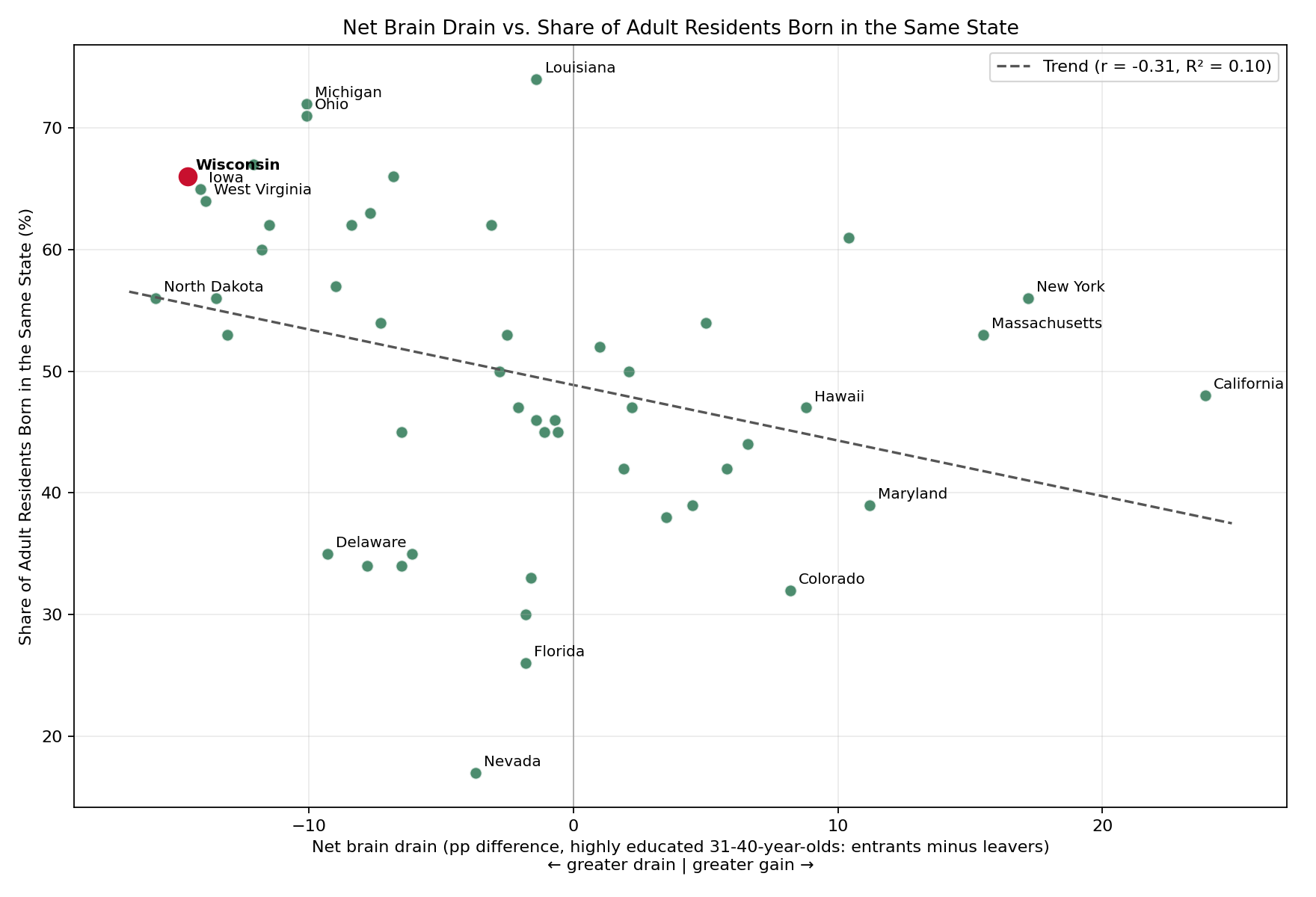
This feeling I’m describing would be particularly high with states in the upper left of the chart. If we give these states an overall combined score, here’s the top 10. Wisconsin is #1! And the Midwest overall is very well-represented.
| Rank | State | Brain drain (X) | In-state born (Y) | Combined score |
|---|---|---|---|---|
| 1 | Wisconsin | -14.6 | 66% | 2.67 |
| 2 | Michigan | -10.1 | 72% | 2.63 |
| 3 | Ohio | -10.1 | 71% | 2.55 |
| 4 | Iowa | -14.1 | 65% | 2.54 |
| 5 | Mississippi | -12.1 | 67% | 2.47 |
| 6 | West Virginia | -13.9 | 64% | 2.44 |
| 7 | North Dakota | -15.8 | 56% | 2.02 |
| 8 | Indiana | -11.5 | 62% | 2.01 |
| 9 | Missouri | -11.8 | 60% | 1.88 |
| 10 | Louisiana | -1.4 | 74% | 1.80 |
You may not be surprised to see the states at the bottom (mostly knowledge hubs and retirement destinations):
| Rank | State | Brain drain (X) | In-state born (Y, %) | Score |
|---|---|---|---|---|
| 41 | Oregon | +3.5 | 38 | -1.59 |
| 42 | Arizona | -1.8 | 30 | -1.62 |
| 43 | Washington | +4.5 | 39 | -1.63 |
| 44 | New York | +17.2 | 56 | -1.74 |
| 45 | Massachusetts | +15.5 | 53 | -1.78 |
| 46 | Florida | -1.8 | 26 | -1.93 |
| 47 | Maryland | +11.2 | 39 | -2.39 |
| 48 | Nevada | -3.7 | 17 | -2.42 |
| 49 | Colorado | +8.2 | 32 | -2.60 |
| 50 | California | +23.9 | 48 | -3.13 |
To clarify, I’m not claiming it’s “good” to be in the top ten or “bad” to be in the bottom ten. In fact, being in the top ten can be a really serious problem, and a long-term brain drain for Wisconsin would be bad for the state. Conversely, California reaps many benefits by having such a high brain gain. What I’m saying is that we can notice some general trends.
I dug a little bit deeper, and I found that if you only take ages 41-50 for “lives in their home state” and re-run the scatter chart, Wisconsin still rates high (#3 behind Iowa and North Dakota), which suggests to me that historically the young educated people who initially leave have often returned (this would include people like me!). Again, this needs a much more thorough and sophisticated exploration including a longitudinal study, and if I was getting paid to do it I would, but all this math is just to make the point that many Wisconsinites feel pulled away and pulled home at different points in their life. For those who never leave, their fate is to see their youth depart, and then wrestle with wanting them to achieve their dreams away but yearning for them to be home again.
Whatever this is (shit, it’s my blog, and my research, so let’s call it “Northstalgia”), Wisconsin might have more of it than any other state, which makes OUR state beer and the feelings it inspires that much more powerful.
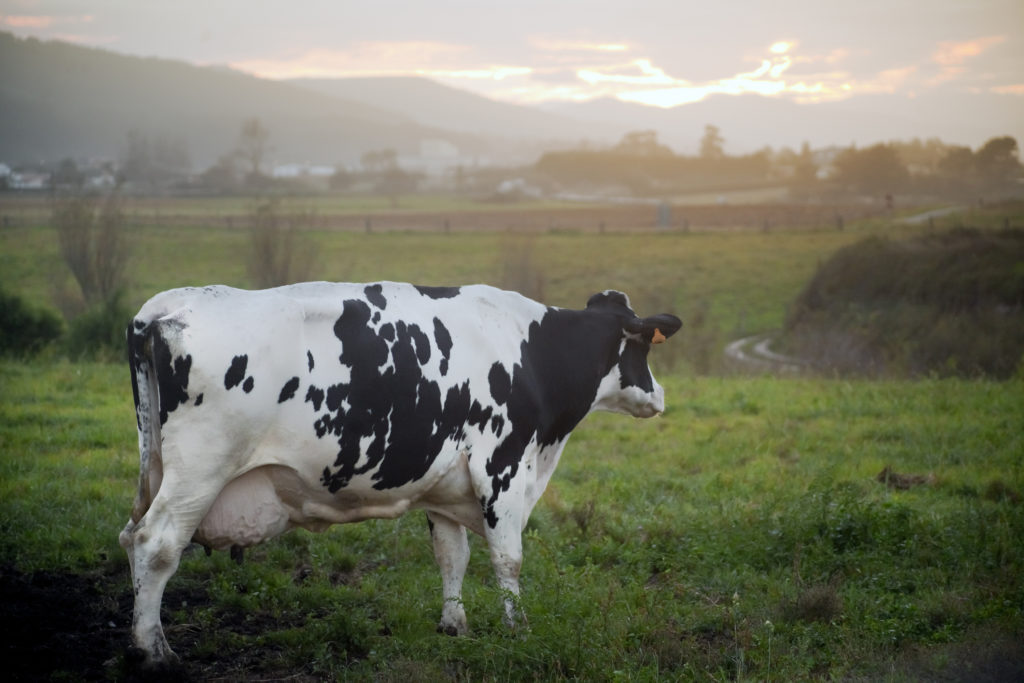
Maybe it’s appropriate, too, that the symbol for this beer is the spotted cow – a Holstein. Wisconsin is “the dairy state,” and much of rural Wisconsin is still dominated by dairy farms. However, while dairy production is stable, the number of family-owned dairy farms continues to decline as it has for several decades. It may not be long before the small family-owned dairy farm is a thing of the past. This is not only sad for cultural reasons, but big ag sucks and large farms are much worse for the environment than smaller farms. In celebrating our identity as “the dairy state,” we are acknowledging an industry that still supports our economy while also mourning something that is fading into the past. Maybe dairy farming – represented in the Holstein – is Northstalgia now, but is headed the way of fernweh, of hiraeth. Perhaps after we’ve been sold out for these fucking data centers, we will long for a home to which we can never return.
So, maybe you understand why there’s so much mention of Spotted Cow in Lives We Might Have Lived.
Quickly, now, since we’re talking about Wisconsin, beer, nostalgia, and advanced analytics: how about these Milwaukee Brewers?
Baseball used to be my favorite sport (both to play and to watch/follow), but I haven’t been really tuned in for many years now, except for when the Playoffs begin and then I lock in on the Brew Crew (and since I’ve moved to Milwaukee I’ve enjoyed going to a few games in the summertime). This team and this run they’re on has made me feel all that old love for baseball again. There’s nothing I can really say that hasn’t been said over and over again the last few weeks, save this: I think if they win the World Series, the 2026 Milwaukee Brewers may become the defining team of 21st Century Wisconsin Sports. More than the 2021 Bucks (legends forever in Milwaukee) and more than any Packers team – even the Super Bowl winners. The reason is that they are so Wisconsin. If you turned Wisconsin into a baseball team, they’d play like the Brewers. Understated, underestimated, underappreciated. “They’ve got Hall of Famers, we’ve got a bunch of gamers.”
Wisconsin has, in general, a branding and marketing problem. We just don’t know how to present ourselves in a way that grabs the nation’s attention, and that’s part of our charm. Perhaps nowhere is it more lacking than in sports; we barely made noise when we had the Triumvirate of MVPs in Rodgers, Yelich, and Giannis. Can you imagine what New York or Boston or Los Angeles or Philadelphia or Chicago would’ve done with that? We’d never stop hearing about it. And yet, I feel like that fact has been lost to time. All three franchises remain overlooked, even as they have each, at times, have been top class in their sport.
“Ope, well, you know.”
MLB is headed for a work stoppage, mostly on account of the team the Brewers just put in sleeper hold in the NLCS. Maybe this team will end up a little lost to history. But if they close out the Rays (and after that thrilling win on Saturday a sweep almost feels inevitable) this “fucking relentless” team will go down with the greatest in Wisconsin’s history, an indelible part of the cultural fabric, one of the many things we remember when we ask the bartenders from Riverwest to Rhinelander for a Spotted Cow.
FNaFND
SDG
peter

