Emotional Confirmation and the Addictive Beauty of Art

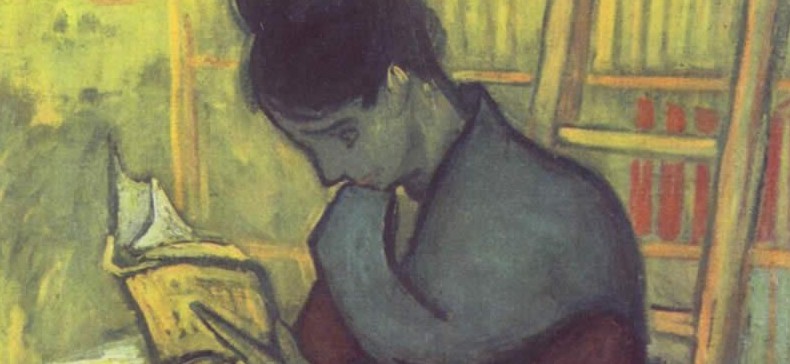
The Novel Reader

The ideas in this blog post may one day be used as the building block of an academic work (a professor’s suggestion, not mine). If for some reason you want to take some idea from here and run with it, please give credit where credit is due. That goes for all content on this blog, but perhaps especially this one. Thank you.

At times, the consumption of literary, performing, and screen arts has been reduced to mere escapism; some believe that people read books, go to plays, and watch television shows and movies in order to distract themselves from real life in a world that is imaginary. Glib pessimism aside, this might be so. The working person turns on the movie channels to relax after a long day at work. The elementary boy gets lost in fantasy books to forget about bullies. The teenage girl binges on Pretty Little Liars to escape high school drama. It’s not so hard to see how people, for a variety of reasons, turn to various arts in order to transport them away from reality, particularly if that reality is difficult and often if the art is…. less strenuous on the mind.

However, to term this reality-shifting mechanism as escapism – certainly a reductive moniker –  is to overlook what might be a more directed, revealing, and beautiful function of art in dealing with the ups and downs of life. In a sense, to call it escapism belittles the utility of art from something that enhances the mind and emotions into something that tranquilizes them.

Aristotle’s metaphor of catharsis in Greek drama reveals art to be aimed with intent at doing much more for the mind than providing an alternate reality. While scholars disagree on some of the finer aspects of Aristotle’s work, the main idea is that the emotions produced in a play could help purge the audience of their own emotions. The audience’s place in the performance would act as a release of emotion that could provide relief from certain emotions, such as fear. So, seeing something horrible happen to a character on stage, though upsetting, would ultimately act to, by the end of the play, cleanse the audience of their own fears and apprehensions as they felt the character’s fear and trauma but came away unscathed. Aristotle’s theories of catharsis support the idea that art’s work in the human mind is much more than a distraction.

I believe that an aspect of art – in literature but perhaps especially in visual, performed arts like the stage and screen – that makes it such a powerful drug in the human mind is what I will call emotional confirmation. This post is, more or less, an outline for an idea that requires much more expansion and research.

Emotional confirmation depends upon two basic principles of human emotions. They are that 1. humans are emotional creatures that must feel emotions inwardly and express them outwardly and 2. humans have an imperfect sense of what emotions feel like, what they look like, and when they should feel or express them.

The first part is simple enough, right? If you’re reading this then you’ve felt and expressed your own emotions and interpreted others’. In I, Robot, one of the things that Dr. Lanning gave Sonny was emotions, and while they are difficult for him to learn, it is his expression of emotions that make him significantly more human than the other robots. (By the way, that has to be one of the most underrated films of the last 15 years).

But, as Sonny finds, emotions are difficult. This is the second part of the two principles. First, how do you know what an emotion feels like? How do you know when you are scared or just nervous? Amused or elated? Infatuated or in love? Second, how do you interpret the emotions of others? Can you be sure that they are as happy as they seem? Are they depressed or just quiet by nature? What does it really look like when someone is angry, happy, or sad? But what really mystifies all of this is our social conditioning regarding emotions. In short, culture and society teaches us what emotions we should feel as well as how we should display them. (Men don’t cry, for example).

For an emotion to properly accomplish its purpose, it must be correctly recognized by the subject, correctly displayed by the subject, and properly received by the audience. If the emotion is unrecognized, misidentified, suppressed, blunted, ignored, or misunderstood along the way, then at least one human is going to be left in a state of confusion and/or frustration. This confusion and frustration is augmented by the first principle: if humans have an innate sense of emotions and a desire to express and understand them, any failures or ambiguities involved will be stressful and uncomfortable.

Art provides a remedy for this with emotional confirmation. In art, a subject can, with certainty, recognize a character’s emotions. More than this, they can identify with that character and feel that character’s emotions as their own, knowing that they are feeling the proper emotion as well as being in a setting where it is acceptable to feel that emotion.

The certainty of emotions in art rests on the premise that the audience can be sure of what they see. Plainly, this accomplishment is not just a side effect of good art, but a prerequisite. If an author cannot use words to describe emotions, they are probably not going to connect with the reader. Prestigious awards are given every year to actors/actresses that can most vividly portray emotion. Great writing and great acting leave little room for uncertainty. When Shakespeare writes King John as saying the following, there is little question what the king is feeling:

“France, I am burn’d up with inflaming wrath;
A rage whose heat hath this condition,
That nothing can allay, nothing but blood,
The blood, and dearest-valued blood, of France.” (3.1.349-52)

The written communication is almost too easy in this sense. It even works to some extent in bad writing: “He was mad.” The portrayal of emotion in acting is rather certain as well. The following scene, basically on its own merit, won Anne Hathaway an Oscar, mostly because of the sheer power of the emotion she conveys:

To make matters easier, performance can benefit from music, visual effects, and so forth. Side note: I left the above video playing as I continued to write, and when she sings “He took my childhood in his stride” my mouth literally dropped, the chills hit, and I teared up a little.

Whereas in real life, emotions are tough to discern and interpret, in art the emotions are made plain. This alone would be enough to make art desirable; watching movies, seeing a picture or painting, and even reading a book that allows the viewer/reader to accurately perceive someone else’s emotions is, for lack of a better word, fun. It’s healthy. Humans spend all of their social time hazarding guesses and jumping to conclusions about someone else’s emotional state, as their mind works at a million miles per hour trying to interpret myriad signals. Having the chance to safely and correctly view emotions is part of what makes Emotional Confirmation so addictive. Not only that, but the viewer/reader does this subconsciously. They begin to feel sad or angry or happy naturally as they view the art.

However, there is another dimension to Emotional Confirmation that makes the experience so edifying, and it is related to Aristotle’s ideas of catharsis.

Art heals our emotions as it prompts and guides us to emotional clarity, bidding us to emote in a certain way and reaffirming our efforts to do so.

This all depends upon the great mystery of how humans come to identify with fictional characters. This identification is what makes us affected when something happens to a character, and it is what makes us keep reading to find out what happens next. Have you ever stopped for a moment when watching or reading something and asked: “None of this actually happened, so why do I care so much?” It’s because you’ve subconsciously put yourself in the story. That’s one of the first things anyone praises about an author – the ability to put the reader in the story. This is, in part, why we care.

This gives us an astounding amount of immediacy to art. We can find ourselves actually taking the place of one of the characters, or standing in very close to them. When a character gives a tearful farewell speech, we imagine they are giving it to us, not just the other characters on screen. When someone wrongs the main character, we get angry because we feel as though they did something wrong to us.

Identifying with characters allows us to cheer for bad guys. Some of the most popular characters in recent television history have been bad guys, or at least guys who do bad things (Walter White, Tony Soprano, Dexter, Stringer Bell). The reason we can want these bad men to succeed is because we’ve taken their side; we’ve come to identify with them and with their cause.

This means that, in many cases, when a character displays an emotion, and a viewer/reader accurately identifies it, the viewer reciprocates the emotion as if they were in the character’s shoes, or at least standing right besides them as a close friend.

Why is it so powerful when Samwise says to Frodo, “I can’t carry it for you, but I can carry you!” and then picks him up to walk the final distance to Mount Doom? It’s because we have put ourselves on the journey with Sam and Frodo (and Gollum). It’s as if Samwise is picking us up, not just Mr. Frodo. That’s part of why it’s so powerful. Also Howard Shore’s score.

The coup de grace: the art tells us its okay to feel that way.

Perhaps some social situations will still prevent some people from displaying some emotions while viewing art. This is probably why, and I know I can attest to this, the affects of art are usually augmented when viewed in solitude (that may be another paper).

But, generally speaking, art gives the viewer/reader a safe place to feel and express emotion. Not only that, but it encourages it. Art draws our emotions from us, and makes it so that we can do so easily and willingly.

And that experience, of clearly seeing and feeling an emotion, and being free to express it, is a powerful drug. And, according to Aristotle, upon realizing it is all fictional, our emotions are healthfully cleansed in catharsis.

Of course, all of this may be significantly more nuanced, detailed, researched, and supported. And, of course, there are exceptions in art that confuse or contradict my assertion. For instance, what of character’s like Hamlet, whose emotions are much more difficult to identify?

But for now, I stand by my outline of the concept of emotional confirmation. Entertainment in the form of movies, plays, television, books, and even music (though that’s another thing) is much more than a distraction. It is a place to settle the tumult of emotion that we live in every day, elucidating these troublesome variables and giving us a safe place where we are encouraged to be hit in the feels, as they say.

Forth now, and fear no darkness.

Soli Deo Gloria

– Peter

Enlightenment via I-94

Chicago River Skyline in Black and White

I took a trip to Chicago. That’s bound to get a writer thinking

A prevailing dichotomy in American society has been urban:rural. Of course this is much more nuanced, with many of us taking up residence in suburbs or small towns and in cities of varying sizes. However, post-American Civil War, American life has remained largely divided into city matters and country matters (and I don’t mean that like the Shakespearean sexual innuendo (readers of Hamlet will understand)).

Notions of urban and rural have evolved over the last 150 years, as has the associated meanings and connotations that go with the setting and the people that inhabit those places. Not as specifically as what it means to be from New York, Boston, Chicago, or Los Angeles versus Appalachia, the Plains, or the Northwoods, but what it means to be from “the city” or not from “the city.”

Where I’m from – definitely not “the city”- there exists a measure of aversion to the city. While many of the youths complain that there’s “nothing to do here,” overall the city is treated as a strange and corrupt place that is by no means preferable to the calm tranquility of small town/rural life in communities of rolling fields, fertile woodlands, and waterfront real estate. The city represents fast life full of loud noises, bright lights, crime, vice, black people, and big buildings. I can picture any number of people I know standing over Chicago like Old Ben over Mos Eisley calling it a “wretched hive of scum and villainy” (but in less sure-handed English). By extension, the peace and calmness of the non-city takes on a level of ethical and moral superiority, which in turn can give life to notions of spirituality and religiosity. This is nothing new, as anyone who has studied American literature can tell you.

Every time I go to Chicago, I go through a time of sensory adjustment. For the first hour or so, I find myself uncomfortable as I am immersed in a setting that is bigger, faster, and louder than the one I am accustomed to. It actually freaks me out a little, and is an uncomfortable transition. While things feel natural after a short while, there is a time where my surroundings become something so different that I can’t help but feel it.

Once I adjust to a level suitable for my short-term visit, I begin to see the brave new world that is the big city.

It’s a world that is a real shame to miss. In fact, I’d say that to ignore the concrete jungle just beyond the dirt path is to turn a blind eye to an integral part of the human mosaic. It is to stand on the edge of the Grand Canyon and choose to look through binoculars rather than enjoy the panorama of spectacle.

The city displays the color palette of humanity, both literally and figuratively. The range of ethnicities, languages, shapes, sizes, and styles goes walking to and fro on the busy streets. The entire tax bracket comes into view as people sleep on the street outside corporate skyscrapers and luxury outfitters. The skyline is outlined by steeples and mosques. The giant McDonald’s is just down the street from the Brazilian steakhouse.

Yes, the city is often defined by what it has to offer, from sporting events to live music to clubs to food to _____. But what makes the city the amazing thing that it is lies within the people. Not just in the surface level stories told by stats that inform the homogeneous small town dweller that the city contains this many Asians or that many poor people, but the realizations that strike the visiting individual when they find something new.

Oh, there are people who look like that… People talk like that?… I didn’t know people live like this… That’s a thing?

While a particular city, like Chicago, might be just a small part of the world, and while it may have its own unique characteristics, large cities are still snapshots of the height and breadth of humanity. In at least some sense, the gap between individual cognizance and the existential nebula of “being a human being” is bridged as a mass of humanity gathers to live life in a shared space.

And this is good. This is natural. Humans began as hunter-gatherers in small communities, but for the most part decided that forming larger communities and building civilization was a smart move. Despite the trade-offs, humans all over the globe have made a natural movement to living in bigger communities. People are social beings, and the move to form cities is a part of our DNA.

To contain your life to areas outside the city is to deprive yourself of much of the range of humanity. In the countryside and small town, much of life tends to move towards moderation and homogeneity. The city forces the individual to experience the world that colors outside the lines of what might have once seemed natural or comfortable.

And while the city is perceived by many Christians to be a place of vice and evil, we should have a heart for the city because God loves the city. The city was designed to be a place to glorify God among the peoples, but mankind’s corruption has taken it away from this purpose. But the city is full of people that God cares for, and therefore we should care for it too. Its function as a great tool for reaching lost souls is not lost; it just lies dormant as mass quantities of people gives rise to what we might generically call sinful activities.

However, while I am encouraging those outside the city to see the world that exists beyond theirs, the converse story is worth exploring as well. City folk hold a view of country bumpkins that is not always so complimentary. The world outside the city is sometimes viewed from within as being simple, ignorant, prejudiced, backwards, and the like.

City-dwellers experience an adjustment like the one I mentioned earlier when entering a new setting. Whilst riding around Sturgeon Bay with a current starting fullback in the NFL, he seemed fixated on the peculiarities of his new surroundings. He mentioned not seeing a black person since leaving Milwaukee, recounted how bored he was in Green Bay for an away game, and asked if I wanted to move away because there was nothing to do where I lived. It was clear that the small town had an entirely different feel from the places he spends most of his time, and there was also a sensible level of discomfort. He could just as easily have talked about something else, but he went right to what he felt was strange about life away from the city.

While the city enhances humanity, it comes at a cost. Some things are lost when we turn 40 acres into 40 stories. City life is loud and fast and can be cold and impersonal. The sense of community is weaker and people are naturally more suspicious of each other. And the overwhelming sense of “man-made”-ness in the city distracts people from the characteristics of life, humanity, and spirituality hidden in nature and in the intimacy of small communities. There are parts of our being that are made all the more lucid and beautiful when in settings surrounded by the natural world and within a smaller community of people.

Yes, my mind was enriched by my time in Chicago, but some of the best times of this summer have been spent sitting on the patio in my tree and shrub-lined  back yard, alone, at night, under the moon and the stars, with the bats and the lightning bugs, listening to the night insects and water a couple hundred yards off,  searching my soul and thinking on life and God and this great big world and the universe beyond. I don’t know that I would find that opportunity in the city.

What I mean to say in all of this is this: the city and the not-city both have worthwhile lessons for us. If you live in the city, take a trip out of town. If you’re an out-of-towner, make a few pilgrimages to the city. You may find yourself to truly be a country boy or a city girl, but just know that parts of yourself are hiding in another place very different from where you currently find yourself. Seeking to experience these places will bring you a better understanding not only of yourself, but of the world around you. Your preconceived notions of what it means to be urban or rural might be dashed in the process, being replaced by profound realizations and awakening sense of one’s place in this world.

Soli Deo Gloria

– Peter

The Tree (Spoken Word)

Gondor Tree

Here’s a few things to know.

  • The “lyrics” are posted below the video.
  • You can find other poetry I’ve done by selecting the “Poems” category at the bottom of the page.
  • This is the first poem I have recorded. I know I have a lot of room to improve but you have to start somewhere!
  • I’m finding that spoken word is way easier than rapping (but still not easy).
  • Even though I haven’t been posting a lot, I have been writing (although not quite daily).
  • I am working on some larger projects.
  • Sort of unrelated: John Owen is dope.
The Tree

Good soil
because no matter the toil
it comes down to the earth 
touched by royal hands.
Acres in the king's lands
anchored within the lord's plans.
Elected, predestined and tested to withstand
the present trials and meant for a future return from exile
that is the difference between the narrow path and the paved road.
Seeds sown here are the ones that grow.

Rooted
in what you know. 
What you can't change, what's ever present,
effervescent in the core of the mind and heart of the soul and you know.
You exist.
There's no room in cogito ero sum to say you can't think
and therefore you are.
God exists. 
Or gods, or ten thousand things, as nature has imprinted this idea
on your mind and if you don't mind mine is fixed on one divine.
Yahweh? Yeah, way above anything you dream the precious Elohim
El Shaddai or should I say a bridge in the great divide the almighty.
And for God to be God and for me to me 
I'd say it's safe to say he created me
and is greater for he's the creator and that leaves a crater
in a landscape of worldview
because if God made you
then this life through and through is
a relationship between him and you.

Planted by water
Receiving streams of mercy from the father
Listen for his voice, you hear it? 
That's the flow of the spirit
so come near it 
and no amount of heat or drought can ever
defeat or knock out the lifeline of communication
for praise, thanks, and supplication.

With a trunk that rings true of who you say you
belong to. An interior authentic to its exterior,
and though the bark may be a thick hide 
inside there's nothing to hide
because salt and light have made no room for parasites
and this wood isn't rotten because on that wood lay the begotten
and no matter size or make no matter how this tree might shake
it will stand strong and not break.

Branches, that reach out and reach high,
arms that reach to the sun and the sky and tendrils that
extend til they rest with ease at its side.

And these many faceted limbs bear leaves
boasting of colors that hail a glory not its own.
The first sight that anyone sees is the vibrancy 
that comes no matter the season,
however life changes for whatever reason,
those who see the leaves leave them
thinking of beautiful words and the one who breathes them
even in the winter when the leaves leave them
the branches hold a beauty for whomever sees them.

The utility of these branches and these leaves,
the life that might find rest in the treetops
and the shade and shelter for the one who stops and
leans against or lies beneath and enjoys a reprieve to hear
the wind gently rustle the canopy and give rest to the weary.

Storms will come and winds will howl.
Lightning will strike, and the rains won't fall,
the trunk will creak and the boughs will bow
but this tree will endure it all.

And not only that, but it will bear fruit.
The signs of righteousness and holiness,
the return of the spirit's work,
love joy peace patience kindness
and others of their kind it's
the honorable output of a healthy
well watered being living in the warmth of the sun.
Fruit that leaves a seed a legacy
of gloria deo soli.

That's my prayer for you. It's my prayer for me.
From seed and sapling, that you'll find true roots in fertile soil,
drinking the only water that satisfies, healthy through the core,
reaching high, with beautiful leaves and good fruit,
no matter the storm or season.
God loves us,
Christ is the reason.
This is my prayer.
For you, for me.
Grow tall, live free.
Praise Jesus.
Be a tree.


Love is the Why – Why the Love Is

<p>Arizona Street Art</p>

“Jesus Saves”

Over the course of the last few weeks, I have posted some articles discussing American Christianity. It would be fair to call these posts criticisms, as I walked through why a lack of love has helped contribute to the decline in the number of Americans who call themselves Christians. I would say it has been, in some respects, an exercise in righteous anger. It has been a vehement exhortation for social change among American Christians.

I told you that love is the why.

But, as much as I believe that “love is the why” is a beautifully simple credo, and while I appreciate that DeRay McKesson continues to tweet it every few days as he continues his tireless work for racial justice, “love” is much too broad to be thrown around when speaking of topics of great importance, topics like the ones I spent the last few weeks posting about.

Let me be clear: American Christianity makes me very angry sometimes. And I earnestly hope that we will make efforts at all times to be loving, especially in areas of sin, gay marriage, racism, and politics, and I hope a lack of love is not the reason for an increasingly secular society.

And the reason for this love and this anger and this urgency is the love that our very name contains.

I am a Christian. By calling myself that I am a representative of Jesus Christ and the Gospel message.

And that message is the most important thing in the world.

Every good thing in the world is a reflection of the glory of God, and God’s most important revelation to humanity is the god-man Jesus.

God took the form of a Jewish carpenter, and after a ministry full of love through service to others and the glorification of God, the most innocent person in history died the most unjust death in history, bearing the entire brunt of God’s wrath against sin. Jesus lived the life we couldn’t live and died the death we should all die, in an act that shows not only Jesus’ love for God but Jesus’ love for us. Then Jesus conquered death and rose from the dead, giving us victory over the grave, allowing us to die to sin and be exalted with Jesus.

All love flows from God, and God’s most beautiful demonstration of this love came in the Gospel. The religion of Christianity exists because of the Gospel. Jesus’ disciples took his story to the nations and endured hardship, persecution, and death in an effort to bring the world the Good News.

How unconscionable is it that Christians should ever drive someone away from Christianity for a lack of love?

Yes – some churches are like country clubs and youth groups are sometimes just social time and the whole thing can just look more like a big politically interested organization built to maintain comfort for good honest Americans.

But that is not what Christianity is. It isn’t a game. And to just call it a lifestyle would even be an act of shortchanging.

It’s something to die for and it’s something to live for. It’s something that calls us to fight and also to surrender. It’s about knowing you’re wrong and seeking what is right.

And it’s all tied together by love.

Love is the why. Why? Because God is love.

I don’t always show this love, and neither does the body of American Christianity. But what we have in American Christianity is the peace of God which surpasses understanding. We have something of supreme importance, and we live in a nation full of people who need what we have. And the first step is love.

We’re allowed to disagree. No one has all the answers. But Christianity’s objective first and foremost is to show Christ-like love to all people. We are called to imitate Christ, and I believe that means an honest re-evaluation of American Christianity’s thoughts on sinning, gay marriage, racism, and politics.

The Gospel is taken as offensive because it calls everyone a sinner deserving death. The Bible is not politically correct. Christianity is, at its root, about being an outsider.

But “I am unashamed of the Gospel, for the it is the power of God to salvation for all who believe.” And if we live our lives as American Christians unashamed of Jesus Christ and as conduits of God’s overflowing love, then the power of the Gospel will work in the hearts and minds of a nation and a world that is crying out for a savior.

Maybe our nation will continue to become more secular.

Let Christians be all the more loving.

Soli Deo Gloria

– Peter